Most major cities and now two whole prefectures (Hokkaido, Hiroshima) charge an accommodation tax on top of room rates. Whether it's bundled into your online booking or collected separately at check-in depends on the platform and the property — always check the "taxes and charges" line. Budget ¥200–1,000 extra per night for most cities, or much more in Kyoto's new 5-tier system (up to ¥10,000/person/night at the top tier). See our Japan tourist taxes guide for city-by-city rates and the 2026 changes.
Japan has more accommodation variety than almost any country. You can sleep in a 400-year-old temple, a neon-lit capsule pod, a business hotel with a hot-spring bath, or a robot-staffed hotel. The choice is overwhelming, but it doesn't need to be.
This guide covers every type of accommodation you'll encounter in Japan, with verified 2026 prices, insider tips, and honest advice on who each type is best for. If you're planning your first trip, pair this with our complete first-time Japan guide for the full picture.
USD figures throughout use approximately ¥156/USD (May 2026). Rates fluctuate.
How to Choose: Quick Decision Guide
Not sure where to start? Use this decision matrix to find your best match based on your travel style.
| Your Situation | Best Accommodation Type |
|---|---|
| First time in Japan + want Japanese culture | Ryokan (at least 1 night) |
| Budget solo traveler | Hostel or Capsule Hotel |
| Budget couple | Business Hotel or Love Hotel |
| Family with kids | Vacation Rental or Full-Service Hotel |
| Maximum comfort | Full-Service Hotel or Luxury Ryokan |
| Spiritual experience | Temple Stay (Shukubo) at Koyasan |
| Missed the last train | Manga Cafe or Capsule Hotel |
Most travelers mix accommodation types — and we highly recommend it. A typical 10-day itinerary might include 5 nights at a business hotel, 2 nights at a ryokan, 1 night at a capsule hotel for the experience, and 2 nights at a hostel. Variety is half the fun.
At-a-Glance Comparison
Here's how every major accommodation type in Japan stacks up. Prices are per person per night unless noted, and they are nationwide spans — the same category costs far more in central Tokyo than in a regional city, which the next section measures.
| Type | Price Range | Room Size | Best For | English Booking | Meals |
|---|---|---|---|---|---|
| Business Hotel | ¥5,000–12,000 (~$32–77) | 12–18m² | Solo travelers, couples on a budget | Excellent | Breakfast optional |
| Full-Service Hotel | ¥15,000–80,000+ (~$96–513+) | 25–50m² | Families, luxury travelers | Excellent | Restaurants on-site |
| Ryokan | ¥12,000–60,000+ (~$77–385+) | 15–30m² (tatami) | Cultural experience seekers | Good | Dinner + breakfast (kaiseki) |
| Minshuku | ¥5,000–10,000 (~$32–64) | 8–15m² (tatami) | Budget travelers wanting local feel | Limited | Homestyle dinner + breakfast |
| Shukubo | ¥8,000–15,000 (~$51–96) | 8–12m² (tatami) | Spiritual experience | Limited | Shojin ryori (vegetarian Buddhist) |
| Hostel | ¥3,000–6,000 (~$19–38) | Bunk or 6–10m² private | Solo backpackers, social travelers | Excellent | Rarely included |
| Capsule Hotel | ¥3,000–5,500 (~$19–35) | ~2m² pod | Solo travelers, one-night novelty | Good | Rarely included |
| Vacation Rental | ¥8,000–25,000 (~$51–160) /unit | 30–80m² | Families, groups, long stays | Good | Self-catering |
| Love Hotel | ¥5,000–15,000 (~$32–96) /room | 20–40m² | Couples (budget or splurge) | Limited | None |
The City Matters More Than the Type
The table above gives nationwide ranges, which is the honest way to describe a country spanning Sapporo and Shibuya. But it hides the fact that moves your budget most.
Pricing the same business hotel chains on the same night in four cities, the cheapest APA branch ran ¥12,510 in Shinjuku against ¥5,400 in Kanazawa — 2.3 times, same brand, same standard single. In Shinjuku that night, none of the four chains we tracked had anything under ¥11,550, more than double the ¥5,000 floor of the range above.
Which leads to the comparison worth acting on: a bunk in a shared Tokyo dorm costs about ¥1,100 less than a private room with its own bathroom in Kanazawa. On a multi-city route, moving a night out of central Tokyo saves more than downgrading what you sleep in.
Season moves it further still — the same Kyoto room ran 3.6x apart across four dates, and during autumn foliage week Kyoto costs more than Shinjuku. The city-by-city and date-by-date measurements are in our Japan hotel prices guide.
Business Hotels — Best Value for Most Tourists
For most travelers, a Japanese business hotel is the sweet spot of price, cleanliness, and convenience. These are compact, no-nonsense hotels built for salarymen on work trips — and they happen to be perfect for tourists too. Major chains include Toyoko Inn, APA Hotel, Dormy Inn, Route Inn, Super Hotel, and Comfort Hotel, and you'll find them clustered around virtually every major train station in the country.
Expect to pay ¥5,000–12,000/night (~$32–77 USD) for a single or double room. Rooms run 13–18sqm, which sounds tiny but is completely standard in Japan — you'll have a bed, desk, bathroom unit, and everything you actually need.
What surprises first-time visitors is how much is included for free. Every business hotel lobby has an amenity bar stocked with toothbrushes, razors, hair ties, cotton pads, and skincare products — just grab what you need at check-in. Rooms come with pajamas or nightwear and slippers. Most properties have coin laundry on a shared floor, which is a lifesaver on longer trips.
Dormy Inn is our top pick in this price range. Many locations have excellent large public baths — some natural hot springs, others "onsen-style" artificial baths — plus saunas, and the chain is famous for complimentary late-night "yonaki soba" ramen around 21:30–23:00. Confirm the specific bath type when booking if it matters to you. Super Hotel offers free hot-spring or large bath facilities at many locations plus a recognised organic breakfast. Toyoko Inn includes a simple free breakfast (often onigiri, miso soup, or simple Japanese staples, varying by property).
Check-in times vary by chain — read carefully before you plan:
- Most business hotels: 15:00 check-in / 10:00 check-out
- Toyoko Inn: 16:00 check-in for non-members (Toyoko Inn Club Card members can check in from 15:00)
- APA Hotel checkout varies by membership tier (non-member 10:00, Regular member 11:00, President member 12:00)
If you arrive early, every chain will hold your bags at the front desk for free — just walk in and ask.
| Chain | Typical Price/Night | Free Breakfast | Onsen / Large Bath | Standout Perk |
|---|---|---|---|---|
| Dormy Inn | ¥7,000–12,000 | At most locations | Large bath at many/most locations — check property | Free late-night yonaki soba |
| Super Hotel | ¥5,000–9,000 | Yes (organic) | Hot-spring or large bath at many locations | LOHAS organic breakfast |
| Toyoko Inn | ¥5,000–8,000 | Simple Japanese breakfast | No (rooms only) | Club Card: 20% off Sundays/holidays, 15:00 check-in |
| APA Hotel | ¥5,000–11,000 | Paid (~¥1,500–2,000 at many properties) | Some locations | Points program, central locations |
| Route Inn | ¥6,000–10,000 | Yes (buffet) | Yes (many locations) | Generous breakfast spread |
| Comfort Hotel | ¥5,500–10,000 | Yes | No | Choice Hotels points eligible |
Which Platform Is Actually Cheaper
The usual advice is that Rakuten Travel and Jalan undercut Booking.com by 10–20%. We priced eight Shinjuku hotels on the same night across all three, signed out, on 2026-08-30. The Japanese platforms won six of eight — and Booking.com won two, one of them by 10%. Three of the eight landed under 1% apart.
So the honest rule is not "book Japanese." It is that the cheapest platform changes by property and runs in both directions, and you cannot tell which without checking. One useful shortcut did emerge: APA priced within 0.6–5% across all three platforms, so for tightly controlled chains the cross-check earns you almost nothing — the wide gaps live at independents and smaller chains.
The full eight-hotel table, plus what the sticker price hides (a 10% property service charge inside Booking's rate, the accommodation tax outside it, and a 10x difference in points between Jalan and Rakuten), is in our Japan hotel prices guide.
Loyalty Cards Worth Joining
Toyoko Inn Club Card is the most useful for short-trip travelers — ¥1,500 enrollment fee that pays back fast:
- 20% off on Sundays and Japanese holidays
- 15:00 check-in (vs the standard 16:00)
- 1 free night after 10 paid stays
APA Hotel membership is free and earns ~10% in points back, usable at your next stay. Worth signing up if you'll do 3+ APA stays.
 Often Cheapest in Japan
Book Japan Hotels & Ryokan on Agoda
Frequently the lowest OTA rate in Japan
Agoda is strong right across Japan — business hotels, mid-range stays, and onsen ryokan alike — and often a step cheaper than Booking.com on the same room. Cross-check the Japanese platforms above for early-bird deals before you book.
Full-Service Hotels & International Chains
All the major international brands operate in Japan. Hilton, Marriott, Hyatt, and IHG have properties across Tokyo, Osaka, Kyoto, and other major cities. If you're sitting on loyalty points, this is a legitimate way to stretch your budget — especially for families who need connecting rooms or suites.
On the Japanese luxury side, Prince Hotels, Hotel New Otani, and The Peninsula Tokyo deliver world-class service with distinctly Japanese hospitality. At the top end, Aman Tokyo and Park Hyatt Tokyo (yes, the Lost in Translation hotel — the New York Bar is still worth a drink; the property reopened in late 2025 after a renovation) offer experiences that are hard to replicate.
Expect to pay ¥15,000–80,000+/night (~$96–513+ USD) depending on brand, city, and season. These hotels also make practical sense for travelers with accessibility needs, as rooms are larger and staff are trained to accommodate specific requests — something budget hotels rarely handle well.
Even at luxury properties, a standard double room in Japan typically measures 22–28sqm — noticeably smaller than equivalent Western hotels. If space matters, book a "superior" or higher category. Also: many upscale hotels and ryokan add a 10–15% service charge. It's usually visible on the final price-breakdown screen before confirmation, but it's easy to miss — read the price details carefully. Luxury properties may also offer 11:00–12:00 checkout instead of the standard 10:00.
Ryokan — Traditional Japanese Inns
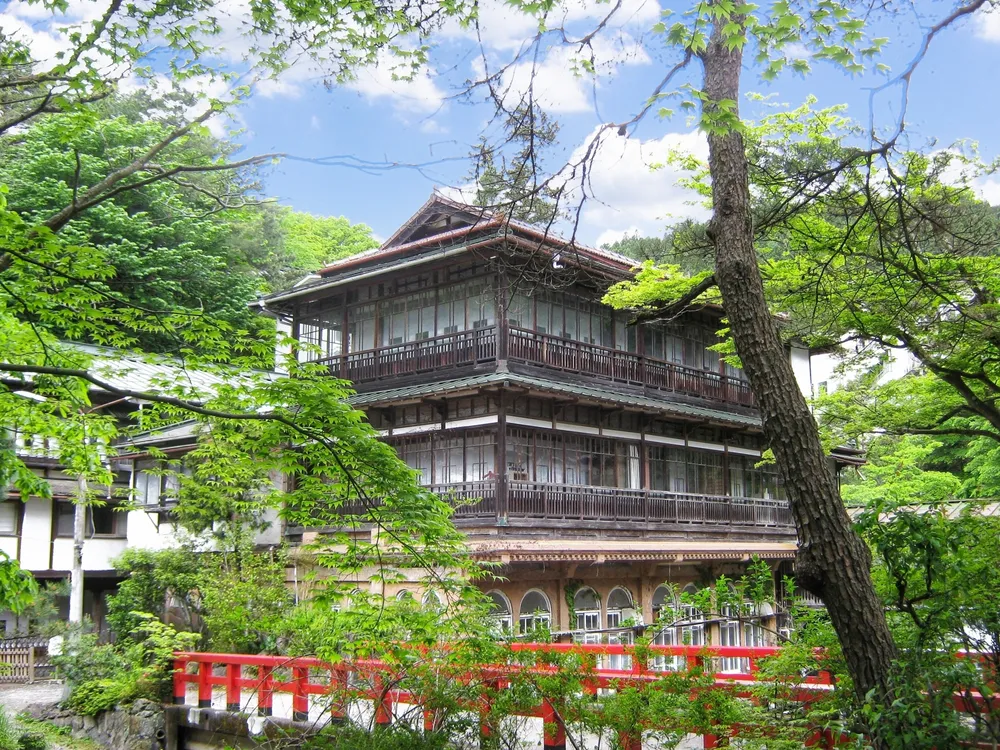
A ryokan stay is the quintessential Japanese accommodation experience. You sleep on futon bedding laid out on tatami floors, change into a yukata (light cotton robe) provided by the inn, and — at most properties in onsen towns — soak in onsen hot spring baths, sometimes both shared and private. The highlight for most guests is kaiseki, a multi-course dinner showcasing seasonal and regional ingredients that rivals high-end restaurant dining.
The single most important thing to understand about ryokan pricing: rates are per person, not per room. A ryokan listed at ¥30,000/person ($192) for two guests means you're paying ¥60,000 ($385) total. This trips up foreign tourists constantly.
| Tier | Price Per Person | What's Included |
|---|---|---|
| Budget | ¥8,000–15,000 (~$51–96) | Room only, no meals |
| Mid-range | ¥15,000–30,000 (~$96–192) | Room + kaiseki dinner & breakfast |
| Luxury | ¥40,000–100,000+ (~$256–641+) | Premium kaiseki, private onsen, refined service |
Ryokan prices are almost always listed per person (1名あたり), not per room. A couple staying at a ¥25,000/person ryokan will pay ¥50,000 total (~$321). Always multiply by the number of guests before booking. This is the #1 pricing surprise for foreign visitors.
Ryokan run on a strict schedule. Dinner is served between 18:00 and 19:00, breakfast from 7:30 to 8:30 — miss the window and you simply don't eat. Many ryokan won't accept check-in after 17:00 or 18:00 because the kitchen needs time to prepare your kaiseki dinner. Plan your travel day accordingly.
Not every ryokan has onsen. Many ryokan — especially in onsen towns like Hakone, Kinosaki, Kurokawa, Beppu, and Ginzan — include access to communal or private baths, often with natural hot-spring water. But ryokan outside onsen regions may have only ordinary baths or none of their own. Check the bath details on the listing before booking if onsen access is a priority. If you have visible tattoos, also confirm the bath's tattoo policy — some shared baths still enforce restrictions. Practical workarounds include tattoo-cover stickers, private-bath ryokan (貸切風呂 included), or onsen explicitly listed as tattoo-friendly.
For the best ryokan experiences, we recommend Hakone (easy day trip or overnight from Tokyo), Kinosaki Onsen (charming town with seven public bathhouses), Kurokawa Onsen in Kyushu, Beppu, and the photogenic Ginzan Onsen in Yamagata.
Jalan and Rakuten Travel list far more ryokan than Booking.com or Expedia. Many small, family-run ryokan are exclusively on Japanese platforms. Both sites have English interfaces — use them to unlock options you won't find elsewhere.
Minshuku — Family-Run Guesthouses
Think of a minshuku as a ryokan's more casual, affordable cousin. These are family-run guesthouses where the owner lives on-site, the atmosphere is relaxed, and the experience feels more like staying with a Japanese family than at a hotel. Expect ¥5,000–10,000 per person (~$32–64), usually with home-cooked dinner and breakfast included.
Meals are served in a shared dining room, and the food is hearty home cooking rather than refined kaiseki. The owner might sit down and chat with you over dinner — we've had some of our best travel conversations at minshuku tables. Rooms are tatami-style with futon, bathrooms are typically shared, and amenities are basic but clean.
Minshuku shine in rural areas where hotels are scarce. If you're hiking the Kumano Kodo, exploring small fishing villages, or staying in mountain towns, a minshuku is often your best (and sometimes only) option. English is limited at most places, but owners are overwhelmingly welcoming and will go out of their way to help. A translation app on your phone goes a long way.
Heads up on payment: many minshuku, shukubo, and small ryokan are cash-only. Withdraw enough yen before heading to a rural area.
Shukubo — Temple Stays
Shukubo are temple lodgings where you stay overnight at a working Buddhist temple. It's one of the most unique accommodation experiences in Japan — falling asleep to silence, waking up to monks chanting morning prayers, and eating centuries-old vegetarian cuisine.
The most famous destination for temple stays is Koyasan (Mt. Koya) in Wakayama Prefecture, where over 50 temples offer overnight lodging. Prices run ¥10,000–15,000 per person (~$64–96), including shojin ryori — traditional Buddhist vegetarian cuisine, generally avoiding meat and fish and often avoiding pungent ingredients such as garlic and onion (exact rules vary by temple and region). The food is beautifully presented and surprisingly satisfying.
| What to Expect | Details |
|---|---|
| Rooms | Simple tatami with futon, no TV |
| Bathrooms | Shared, with communal baths |
| Dinner | Shojin ryori (vegetarian Buddhist cuisine) |
| Morning prayers | Usually 6:00–6:30 AM, optional but highly recommended |
| Curfew | Many temples lock doors by 21:00 |
| Payment | Cash often preferred or required |
We strongly recommend joining the morning prayer ceremony — sitting in a dimly lit hall while monks chant sutras is an unforgettable experience, regardless of your religious background. Book through the Koyasan Shukubo Association's official site for the widest selection, or search Jalan and Rakuten Travel for temples across other regions like Nagano and Kyoto.
Hostels — Social & Budget-Friendly
Japan's hostels shatter every negative stereotype you've picked up from backpacking in Europe. The cleanliness alone justifies the category. What has changed is the price.
Budget ¥4,000–5,000 a night for a Tokyo dorm bed, not the ¥2,500 that still circulates. Pricing every Tokyo hostel dorm Booking.com listed for one night in December 2026, the median came to ¥4,265, nothing was available under ¥3,000, and six of twenty were over ¥5,000 — UNPLAN Shinjuku, a deservedly popular pick, priced at ¥6,598. Outside Tokyo the floor is lower, and a dorm still beats a private room by a wide margin anywhere. The full twenty-property breakdown is in our Japan hotel prices guide.
The cleanliness is on another level. We're talking spotless shared kitchens, immaculate bathrooms, and dorm rooms where you could eat off the floor. Quiet hours are strictly enforced, and guests actually respect them — this is Japan, after all.
What sets Japanese hostels apart is the common-area game. Places like Nui. in Tokyo's Kuramae have a ground-floor café-bar that fills up every night. UNPLAN Shinjuku has a rooftop terrace. Piece Hostel Sanjo in Kyoto is practically a design hotel. K's House runs locations nationwide with organized pub crawls and day trips — perfect if you're solo and want to meet people fast.
In Kyoto, look for machiya hostels — traditional wooden townhouses converted into small guesthouses. They cost a bit more but give you a taste of old Japan that no regular hotel can match.
Capsule Hotels — Uniquely Japanese
Picture this: rows of individual sleeping pods, stacked two high, each closed off with a curtain or non-locking panel. Inside your capsule you get a light, power outlet, small shelf, and sometimes a built-in TV. That's the capsule hotel — pioneered in 1979 at the Capsule Inn Osaka (Umeda), designed by architect Kisho Kurokawa, as a crash pad for salarymen who missed the last train.
A night runs ¥3,000–5,000 (~$19–32). For that price, you get more than just a pod. Most capsule hotels include a shared bathhouse — and these aren't afterthoughts. We've used capsule hotels where the bath facilities rivaled mid-range onsen hotels.
The new generation has completely reinvented the concept. Nine Hours is minimalist and futuristic, found in major stations and airports. The Millennials gives you a motorized bed and smart controls. These modern capsules are a genuine experience worth trying at least once, even if your budget allows for regular hotels.
For legal and safety reasons (fire safety, anti-confinement), capsule doors generally do not lock — they're either curtains or non-locking panels. Use the assigned locker for valuables and don't leave your phone, wallet, or passport in the pod unattended. Most capsule hotels also separate floors by gender, so couples can't share a pod. If you're claustrophobic, skip this one — the pods are roughly coffin-sized, and there's no getting around that.
Capsule hotels have lockers, but they're designed for a backpack and small bag — not a full-size suitcase. Use coin lockers at the nearest train station or a luggage storage service like ecbo cloak. Or send your big bag ahead to your next hotel via takkyubin (forwarding service) for about ¥2,000.
Manga & Net Cafes — Emergency Budget Option
We don't recommend sleeping in a net cafe as your travel plan. But when the last train is gone and taxis would cost ¥10,000+, these places are a lifesaver — and surprisingly functional.
Japan's manga/net cafes are 24-hour internet cafes with private booths, massive manga libraries, free soft drink bars, and shower rooms. Major chains include Manboo, Kaikatsu Club, Jiyu Kukan (自遊空間), DiCE, and Media Cafe Popeye. You'll find them everywhere in major cities. An overnight "night pack" (typically 8–10 hours from around 23:00) costs ¥1,500–3,000 (~$10–19).
Book a flat-seat or mat booth — these let you actually lie down instead of sleeping in a desk chair. You'll have a thin mattress, a blanket (sometimes for rent), unlimited drinks, and access to showers and laundry machines. It's not comfortable for more than one night, but it works in a pinch.
Love Hotels — A Surprisingly Practical Budget Option
Love hotels are common in Japan and are often clean, private, and spacious for the price. They are primarily designed for couples, but two travelers sharing a room can use them as overnight accommodation, especially in a budget pinch.
Love hotels are designed for couples, but they're a legitimate accommodation option for two people traveling together.
There are two rate types: "rest" (2–3 hours, ¥3,000–6,000 / ~$19–38) and "stay" (overnight, ¥6,000–15,000 / ~$38–96). Stay rates kick in around 22:00–23:00 and last until 10:00–11:00 the next morning. For that price, you get a room that's typically 25–40sqm — large by Japanese standards — with a spotless bathroom, often featuring a jacuzzi tub, and amenities that put business hotels to shame.
Modern chains like HOTEL FELICE and themed lifestyle love hotels are barely distinguishable from boutique hotels. Some now list on Booking.com, though most are still walk-in only. Look for illuminated "空" (vacancy) signs on the building exterior — if it's lit, walk in and pick a room from the photo panel in the lobby.
Practical caveats: many love hotels don't accept solo guests, same-sex pairs, families with children, or guests under 18; check at the panel before paying. Most are walk-in only and cash-only, though more modern ones now accept cards. The late check-in window (22:00 onward for the cheaper "stay" rate) means love hotels work best as a planned budget night rather than an early evening rest.
Vacation Rentals & Airbnb in Japan
Japan introduced a national framework for private lodging in June 2018 under the Private Lodging Business Act (民泊新法). Most short-term Airbnb-style stays now operate under this law, though some legitimate vacation rentals operate under traditional hotel/inn licenses (旅館業法) or national-strategic-special-zone (特区民泊) rules instead — the exact rules vary by property and city.
Whichever framework applies, the listing should display a registration number (届出番号 or similar). If you don't see one, that's a red flag.
The most common rule (Private Lodging Business Act) caps hosts at 180 days/year of operation. This means Japan has significantly fewer vacation rental options than destinations like the US or Europe, and popular properties book out fast during peak seasons.
Some areas go even further:
- Kyoto allows minpaku in residential zones only during a limited winter window — January 15 noon to March 16 noon (about 60 days). Outside that window, residential-zone listings are not permitted. Many travelers don't realize this and try to book in May or November, then get cancelled.
- Certain Tokyo wards add weekday-rental restrictions.
These rules can change, so always check current regulations for your specific destination.
Unlicensed listings still appear on platforms and can be cancelled without notice by the platform or local government — sometimes days before your trip. Always confirm the listing displays a valid registration number (届出番号). If the host can't provide one, book elsewhere.
That said, a legitimate vacation rental can be excellent value, especially for families and groups. You'll get a kitchen, a washing machine, and significantly more space than a hotel room — often at a lower per-person cost. The "mansion-type" (マンション, meaning apartment) rental is the most common format, typically a furnished 1–2 bedroom unit in a regular residential building.
The experience of waking up in a quiet residential neighborhood, grabbing coffee from the local konbini, and using your own kitchen genuinely feels like living in Japan rather than visiting it.
Where to Book: Platform Comparison
Not all booking platforms are created equal in Japan. The domestic platforms often offer deals that international sites don't have access to, but it's worth cross-checking both.
| Platform | Best For | Japan Coverage | Price Level | English Support |
|---|---|---|---|---|
| Booking.com | Wide hotel selection | ★★★★☆ | Mid–High | ★★★★★ |
| Agoda | Budget-conscious travelers | ★★★★☆ | Low–Mid | ★★★★☆ |
| Rakuten Travel | Early bird deals & ryokan | ★★★★★ | Low–Mid | ★★★☆☆ |
| Jalan.net | Ryokan & exclusive plans | ★★★★★ | Low–Mid | ★★☆☆☆ |
| Hotels.com | Loyalty rewards | ★★★☆☆ | Mid | ★★★★★ |
| Airbnb | Family/group apartments | ★★★☆☆ | Varies | ★★★★★ |
| Direct booking | Hotel perks & upgrades | Varies | Mid | Varies |
Booking.com has the widest international coverage and generous free cancellation policies, making it a safe default. However, it's often not the cheapest option for Japan — we regularly find the same room ¥1,000–3,000 cheaper elsewhere.
If you choose a non-refundable ryokan or hotel rate, add the amount to your at-risk trip cost and use our Japan cancellation insurance guide to check what happens after illness, a typhoon or transport disruption.
Agoda is strong across Asia and frequently beats Booking.com on Japan prices, especially for business hotels and mid-range properties. Worth cross-checking every time.
Rakuten Travel is the platform Japanese travelers use most. Its killer feature is 早割 (hayawari) early bird plans — book 28–75 days in advance and you'll see discounts of 20–40% that often don't appear on international platforms. You also earn Rakuten Points, usable at convenience stores across Japan.
Jalan.net is Japan's second-largest domestic platform and has the best ryokan selection we've found anywhere. The interface is mostly Japanese, but Google Translate handles it well enough. Jalan often carries exclusive meal-inclusive plans you won't find on OTAs.
Hotels.com can be useful if your region/account is eligible for Hotels.com Rewards (often "stay 10 nights, get a reward night"), but rewards programs vary by country and may differ depending on whether your account is on Hotels.com Rewards or the One Key cross-brand program. Check the current terms for your account before relying on it.
Airbnb is limited by the minpaku law, but still useful for finding spacious apartments for families or groups of 4+, where the per-person cost often beats hotels.
Direct hotel websites occasionally include perks like late checkout, welcome drinks, or amenity upgrades that OTAs can't offer. Always worth a quick check for your top-choice property.
Easiest for English SpeakersBook on Booking.com
The safe English-first default
The widest international coverage in Japan with generous free cancellation. Not always the cheapest — cross-check Agoda and the Japanese platforms above — but the easiest to book, change, and cancel entirely in English.
Booking Tips That Save Real Money
-
Book 28+ days ahead on Rakuten Travel or Jalan for early-bird discounts of 20–40% that often don't appear on international OTAs. For a ¥15,000/night room, that's ¥3,000–6,000 saved per night.
-
Watch the weekday/weekend pricing pattern by area. Business hotels in business districts can be cheaper on weekends (corporate guests are gone). Tourist-heavy areas (Kyoto, central Tokyo, Osaka in tourism season) often rise on Fridays and Saturdays instead. Ryokan and resorts are usually cheaper on weekdays.
-
Book peak season 3–6 months ahead — or even earlier for Kyoto. Cherry blossom season (late March–April), autumn foliage (November), Golden Week (late April–May), and New Year are brutal for availability. For Kyoto cherry blossom or autumn foliage, book as early as your dates are fixed, especially for ryokan and family rooms — popular properties sell out 6+ months in advance.
-
Accommodation tax may or may not be included. It depends on the platform and how the property has it configured — some bookings bundle it in, others collect at check-in. Always check the "taxes and charges" line and the property notes. See our tourist taxes guide for city-by-city rates and Kyoto's 2026 5-tier structure.
-
Check-in/out times vary more than you think. 15:00 / 10:00 is the most common pattern, but Toyoko Inn starts at 16:00 for non-members, APA checkout varies by tier (10:00–12:00), and full-service luxury hotels often offer 11:00–12:00 checkout. Read your reservation. Use takkyubin (luggage forwarding) to send bags to your next hotel for ¥2,000–3,000 and explore bag-free. For more on getting around, see our complete train guide.
-
Sign up for business hotel loyalty programs before your trip. Toyoko Inn Club Card (¥1,500 enrollment) gives 20% off on Sundays and Japanese holidays plus 15:00 check-in. APA Hotel membership (free) earns ~10% cashback points. If you're staying 5+ nights at business hotels, these pay for themselves immediately.
For a 10-day trip, book business hotels on Rakuten Travel with a 28-day early-bird plan on weekdays, then use the savings to splurge on one or two nights at a ryokan with kaiseki dinner included. You get the best of both worlds without blowing your budget.
Last verified: 2026-05-12. Information sources include the Japan Tourism Agency private-lodging portal, Kyoto City minpaku regulations, the Koyasan Shukubo Association, and chain operator websites (Toyoko Inn, APA Hotel, Dormy Inn, Super Hotel). Prices, policies, and chain perks can change — verify with the property or platform before booking.