
On this page
Since January 25, 2024, Visit Japan Web uses one unified 2D code for both immigration and customs — not two separate codes. For an ordinary foreign visitor, the current service places both sets of questions inside a combined “Immigration Clearance and Customs Declaration” procedure. In the standard customs flow, scan the code and your IC passport at an electronic declaration terminal before collecting your bags, then proceed through the facial-recognition e-Gate or to a staffed counter.
If you've registered for Visit Japan Web, you have most of what you need — as long as you also completed the customs questions in the arrival procedure. For an ordinary foreign visitor, the current official manual shows a combined “Immigration Clearance and Customs Declaration” procedure; Japanese nationals and some foreign residents may see a different, customs-only flow. Follow the label shown for your traveler type and make sure both sets of required information are complete.
This guide covers the post-2024 unified QR flow, the actual duty-free limits in both JPY and USD, prohibited and restricted items, medication import rules that trip up the most travellers, and the realistic e-Gate experience.
What the Customs Declaration Covers
When you arrive in Japan, you must declare:
- Items that exceed duty-free limits (alcohol, tobacco, perfume, general goods)
- Cash or financial instruments over ¥1,000,000 (≈ $6,700 USD at ¥150/USD)
- Gold bullion or gold products, regardless of quantity, weight, value or whether they are new or used
- Prohibited items (drugs, weapons, counterfeit goods)
- Restricted items (certain medications, plants, animal products)
- Goods exceeding ¥300,000 in dutiable value (treated as commercial cargo)
- Unaccompanied baggage (items shipped separately)
Until early 2024, Visit Japan Web generated separate QR codes for immigration and customs. Since January 25, 2024 at 3:00 JST, those codes have been unified into one — and 2D codes from the older standalone Customs Declaration App stopped working on that same date. If you're reading a guide that mentions "blue and red QR codes" or tells you to scan two separate codes, it's out of date.
- Visit Japan Web (entry) — one unified QR for immigration + customs (scanned at the airport on arrival)
- Tax-Free shopping QR — generated separately inside Visit Japan Web, shown to retailers for duty-free purchases
- Old Customs Declaration App — no longer works since 2024-01-25
This guide covers the entry QR. See our Tax-Free Shopping guide for the shopping QR.
Duty-Free Allowances (Adults)
These limits apply to adult travellers entering Japan. Values from Japan Customs, last verified 2026-10-07.
| Category | Limit | Notes |
|---|---|---|
| Alcoholic beverages | 3 bottles × 760 ml each | Any type (wine, spirits, beer) |
| Cigarettes | 200 sticks | — |
| Cigars | 50 sticks | — |
| Heat-not-burn tobacco | 10 individual packages | E.g., IQOS: 200 sticks / glo: 200 sticks / Ploom TECH: 50 capsules |
| Other tobacco | 250 g | If mixing types, the combined limit is 250 g |
| Perfume | 2 ounces (≈ 56 ml) | Japan Customs defines 1 ounce as about 28 ml, so 2 ounces ≈ 56 ml — slightly less than 2 US fluid ounces (~59 ml) |
| Other goods (total) | ¥200,000 overseas market price | ≈ $1,340 USD at ¥150/USD |
| Cash & financial instruments | Up to ¥1,000,000 | ≈ $6,700 USD; above this, separate declaration required |
How the ¥200,000 "Other Goods" Total Actually Works
Japan Customs' detailed allowance rules use the combined overseas market value for each category of goods, not the price of each individual unit:
- A category with a combined overseas market value of ¥10,000 or less is generally duty-free and excluded from the ¥200,000 calculation. Customs gives two ¥5,000 ties as an example.
- Five souvenirs of the same category costing ¥3,000 each total ¥15,000; they are not automatically excluded just because each one costs less than ¥10,000.
- If the remaining goods total more than ¥200,000, Customs selects whole items within the allowance, in the traveler's favor, and taxes the remaining items. You cannot simply subtract ¥200,000 and tax the difference.
- A single article or set worth more than ¥200,000 receives no allowance. A ¥250,000 bag is taxable on its full value, not just ¥50,000.
- Overseas market value means the normal retail price abroad. Customs uses its published exchange rate when converting currencies.
Example: a ¥180,000 bag and a ¥60,000 coat total ¥240,000. Both cannot fit within the allowance. If Customs exempts the bag, the coat remains taxable as an item; the taxable item value is not simply ¥40,000. The actual tax depends on the goods and valuation rules.
Reasonable quantities of personal effects for your own use during the trip have a separate exemption. Do not automatically treat the clothes you are wearing or your used travel equipment as new gifts or purchases. Declare uncertain goods and ask the officer which rules apply.
Travelling with Family: Age Rules That Matter
- Travellers under 20 years old receive no duty-free allowance for alcohol or tobacco. They still get the ¥200,000 "other goods" allowance
- Children under 6 years old receive duty-free allowances only for items clearly for their own use (toys, child-specific clothing, etc.). You cannot use your child's allowance to import items intended for yourself
Each adult traveller gets their own full allowance. You cannot pool a child's allowance with yours.
What You'll Need
- Valid passport (machine-readable)
- Completed Visit Japan Web account with the combined immigration-and-customs procedure completed for your traveler type
- Flight details (already entered in the immigration step)
- Estimated value of declared items if any — most tourists with standard luggage declare nothing
Both forms assume you already have permission to land. If you are not certain that your nationality is on Japan's visa-exemption list, or how many days it grants you, check with the Japan visa calculator before you fly and confirm the result with Japan's Ministry of Foreign Affairs.
Step-by-Step: Customs Declaration on Visit Japan Web
Step 1: Open Your Trip in Visit Japan Web
Log into vjw.digital.go.jp and select your existing trip. If you haven't registered yet, follow our Visit Japan Web Guide first.
Step 2: Open the Combined Arrival Procedure
For an ordinary foreign visitor, open “Immigration Clearance and Customs Declaration” on the Japan entry/return procedure screen and continue through both sets of questions. Japanese nationals and some foreign residents using a re-entry flow may instead see a customs-only label. In either case, the completed arrival procedure generates one unified 2D code — not a second customs QR.
Step 3: Answer the Standard Questions
You'll be asked:
- Are you bringing prohibited items into Japan? (drugs, weapons, counterfeit goods)
- Are you bringing restricted items that need permits? (certain medications, plants, animal products)
- Are you bringing gifts, commercial samples, or items for resale?
- Are you carrying over ¥1,000,000 in cash or financial instruments?
- Are you carrying gold bullion or gold products, regardless of quantity, weight or value?
- Are you bringing alcohol, tobacco, or perfume over the duty-free limit?
- Are you bringing items exceeding the ¥200,000 "other goods" limit?
- Are you sending separately-shipped baggage to Japan (unaccompanied articles)?
For most tourists with standard luggage and personal items, all answers are "No".
Step 4: Declare Items If Applicable
If you answered yes to any question, the form expands to ask for:
- Item description
- Quantity
- Estimated overseas market value (JPY or USD)
- How you're bringing it (carry-on / checked baggage / shipped separately)
Step 5: Confirm Your Unified QR Code
Submit the form. Your existing Visit Japan Web QR code now reflects both immigration and customs information — there is no separate customs QR. Save a screenshot of the QR for offline use; airport WiFi can be slow or unreliable after a long flight.
Prohibited Items: Never Bring These
Per Japan Customs, these include prohibited imports. Controlled medicines have separate rules described below:
- Narcotics and stimulants: Heroin, cocaine, MDMA, cannabis and products classified as narcotics under Japanese law, methamphetamine
- Some prescription stimulants including amphetamine (Adderall) — see Medication section below
- Firearms such as pistols, their ammunition and parts, and explosives
- Chemical weapon precursors
- Counterfeit goods: Fake brand-name items (replica handbags, watches, etc.)
- Counterfeit currency or altered notes
- Obscene materials, including child pornography
- Intellectual property-infringing goods
A 0% THC label or a manufacturer's certificate of analysis is not, by itself, proof that a product can be imported. Japan applies product-specific residual limits for delta-9-THC: 10 ppm for oils/fats that are liquid at room temperature and powders, 0.1 ppm for aqueous solutions, and 1 ppm for other products. The exact product classification matters.
CBN became a designated substance on June 1, 2026; ordinary CBN products cannot be imported. Check all ingredients, not just CBD and THC. Consult the Narcotics Control Department's current CBD guidance and June 2026 assessment guide if classification is unclear. Its advance assessment is optional and does not certify compliance with every other import law.
Restricted Items: Permits or Quantity Limits
Medication — Read This Carefully
The rules below trip up more travellers than any other topic. Sources: MHLW: Bringing Medication into Japan and Narcotics Control Department.
General prescription medication that is not prohibited or separately controlled:
- Up to a 1-month supply: bring without any extra paperwork — passport + prescription + original packaging is enough
- More than a 1-month supply: apply for a Yakkan Shoumei (also called Yunyu Kakunin-sho / "Import Confirmation") before you travel
Self-injection devices (insulin pens, EpiPen, etc.):
- Up to 1-month supply with the device: Yakkan Shoumei not required
- General prescription rules otherwise apply
ADHD and other controlled stimulant medications — the rules differ by drug, so don't generalise:
- Adderall (amphetamine): cannot be imported into Japan even with a foreign prescription. There is no permit pathway. This is a hard ban.
- Vyvanse (lisdexamfetamine): classified as a Stimulants Raw Material under the Stimulants Control Act. Can be imported with advance permission from the Narcotics Control Department — apply in advance and carry the approval document.
- Ritalin / Concerta (methylphenidate): these are psychotropics and do not follow the Vyvanse process. If the amount is within the limit in the Narcotics Control Department table and the medicine is not injectable, neither advance permission nor a doctor's certificate is required. Above the limit or in injectable form, bring a doctor's certificate; for more than a one-month supply, contact the NCD before travelling.
Painkillers and cold medicines: check the active ingredient, concentration and quantity. The NCD controlled-substances list excludes preparations containing codeine or its salts at 1% or less, and pseudoephedrine or its salts at 10% or less, from the respective controlled categories. An overseas “over-the-counter” label does not determine the Japanese classification, and these exclusions do not remove ordinary medicine-import requirements.
Use the correct application route:
- Import Confirmation (Yunyu Kakunin-sho, formerly Yakkan Shoumei): follow the MHLW personal-import instructions for medicines or quantities that require it.
- Narcotics or stimulants' raw materials: apply separately to the NCD office responsible for your arrival airport, using its forms and submission instructions (email, fax or post). The general Import Confirmation does not replace this permission.
- The NCD asks for applications at least 14 days before travel. Allow more time for missing documents or holidays. If taking leftover controlled medicine out of Japan, apply for the export permission too.
- Carry the required approvals. A foreign prescription alone does not override an import ban or permit requirement.
Swords and Other Regulated Weapons
Japan Customs lists swords, hunting guns and air guns as restricted articles requiring permission to possess. Do not pack a sword or weapon as an ordinary souvenir; confirm the applicable permissions before travel.
Food
- Beef, pork, poultry, and processed meat products (including jerky and meat-flavoured instant noodles): in principle cannot be brought to Japan. Certification is rarely available to individual tourists.
- Most fresh fruits and vegetables: cannot be brought into Japan. Even where not outright banned, a phytosanitary certificate from the country of origin plus an arrival inspection are required.
- Plants, seeds, grains, and beans: even when not banned, the same certificate + inspection requirement applies.
- Dairy products: small personal amounts in sealed commercial packaging are generally accepted; bulk requires certification.
Plants and Animal Products
- Most fresh plants require a phytosanitary certificate and plant quarantine inspection
- Ivory, certain furs, exotic skins: CITES permit required, and most are outright banned
Gold and Other Special Rules Worth Knowing
These rules don't fit cleanly under "duty-free" but are important to know:
- Gold: select "Yes" for gold bullion or gold products on the customs declaration regardless of quantity, weight, value or whether the item is new or used. If you carry more than 1 kg of gold bullion with purity of 90% or higher, you must also file the Declaration of Carrying of Means of Payment, etc. Japan Customs also states that quantities or values outside the scope of traveller's baggage require a general import declaration.
- Rice — duty-free allowance of up to 100 kg per person per year, subject to the required rice-import report. This is an allowance, not a blanket import limit or an exemption from plant-quarantine requirements. Check the applicable procedures before bringing rice.
- ¥300,000 commercial threshold — when your dutiable goods exceed ¥300,000 in value, the items are no longer treated as traveller's baggage. Formal commercial customs procedures (with clearance fees and broker paperwork) become required, even if the items are clearly for personal use.
At the Airport: Electronic Terminal First, e-Gate Second
Major Japanese airports have electronic customs declaration gates (e-Gates) that let you clear customs without speaking to an officer in most cases.
Step 1: Use the Electronic Declaration Terminal
At the seven supported airports, Japan Customs recommends using the electronic declaration terminal while you wait for checked baggage. Hold your IC passport and Visit Japan Web 2D code over the terminal scanner, follow the instructions, and complete the identity check. The terminal then directs you toward the e-Gate or a staffed customs inspection desk.
Step 2: Collect Your Bags and Follow the Assigned Route
After collecting your luggage:
- Follow signs for the Electronic Customs Declaration Gate if the terminal directed you there
- Walk through the e-Gate while its camera performs facial recognition — the QR and passport scan has already happened at the terminal
- If the terminal or staff directs you to the inspection desk, take your bags there instead
Each traveler normally completes the terminal procedure individually. Japan Customs says a child under 100 cm may pass through the e-Gate with a family member.
Step 3: Be Ready for Inspection Anyway
Important reality check: even if you pass the e-Gate, customs officers may still select you for baggage inspection. The QR speeds up the paperwork — it does not guarantee skipping a physical check. Have your bags accessible.
If you declared items on Visit Japan Web (answered "yes" to any question), you'll be directed straight to the manned counter for inspection.
Supported Airports
Per Japan Customs, 7 international airports currently have e-Gates:
| Airport | IATA | City |
|---|---|---|
| Narita International | NRT | Tokyo |
| Haneda | HND | Tokyo |
| Kansai International | KIX | Osaka |
| Chubu Centrair | NGO | Nagoya |
| New Chitose | CTS | Sapporo |
| Fukuoka | FUK | Fukuoka |
| Naha | OKA | Okinawa |
Smaller regional airports don't have e-Gates yet — present your QR (or paper form) as directed at the staffed counter instead. Cruise-arrival procedures can differ by port and voyage, so confirm the current instructions from your cruise line and arrival port rather than assuming the airport process is identical.
Paper Form Is Still Accepted
You can still arrive without using Visit Japan Web:
- Fill out the yellow paper customs declaration form on the plane (cabin crew distribute them) or at the airport
- Hand it to the customs officer at the manned counter
Japan Customs recommends the electronic version because it's faster and enables the e-Gate, but the paper form remains fully valid on every flight and at every airport.
Common Mistakes
1. Skipping the customs section of Visit Japan Web For an ordinary foreign visitor, the arrival procedure combines immigration and customs questions. Complete all required information for your traveler type and display the current unified code; do not rely on an old screenshot after changing your declaration.
2. Applying the ¥10,000 allowance to each unit The small-value exclusion uses the total for each category, with ¥10,000 included. Above the general ¥200,000 allowance, Customs exempts qualifying whole items and taxes the others; it does not deduct ¥200,000 from the total as a cash allowance.
3. Confusing Adderall and Vyvanse Both are ADHD medications, but the rules differ: Adderall is banned outright, Vyvanse can be imported with advance permission. If you mix them up and bring Adderall, it will be confiscated and you may face questioning.
4. Underestimating the advance permit timeline Start the applicable application well ahead of travel. The NCD requires at least 14 days for controlled-medicine applications; incomplete documents and holidays can take longer. Check the separate MHLW process if you need Import Confirmation.
5. Looking for a "red customs QR" that no longer exists Older guides still show separate blue (immigration) and red (customs) QR codes. Since 2024-01-25 there is only one unified code. Don't waste time hunting for the second QR.
6. Forgetting the separate declaration over ¥1,000,000 or for more than 1 kg of high-purity gold The Declaration of Carriage of Means of Payment is a separate form at the airport — not part of Visit Japan Web. For most tourists this never applies, but those carrying larger amounts or qualifying gold should plan ahead.
After Customs: Your First Hour in Japan
Once you've cleared the e-Gate, the first hour in Japan sets up the rest of your trip. Three things actually matter:
Activate Your eSIM
Stop paying roaming fees the moment you leave the terminal. Compare the top providers and activate before luggage.
Compare optionsGet a Suica or PASMO
Buy at the airport station in 5 minutes. Works for trains, buses, vending machines, and most convenience stores.
Train guideCheck JR Pass Value
The JR Pass took a 70% price hike in 2023. Use our free calculator to see if it still saves money for your itinerary.
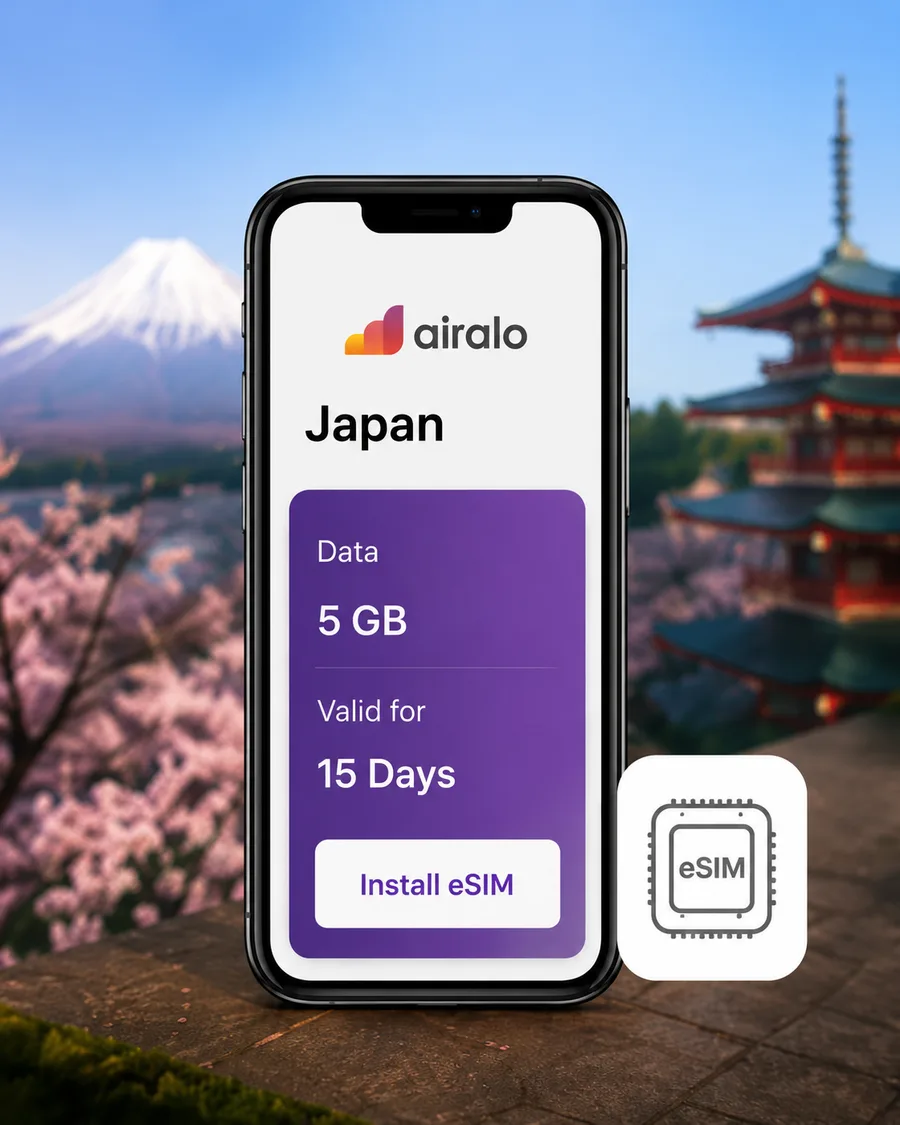
Run the calculatorThe eSIM is the one to lock in before you fly — install it now and you're online the second you step off the plane, no airport-WiFi hunt after a long flight:
 Best Value
Airalo Japan eSIM
Online the moment you clear customs — from ~$4
Why it may fit
Affordable Japan eSIM from ~$4 — install before you fly, switch on the moment you land. Easy app setup with top-ups if you run low. The fastest way to be online the second you clear customs.
Before booking
Check the live price, availability, eligibility, and terms before paying.
For everything else you'll encounter on arrival — cash culture, train etiquette, hotel check-in quirks — read our comprehensive First Time in Japan guide.
Last verified: 2026-10-07. Primary sources: Japan Customs Passenger Guide, Visit Japan Web (Digital Agency), VJW Unified 2D Code Announcement (2024-01-25), Customs FAQ 7105 (Age and Family Rules), MHLW Medication Import, Narcotics Control Department, and Japan Customs e-Gate. Customs rules can change without notice — verify before travel.
Frequently Asked Questions
No. Since January 25, 2024, Visit Japan Web uses a single unified 2D code for both immigration and customs. In the standard customs flow, scan that code and your IC passport at an electronic declaration terminal, preferably while waiting for checked baggage. After collecting your bags, proceed through the facial-recognition e-Gate or follow directions to a staffed inspection counter. Older guides that mention separate blue/red QR codes are out of date.
Up to 1,000,000 yen (about $6,700 USD at 150 yen per USD) in cash or financial instruments per person. Above that, you must file a separate Declaration of Carriage of Means of Payment in addition to the customs declaration. The threshold drops to 100,000 yen if you are travelling to North Korea.
Adderall (amphetamine) cannot be imported to Japan even with a foreign prescription. Vyvanse (lisdexamfetamine) requires advance permission from Japan's Narcotics Control Department. Ritalin and Concerta (methylphenidate) follow the psychotropics thresholds instead: within the NCD table limit and in non-injectable form, neither advance permission nor a doctor's certificate is required; above the limit or in injectable form, a doctor's certificate is required. Always check the active ingredient and quantity before departure.
Possibly. Even if you complete the electronic customs declaration and use the e-Gate, customs officers can still select you for baggage inspection. The QR code speeds up paperwork — it does not guarantee skipping a manual check.
Yes. The yellow paper customs declaration form is still accepted on all flights and at all airports. Japan Customs recommends electronic declaration via Visit Japan Web because it is faster, but either method is fully valid.

Written by
JAPANODE
Based in Japan, sharing real travel tips & local insights for visitors. Follow us on Instagram @thejapanode for daily Japan content.
You Might Also Like
 Planning
Japan Tax-Free Shopping 2026: Current Rules & Nov. 1 Change
15 min read
 Planning
Japan Tourist Taxes 2026: What You'll Actually Pay
15 min read
 Planning
Visit Japan Web 2026: How to Register (Step-by-Step) + QR Code Guide
13 min read
 Planning
First Time in Japan: 15 Things You Need to Know Before You Go
19 min read