On this page
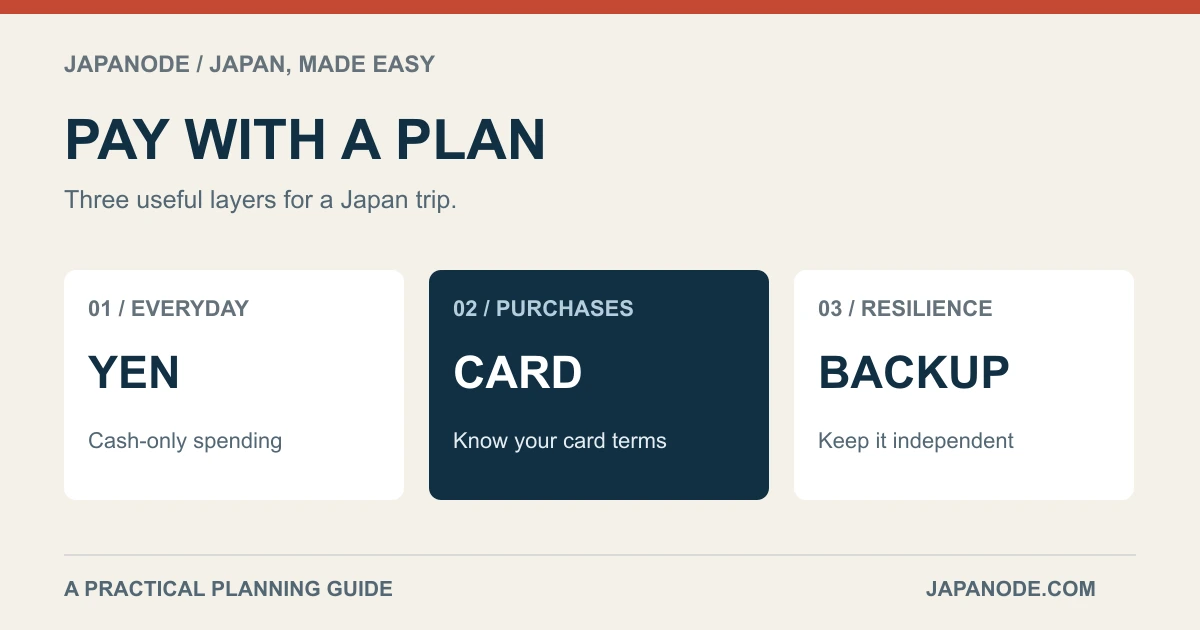
Bring a payment plan with three parts: a card you have checked for overseas use, another way to pay if that card fails, and enough yen for the next cash-only part of your trip. You do not need to turn your whole holiday budget into banknotes before you land.
The useful question is not whether Japan is a cash country. It is which expenses on your route require cash, where you can replenish it, and what each payment method costs you. A week based in Tokyo and a journey through small towns can need different buffers even when their total budgets are similar.
This guide explains the payment decisions. For accommodation, meals and the total cost of a holiday, start with the Japan trip budget guide. Official ATM and card information below was checked on October 17, 2026; your issuer's account terms and the machine's confirmation screen still control your transaction.
How Much Yen Should You Carry?
Estimate your next few days of cash-only spending, then add a separate contingency. Do not multiply your entire daily travel budget by the length of your trip: prepaid hotels and card purchases do not also need to sit in your wallet as cash.
Here is an illustrative calculation, not a price survey or a recommendation that everyone withdraw the same amount:
| Planned use | Assumed amount |
|---|---|
| Two days of small cash purchases at ¥2,000 per day | ¥4,000 |
| A planned cash top-up for a physical IC card | ¥2,000 |
| Contingency for a payment failure | ¥4,000 |
| Initial accessible cash in this example | ¥10,000 |
Change every line to match your booking confirmations and route. A cash-only accommodation payment can change the total substantially. So can a rural excursion that leaves little opportunity to find a compatible ATM. Conversely, a short city stay with prepaid lodging may not require repeated large withdrawals.
Keep the contingency available rather than treating it as spending money. Review your balance before a long transfer, a holiday closure period or an outing where you expect small admission counters and independent shops. Splitting the cash between accessible and backup storage can reduce the consequences of losing one wallet.
What Cards Can and Cannot Solve
A shop displaying your card network's logo is a useful starting point, not a promise that every transaction will succeed. The terminal, issuer checks, purchase type and available balance all matter. Online reservations can introduce additional authentication steps even when the same card works at a physical shop.
Before departure, check overseas spending settings, the card's expiry date and the way you will approve transactions. Make sure the phone number or app used for authentication will remain accessible while you travel. A card that relies on a text message to a number you cannot receive is an avoidable complication.
Keep a second payment method independently accessible. Two cards in one lost wallet do not provide the same resilience as a backup stored elsewhere. A mobile wallet is convenient, but it still depends on the device working and the merchant accepting that form of payment.
For accommodation, read the property's payment and deposit instructions. A prepaid room does not necessarily mean every incidental charge has been settled. Ask the property directly if a deposit, local tax or additional service must be paid at check-in, and whether the method you plan to use is accepted.
Two ATM Networks to Check
Look for the service information for overseas-issued cards, rather than the fee table for a Japanese domestic bank account. Those are different products.
| Operator | Published information checked | What remains specific to you |
|---|---|---|
| Seven Bank | Supported international card networks; up to ¥100,000 per withdrawal, or ¥30,000 for magnetic-stripe transactions | Card compatibility, issuer limit, network fee and access hours |
| Japan Post Bank | Up to ¥50,000 per transaction; a ¥220 ATM charge may apply to certain overseas cards | Issuer charges, machine access and the fee displayed |
Sources: Seven Bank's overseas-card service and Japan Post Bank's international ATM information. An operator's maximum is not your guaranteed withdrawal allowance. Your bank may impose a lower daily or transaction limit.
Choose an ATM you can reach without disrupting the day. A compatible machine inside a building may be inaccessible when that building closes. Save an alternative near your accommodation before you need it, particularly if you arrive late or plan to leave the city early.
A Practical Withdrawal Sequence
- Confirm that the machine supports your card network and that you know your PIN.
- Select the language and withdrawal option carefully.
- Read the currency and fee screens before accepting.
- Check that the yen amount fits your remaining need and your issuer's limit.
- Collect your cash, card and any receipt before stepping away.
- Review the transaction in your banking app when possible.
If the attempt fails, avoid repeatedly guessing the PIN. Check the issuer's message, available balance and overseas settings first. Try a different supported network or contact the card provider when the reason is unclear. The ATM operator cannot necessarily change an issuer decline.
Understand the Four Different Costs
An ATM displaying a small local fee does not mean the withdrawal has only one cost. Separate these lines when comparing payment methods:
| Cost | Who may charge it | What to inspect |
|---|---|---|
| ATM usage fee | The machine operator | The amount on the confirmation screen |
| Withdrawal fee | Your card issuer or account provider | Flat charge, percentage or monthly allowance |
| Currency conversion | Your provider, network or offered conversion service | The rate and any separately stated fee |
| Credit-card cash treatment | Your credit-card issuer | Cash-advance charges and applicable interest terms |
Do not assume a credit card's attractive purchase terms also apply to taking out cash. Read the cash-withdrawal section of the agreement. Likewise, a provider advertising a monthly allowance may still leave you paying an ATM operator's charge or a currency-conversion cost.
A useful comparison uses the same yen amount and the same timing. Comparing a promotional exchange rate from one day with an actual transaction on another can confuse currency movement with provider fees.
Yen or Your Home Currency?
When a terminal or ATM offers to convert the charge into your home currency, it is offering a separate conversion service. Choosing yen keeps that offered conversion out of the transaction; your own provider's conversion terms can still apply.
Wise's ATM guidance advises choosing the local currency. In Japan, that means JPY. Read the wording carefully: declining a conversion offer is not necessarily the same as cancelling the withdrawal itself.
Keep the receipt or transaction record if you need to compare the outcome. Record the yen amount, the amount debited in your account currency and all visible fees. That is more useful than judging a transaction only by whether the ATM called something free.
When a Payment Fails: A Short Recovery Plan
Separate a declined purchase from a failed cash withdrawal. They can have different causes and need different remedies. If you are at a busy counter, offer the backup payment first and investigate afterward; that is usually easier than trying to change account settings while a queue forms.
| Problem | First useful check | Practical fallback |
|---|---|---|
| Physical card declined at a shop | Merchant acceptance and the issuer's transaction notification | Another accepted card or yen cash |
| Online booking will not finish | Authentication request, billing details and confirmation email | The operator's alternative official booking channel |
| ATM rejects a withdrawal | Supported network, available balance and issuer limit | Another supported ATM or issuer support |
| Phone unavailable | Whether your physical card and PIN remain usable | Independently stored card, cash and downloaded booking details |
| Hotel requests a payment method you did not expect | The reservation's payment and deposit conditions | Contact the property before arrival to agree an accepted method |
Do not pay for the same online reservation again merely because the final screen stalled. Check the booking account and email first. A pending card authorization is not conclusive proof of either a confirmed booking or a completed cancellation. The seller can clarify the booking status; the card provider can explain the transaction status.
Track Cash Without Counting It Twice
Use two columns: money moved into the wallet, and money actually spent. If you withdraw ¥10,000 and later spend ¥1,400 on lunch and ¥600 on small purchases, the day's expenses are ¥2,000, plus any withdrawal costs. They are not ¥12,000.
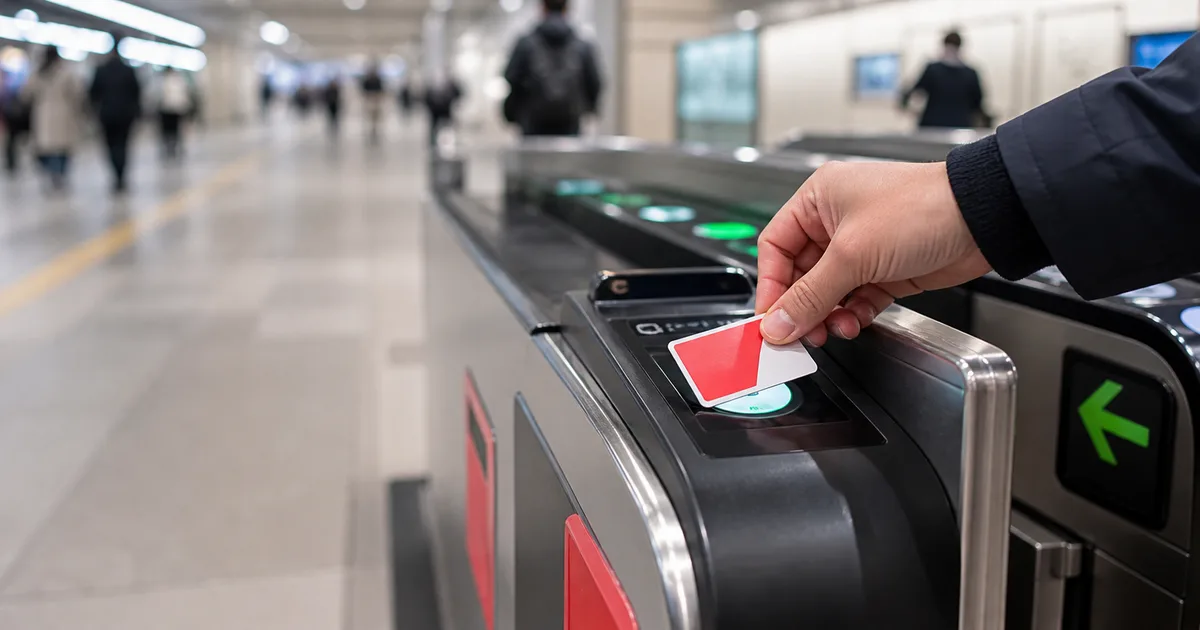
The same principle applies to an IC-card top-up. A transfer from cash into Suica changes where the money is held; the later train fare is the transport expense. This distinction helps you compare the Tokyo daily-budget example with your actual spending without mistakenly concluding that the trip is far over budget.
For a group, decide who pays shared cash bills and how they will be recorded. Photograph receipts for the group's own records and settle shared expenses periodically. Keep each traveler's individual emergency payment separate from the communal food or taxi fund.
Where Wise Fits Into the Comparison
Wise is one option to compare with the card you already have. It is not necessary for every Japan trip. An existing bank card with suitable fees and reliable overseas access may already meet your needs.
Start with card availability in your country of residence, then compare the costs for your expected purchases and withdrawals. Visiting Japan does not change your residential eligibility. If you need a physical card, allow time for verification, delivery and activation before departure.
JAPANODE is a Wise affiliate and may earn a commission when you sign up through our link and complete a qualifying transaction.
 Payment planning
Wise account and card
Why it may fit
Compare residence-based eligibility, conversion costs and ATM fees with your existing bank card before your Japan trip.
Before booking
Check the live price, availability, eligibility, and terms before paying.
No firsthand Wise usage is claimed here. The comparison is based on published product information and the costs a traveler needs to check. A second provider also means another account to set up and manage; that effort belongs in the decision alongside any possible fee saving.
Suica Is a Useful Layer, Not the Whole Plan
An IC card can make supported transport and small purchases easier, but it does not replace every bank-card payment or cash transaction. Check the exact product and device you intend to use; physical cards and mobile versions have different setup and top-up paths.
Use the Suica and Welcome Suica guide for those details. Avoid loading a large amount merely because you expect the card to work everywhere. Keep track of the remaining balance near the end of the trip and understand your product's refund or expiry rules.
Separate transport money from a contingency in your planning. If you have ¥2,000 on an IC card, that does not mean you also have ¥2,000 available for a cash-only admission or restaurant bill.
A Simple Arrival and Departure Plan
Before arrival, save your accommodation's payment instructions, your issuer's support route and the location of a compatible ATM. If you expect to need cash for the first transfer, settle how you will obtain it before choosing a route that leaves no margin.
During the trip, review cash needs when the itinerary changes. A tour that includes admission and transport can reduce cash expenses for that day, while a self-guided rural trip may require more separate payments. Check inclusions instead of guessing.
Before departure, reduce optional top-ups and withdrawals. Allow enough cash for outstanding bills, but do not create a large leftover balance simply to meet an imagined daily cash target. Keep spending records clear: withdrawing ¥10,000 is a transfer into your wallet, while buying lunch with part of it is the expense.
Finally, keep access to your travel information if your phone connection fails. Download essential confirmations and check the Japan eSIM comparison if you need mobile data for banking authentication, navigation and contacting your provider. Connectivity helps you solve a payment problem; it should not be the only thing standing between you and your next meal.
Make it your trip
Still planning your Japan trip?
Pick the question on your mind. Compare your options, check the details and take one more thing off your list.

Which eSIM fits your Japan trip?
Maps, messages, hotspot use: compare five providers by data allowance, network and plan limits before you choose.
Find my Japan eSIM
What should your travel insurance cover?
Compare medical cover, cancellation and activity limits across five options, with the exclusions worth checking.
Compare cover & limitsWould a JR Pass save you money?
Add your train journeys and compare individual tickets with the nationwide pass. See which costs less for your route.
Calculate my rail costsFrequently Asked Questions
Budget cash for the next few days of cash-only spending and a contingency, rather than carrying your entire trip budget. The example in this guide is an illustrative planning exercise, not a universal daily amount.
Seven Bank and Japan Post Bank publish services for supported overseas-issued cards. Check your card network, issuer restrictions, withdrawal limit and the fee shown before confirming.
Choosing Japanese yen avoids accepting the ATM's offered home-currency conversion. Your card issuer or payment provider can still charge its own conversion and withdrawal fees.
No. Suica is useful for supported transit and shops, but it is not accepted everywhere and its top-up methods have their own limits. Keep another payment method and yen cash.

Written by
JAPANODE
Based in Japan, sharing practical travel planning guides for visitors.