The quick dollar answer to “How much does Japan cost?” depends mostly on accommodation and trip length. A useful budget separates daily spending, accommodation, intercity transport and costs paid before the trip.
For 2026 planning, a realistic starting point per person is:
- Budget: $55–90 per day (¥9,000–14,000) before long-distance rail
- Mid-range: $115–190 per day (¥18,000–30,000) before long-distance rail
- Comfortable: $220–380+ per day (¥35,000–60,000+) before long-distance rail
These ranges exclude international flights and shopping. They assume a solo traveler pays the room unless stated otherwise; two people sharing can reduce the per-person hotel line substantially.
Dollar amounts are shown first for easier planning, with yen beside them because Japan's hotels, trains and restaurants charge in yen. The latest Bank of Japan release available on September 23 was its September 18, 2026 17:00 spot quote of ¥157.48–157.50 per US dollar. This guide uses $1 = ¥157.5 and rounds the dollar figures. Your card network and foreign-transaction fee will produce a different total.
Disclosure: Some links on this page are affiliate links. JAPANODE may earn a commission at no extra cost to you. The budget bands are based on official fares, published prices and JAPANODE's own 2026 hotel measurements—not affiliate payouts.
Quick Answer: 7-, 10- and 14-Day Japan Budgets
| Trip length | Budget | Mid-range | Comfortable |
|---|---|---|---|
| 7 days | $530–750 (¥83,000–118,000) | $930–1,460 (¥146,000–230,000) | $1,680–2,790 (¥265,000–440,000) |
| 10 days | $730–1,080 (¥115,000–170,000) | $1,300–2,100 (¥205,000–330,000) | $2,380–4,000 (¥375,000–630,000) |
| 14 days | $1,050–1,560 (¥166,000–246,000) | $1,850–2,980 (¥292,000–470,000) | $3,370–5,650 (¥530,000–890,000) |
The trip totals include a separate allowance for typical intercity travel:
- 7 days: about $125 (¥20,000) for a Tokyo–Kyoto-style route;
- 10 days: about $160 (¥25,000) for a standard Golden Route;
- 14 days: about $255–320 (¥40,000–50,000) for a Hiroshima or Alps extension.
They do not include a $510 (¥80,000) nationwide 14-day JR Pass, because most ordinary first-timer routes do not justify one.
Accommodation, meals, local transport, ordinary paid sights, a contingency allowance and the intercity allowance shown above. They exclude international airfare, shopping, luxury splurges and insurance because those lines vary more by origin and personal risk.
Key Facts: One Illustrative Day by Category
The trip ranges above are planning envelopes. These three sample days show how the categories can add up inside them; they are models, not a record of anyone's spending or a live quote.
| Daily line, per person | Budget example | Mid-range example | Comfortable example |
|---|---|---|---|
| Accommodation | $29 (¥4,500) hostel bed | $76 (¥12,000) business hotel | $171 (¥27,000) hotel or ryokan allocation |
| Food and drink | $19 (¥3,000) | $32 (¥5,000) | $57 (¥9,000) |
| Local transport | $6 (¥900) | $8 (¥1,200) | $19 (¥3,000) |
| Sights and activities | $5 (¥800) | $19 (¥3,000) | $32 (¥5,000) |
| Daily buffer | $11 (¥1,800) | $18 (¥2,800) | $19 (¥3,000) |
| Total | $70 (¥11,000) | $152 (¥24,000) | $298 (¥47,000) |
The accommodation row is where the examples separate. Your hotel may cost more on a peak date, and you can spend on one important meal without making every other category more expensive. Replace each sample amount with a quote for your own dates before multiplying it by the trip length.
JNTO's official budget guide lists a bowl of ramen from roughly $4 (¥650) and a casual coffee-shop breakfast around $2.50–4.50 (¥400–700), while warning that current prices can differ. Those figures show the low end, not what every central Tokyo meal will cost in 2026. For planning, allow more than the theoretical minimum.
Accommodation Is the Budget's Main Lever
Generic advice often says a Japan business hotel starts around $38 (¥6,000). That price exists, but it is not a safe Tokyo baseline.
JAPANODE priced the same set of hotel types across four cities and several 2026 dates. On an ordinary weeknight, the measured per-person ranges were:
| Accommodation | Measured planning range |
|---|---|
| Tokyo business hotel | $79–108 (¥12,500–17,000) |
| Kyoto business hotel | $49–79 (¥7,700–12,400) |
| Osaka business hotel | $43–63 (¥6,750–9,900) |
| Kanazawa business hotel | $34–63 (¥5,400–10,000) |
| Tokyo hostel dorm | $21–56 (¥3,250–8,800); median $27 (¥4,265) |
| Tokyo capsule | $17–47 (¥2,660–7,450); median $31 (¥4,950) |
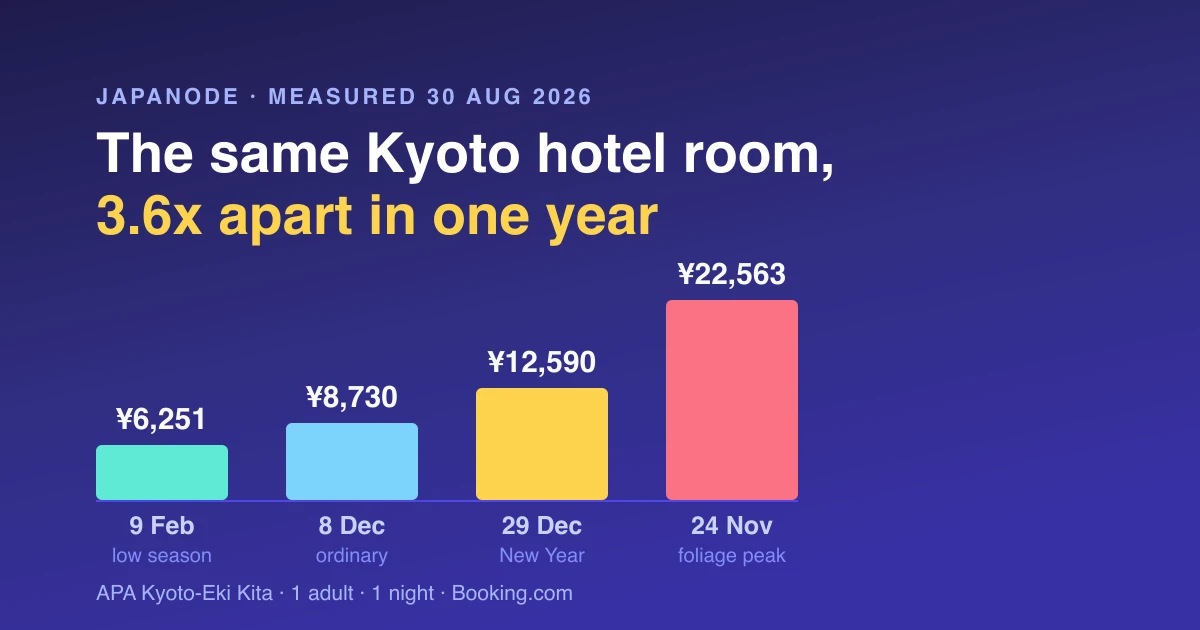
Season changed the answer more than hotel category. The measured Tokyo business-hotel sample rose from roughly $73–87 (¥11,500–13,700) in February to $130–187 (¥20,500–29,500) around the city's New Year peak. Kyoto's measured business-hotel sample reached roughly $127–171 (¥20,000–27,000) around its autumn peak.
Read the full Japan hotel price study for the dates, sample and limitations. Do not copy its cheapest number into every night of a cherry blossom trip.
Solo and Couple Budgets Are Not the Same
A $102 (¥16,000) double room costs a solo traveler $102 and two travelers about $51 (¥8,000) each. Most published “per person per day” estimates hide this assumption.
For couples, calculate the room first and divide it. For solo travelers, compare three different products rather than three booking sites only:
- a private business-hotel room;
- a hostel private room or dorm bed;
- a capsule, checking luggage, noise and bathing arrangements.
Our Japan accommodation types guide explains what each option is actually like.
Food: Cheap Is Available, but Variety Costs More
Japan makes it easy to eat one inexpensive meal. It is harder to eat three varied, nutritious meals plus coffee, drinks and snacks for the price of one gyudon.
A workable daily food model is:
| Meal pattern | Daily total | What it looks like |
|---|---|---|
| Tight | $16–25 (¥2,500–4,000) | Bakery or convenience breakfast, casual lunch, gyudon/ramen/set meal dinner, water |
| Balanced | $25–44 (¥4,000–7,000) | Simple breakfast, set lunch, izakaya or casual sushi dinner, coffee/snacks |
| Food-focused | $51–95+ (¥8,000–15,000+) | Better sushi/yakiniku, drinks, dessert and occasional reservation |
Do not classify every market snack as “just $3.20 (¥500).” Five snacks, two coffees and an evening drink can exceed the planned dinner. Keep a food budget, not a restaurant budget.
The best compromise is to choose the meals that matter before the trip. Spend on one sushi, kaiseki, food tour or yakiniku night; use casual chains and set lunches elsewhere. Our Tokyo food tour comparison shows when a guided experience replaces a meal and when it is an extra activity on top of one.
Transport: Separate City Travel from Intercity Travel
City transport is usually a small daily line. Shinkansen travel is not.
JAPANODE's fare dataset, last verified in July 2026, uses these practical one-way baselines:
| Route | Baseline adult fare | Approximate time | Note |
|---|---|---|---|
| Tokyo → Kyoto | $85 (¥13,320) | 155 min | Non-reserved Hikari baseline |
| Tokyo → Shin-Osaka | $88 (¥13,870) | 165 min | Non-reserved Hikari baseline |
| Kyoto → Hiroshima | $68 (¥10,770) | 100 min | Via Shin-Osaka on Sakura/Kodama |
| Tokyo → Kanazawa | $86 (¥13,600) | 150 min | Non-reserved baseline; Kagayaki is all-reserved |
| Hiroshima → Miyajima | $4 (¥600) | 45 min | JR train + JR ferry; excludes the $0.65 (¥100) visitor tax |
The official Japan Rail Pass price is about $510 (¥80,000) for a 14-day ordinary adult pass when purchased online. An overseas designated agency charges about $535 (¥84,000) for a 14-day ordinary adult exchange order purchased on or after October 1, 2026. No normal Golden Route budget should silently include that purchase.
Use the JR Pass Calculator with your exact legs. A Tokyo–Kyoto–Hiroshima–Tokyo example in the site's verified route data totals about $305 (¥48,180) in core adult fares—far below a $510 (¥80,000) 14-day pass. Convenience has value, but not $200 (¥31,820) of unexplained value.
For local trips, load a Suica or another compatible IC card and pay as you go unless a specific day pass matches the plan. The Suica and Welcome Suica guide covers purchase, mobile use and refunds.
Cash, Cards and the Exchange-Rate Trap
Build the spreadsheet in dollars, but keep the yen amount beside every line so you can compare it with the price charged in Japan. Then add the fees your bank actually charges.
On September 18, 2026, the Bank of Japan published a 17:00 USD/JPY spot quote of ¥157.48–157.50 per dollar. A traveler would not necessarily receive that interbank rate. Card networks, ATM operators and issuers can add conversion spreads, flat withdrawal fees or foreign-transaction fees.
Use this sequence:
- ask your bank for its foreign transaction and ATM fees;
- decline dynamic currency conversion when a terminal offers to bill in your home currency, unless you have independently checked the rate;
- carry at least two payment methods separately;
- keep accessible yen for cash-only situations;
- record withdrawals as transfers, not new spending, or your budget app will count them twice.
Japan is much more card-friendly than old guides suggest, but small restaurants, temple counters, rural buses, lockers and older machines can still require cash. For many city travelers, about $65–125 (¥10,000–20,000) in accessible cash is a sensible buffer—not a daily target and not a guarantee for every route.
Hidden Costs That Break an Otherwise Good Budget
The expensive surprises are usually not mysterious. They were simply omitted from the first spreadsheet.
- Accommodation taxes: collected per person per night in several cities; rules differ by city and room price.
- Japan's international tourist tax: currently added to qualifying departure tickets rather than paid at a booth.
- Miyajima visitor tax: about $0.65 (¥100) for most visitors entering the island, including JR Pass users.
- Oversized-baggage rules: certain Shinkansen seats require a reservation; the problem is planning, not a generic luggage fee.
- Luggage forwarding or storage: useful, but not free. Compare it with the time and taxi cost it can save.
- Peak-date transport and hotel terms: a cheap non-refundable rate is expensive when the itinerary changes.
- Card and ATM fees: a 3% foreign-transaction fee is about $57 (¥9,000) on $1,905 (¥300,000) of card spending.
The tourist taxes and hidden costs guide maintains the city-by-city details.
Three Sample Budgets
Seven Days: Tokyo and Kyoto
| Line | Budget | Mid-range | Comfortable |
|---|---|---|---|
| Daily base × 7 | $400–620 (¥63,000–98,000) | $800–1,330 (¥126,000–210,000) | $1,560–2,670 (¥245,000–420,000) |
| Intercity allowance | $125 (¥20,000) | $125 (¥20,000) | $125 (¥20,000) |
| Total | $530–750 (¥83,000–118,000) | $930–1,460 (¥146,000–230,000) | $1,680–2,790 (¥265,000–440,000) |
The 7-day first-timer itinerary shows what fits without adding a new hotel every night.
Ten Days: Golden Route
| Line | Budget | Mid-range | Comfortable |
|---|---|---|---|
| Daily base × 10 | $570–890 (¥90,000–140,000) | $1,140–1,900 (¥180,000–300,000) | $2,220–3,810 (¥350,000–600,000) |
| Intercity allowance | $160–190 (¥25,000–30,000) | $160–190 (¥25,000–30,000) | $160–190 (¥25,000–30,000) |
| Total | $730–1,080 (¥115,000–170,000) | $1,300–2,100 (¥205,000–330,000) | $2,380–4,000 (¥375,000–630,000) |
Our 10-day route is slower than the standard Tokyo–Kyoto–Osaka sprint and uses some private railway travel, so price its exact legs rather than buying a pass from habit.
Fourteen Days: Hiroshima or Alps Extension
| Line | Budget | Mid-range | Comfortable |
|---|---|---|---|
| Daily base × 14 | $800–1,240 (¥126,000–196,000) | $1,600–2,670 (¥252,000–420,000) | $3,110–5,330 (¥490,000–840,000) |
| Intercity allowance | $255–320 (¥40,000–50,000) | $255–320 (¥40,000–50,000) | $255–320 (¥40,000–50,000) |
| Total | $1,050–1,560 (¥166,000–246,000) | $1,850–2,980 (¥292,000–470,000) | $3,370–5,650 (¥530,000–890,000) |
These are not targets to spend. They are envelopes. If the Tokyo room costs $152 (¥24,000) instead of $95 (¥15,000), the hotel line changes; food does not automatically need to increase too.
Where Travelers Overspend
- Buying a nationwide rail pass before building the route. Calculate first.
- Treating every city as Tokyo-priced. Osaka and Kanazawa can lower the room average.
- Comparing headline room prices with different tax and cancellation terms. Compare the final payable total.
- Booking one-night stays to save $13 (¥2,000). Luggage, check-in time and a station taxi can erase the saving.
- Letting convenience-store snacks disappear from the food line. Small transactions still total real money.
- Converting every purchase mentally at yesterday's rate. Track yen, reconcile later.
- Leaving no contingency. A weather change, missed train or clinic visit should not put the rest of the trip on a credit balance.
Pre-Trip Money Checklist
- Set the budget in dollars, keep the yen price beside it, and use a conservative exchange rate.
- Price international flights separately; origin changes them too much for one Japan-wide estimate.
- Divide hotel cost by the actual number of people sharing.
- Add every long-distance leg, then test passes in the calculator.
- Check accommodation and visitor taxes.
- Confirm card, ATM and mobile-wallet fees.
- Keep emergency funds outside the daily spending account.
- Budget travel insurance from a live quote, not an article average; compare options in the Japan insurance guide.
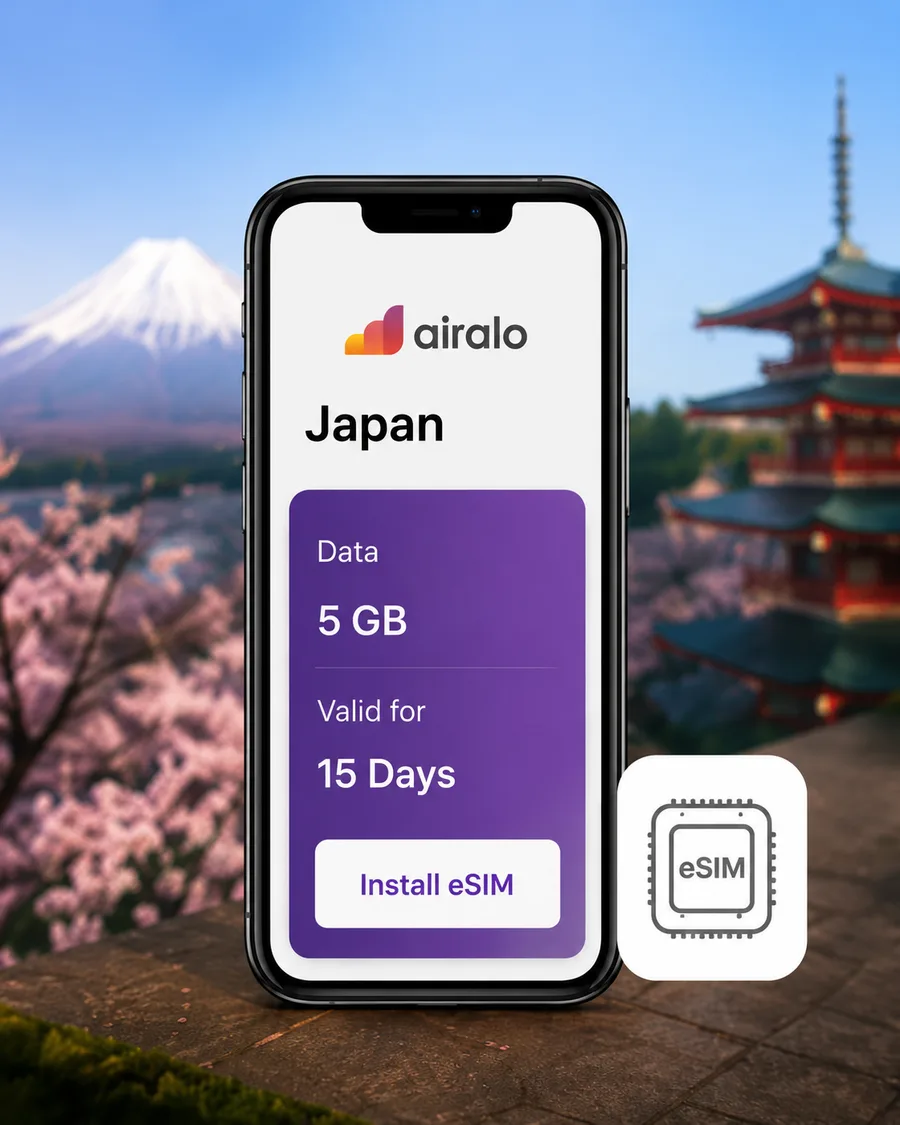
- Arrange data before arrival so you can check transport and banking alerts; compare providers in the Japan eSIM guide.
 Pre-trip cost
Airalo Japan eSIM
Put connectivity in the pre-trip budget
Why it may fit
A prepaid data plan makes transport, banking alerts and live price checks easier. Compare the live plan price, network and device compatibility before buying.
Before booking
Check the live price, availability, eligibility, and terms before paying.
The point of a budget is not to make every day cheap. It is to decide what deserves money before the trip makes the decision for you.
Last verified September 23, 2026. USD conversions use $1 = ¥157.5, based on the Bank of Japan September 18 foreign-exchange rate. Other primary sources and measurements: official Japan Rail Pass prices, official JR Pass conditions, JNTO budget guide, JAPANODE's measured 2026 hotel price study, and the site's verified jr-pass-fares.json dataset. Prices, exchange rates, taxes and product terms change; recheck them for your dates.