On this page
Insurance may cover the remaining prepaid, non-refundable loss when a listed event prevents the trip. It normally does not pay for fear of traveling, an event already known when you bought the policy, or a flight or hotel that the supplier has already refunded. Your issued policy determines the result.
Start with three questions: What exactly stopped you traveling? What will the airline, hotel or tour operator refund? Does the policy list the remaining loss as covered? That sequence matters more than whether the disruption was called a typhoon, earthquake, illness or transport cancellation.
This guide shows where to claim first, what evidence to save, and when standard cancellation, trip interruption, travel delay or Cancel For Any Reason may apply. If you mainly need help choosing a provider, start with our Japan travel insurance comparison. For a US-resident trip, see the US plan and quote comparison for state-specific checks and purchase timing.
Transparency: this guide contains affiliate links. JAPANODE may earn a commission at no extra cost to you. Recommendations are based on policy fit, current published features and third-party review patterns. The certificate issued for your residence and quote controls.
The four different ways money comes back
Most confusion disappears once you separate these four systems.
| What happened | First place to claim | What insurance may fill |
|---|---|---|
| Airline cancels your flight | Airline or booking agent | Eligible meals, hotel, onward arrangements or other non-refundable losses |
| Hotel or tour cancels | Hotel, platform or operator | Remaining prepaid loss if the event is covered |
| You become medically unable to travel | Supplier refunds first | Eligible non-refundable costs under cancellation cover |
| Trip has already started and must end early | Suppliers plus insurer | Eligible unused bookings and approved return transport |
| Transport is delayed | Carrier assistance first | Eligible reasonable expenses after the policy's minimum delay |
Insurance does not normally pay you twice. If ANA refunds the cancelled flight, that ticket is no longer your insured loss. Your unexpected hotel, unused ryokan or replacement connection may still be — if the policy wording applies.
The quickest buying decision
| Your trip | Best starting point |
|---|---|
| Fixed 1–4 week holiday, US resident, several prepaid bookings | Faye; check the quote soon after your first trip deposit |
| Fixed 1–4 week holiday, non-US resident, several prepaid bookings | Heymondo; add cancellation within 7 days of the first booking |
| Luxury ryokan, tours or expensive flights that become non-refundable | Use the cancellation option shown in your eligible quote; do not miss its purchase deadline |
| Long trip with few prepaid costs and changing dates | SafetyWing |
| You are already traveling | SafetyWing for future eligible events |
| A storm or disruption is already known | No new policy will retroactively cover it |
For non-US residents, Heymondo is our first quote for a conventional Japan vacation because that is the trip shape it fits: known dates, booked costs and a desire to handle medical and disruption cover in one place. Its official site says more than 3 million travelers have been insured. On August 15, 2026, its international Trustpilot profile showed 4.2/5 from more than 3,500 reviews. Buyers commonly mention simple purchasing and helpful support; negative reviews include slow responses and claim disputes. The platform score covers the whole customer journey; it is not an audited claim-payment rate or a substitute for reading the policy.
Before buying, confirm four fields in the quote: the first booking or deposit date, whether you are still inside the cancellation-option purchase window, the maximum cancellation limit, and the wording for events already known before cover began. If any field is unclear, ask Heymondo in writing before paying.
 Our fixed-trip first quote
Heymondo Travel Insurance
Check cover for a fixed-date Japan itinerary
Why it may fit
Get one quote for your actual dates and prepaid trip cost, then inspect the cancellation option and covered reasons shown for your residence. The international product says to add cancellation within 7 days of the first booking. JAPANODE readers receive 5% off where eligible.
Before booking
Check the live price, availability, eligibility, and terms before paying.
Cancellation, interruption and delay are not interchangeable
Trip cancellation applies before departure when a covered reason prevents the trip. It generally concerns prepaid, non-refundable costs.
Trip interruption applies after departure when a covered event forces you to end or change the trip. It may address unused arrangements and approved additional transport.
Travel delay concerns reasonable extra expenses after a delay reaches the minimum duration in the policy. A three-hour delay and a 12-hour overnight delay can have completely different outcomes.
Missed connection can be separate again. The policy may require a common carrier delay, a minimum scheduled connection and specific proof.
Do not choose a plan because its comparison page has four green check marks. Find the financial limit, minimum delay, covered reasons, affected suppliers and required documents for each benefit.
If a typhoon affects your trip
Japan's typhoons are trackable, but their exact path and transport impact can change. JNTO advises travelers to monitor official information, avoid going outside during dangerous conditions and allow time before public transport suspends. The Japan Meteorological Agency provides multilingual weather, heavy-rain and typhoon information.
Safety comes first. The claim process comes second:
- Follow JMA, local authorities and your accommodation's instructions.
- Check the operating airline or rail company's official status.
- Contact the insurer before making expensive changes when it is safe and practical.
- Ask each supplier what it will refund or rebook.
- Save status screenshots, cancellation certificates, emails and receipts.
- Claim only the remaining eligible loss.
When the airline cancels
ANA says flights expected to be delayed or cancelled by bad weather may be changed or refunded without handling fees, subject to the ticket, route and purchase channel. International sectors, package bookings and travel-agent tickets can use different procedures.
That solves the ANA ticket. It does not automatically solve your separate Kyoto hotel, ski transfer or tour. Those bookings have their own contracts. Insurance becomes valuable when a documented, covered disruption leaves reasonable costs that the suppliers do not return.
When trains stop but your flight still operates
Japan's rail operators may suspend services before severe weather. Your original rail ticket may be refundable under the operator's rule, but a taxi across the region, an extra hotel or a missed flight is not automatically the rail company's responsibility.
If a typhoon is approaching, do not wait until the last train to reposition. Follow official safety advice, keep your insurer informed and choose reasonable alternatives. Our Japan train guide explains the network; our summer guide covers practical typhoon preparation.
When you decide not to go
An uncomfortable forecast is not necessarily a covered cancellation. Standard policies pay for listed reasons, not general fear or a change of mind. Look for triggers such as cancelled transport, an official evacuation, government advice covered by the wording or accommodation that becomes unusable.
“Cancel For Any Reason,” where available, is a different optional benefit. It normally has an early purchase deadline, a deadline for cancelling before departure and partial rather than full reimbursement.
For US residents, Faye offers CFAR as an optional add-on. Its current CFAR page says it must be purchased within 14 days of the initial trip deposit, the trip must be cancelled at least 48 hours before departure, and eligible reimbursement is up to 75% of non-refundable trip costs. CFAR is not available in New York, and all benefits remain subject to the state-specific plan.

Faye Travel Insurance
Whole-trip cover with an optional CFAR add-on
Why it may fit
For US residents only. Start a state-specific quote soon after your first Japan booking if CFAR matters: Faye's published window is 14 days from the initial trip deposit, and CFAR is not available in New York.
Before booking
Check the live price, availability, eligibility, and terms before paying.
US residents who prefer to compare several insurers can see which plans offer CFAR, and at what percentage, on VisitorsCoverage's filtered comparison. The marketplace says the purchase window is commonly 15–21 days after the initial trip deposit, but the deadline, cancellation cutoff and reimbursement percentage are plan-specific.


VisitorsCoverage — plans with Cancel For Any Reason
US plans filtered to CFAR-eligible options
Why it may fit
For US residents only. The list opens already filtered to plans that sell the Cancel For Any Reason add-on, with each plan's reimbursement percentage and purchase deadline. Add your trip cost and dates to see the price of the add-on.
Before booking
Check the live price, availability, eligibility, and terms before paying.
If an earthquake affects your trip
First protect yourself. JMA says to stay calm and secure your safety during strong shaking; when a tsunami warning or advisory is issued, leave coastal areas and move to higher ground. JNTO's Safe Travel service publishes significant emergency information, and its 24-hour visitor hotline is 050-3816-2787.
Insurance can become relevant when the event causes a defined loss: a cancelled flight, official evacuation, unusable accommodation or necessary trip interruption. Fear of a future earthquake is not the same as an earthquake making your trip impossible.
Keep official alerts and transport notices, but do not rely on a screenshot alone. The insurer will also need proof of what you paid, what the supplier returned and why the remaining cost meets the policy.
The timing rule most travelers discover too late
Insurance covers unforeseen future events, not a problem you already know about. Record this timeline:
| Date | Evidence |
|---|---|
| Major booking paid | Invoice and cancellation terms |
| Policy purchased | Certificate and receipt |
| First relevant official warning or event | JMA, authority or carrier notice |
| Supplier cancels or refuses service | Email or certificate |
| Extra cost incurred | Itemized receipt |
Heymondo's international product also says the cancellation add-on must be purchased within 7 days of the first trip booking, and its cancellation guidance notes that situations known before purchase are excluded, including destination disasters that already had official alerts. Residence-specific products can differ, so the quote and issued certificate control. The practical rule is simple: consider cancellation cover with the first booking, not after you see the forecast.
Illness and family emergencies
Illness is one of the most common reasons travelers expect cancellation insurance to cover. The policy will still define how serious it must be, who counts as a family member, whether a doctor must certify that you cannot travel and how pre-existing conditions are treated.
Normal pregnancy, a foreseeable treatment, a condition already under investigation or a relative outside the policy's family definition may be handled differently. Never assume “medical reason” means every health-related cancellation.
Add up only what is truly at risk
Create this table while your bookings are open:
| Booking | Amount paid | Refundable today | At-risk amount | Deadline |
|---|---|---|---|---|
| Flights | ||||
| Hotels / ryokan | ||||
| Tours and tickets | ||||
| Rail and transfers | ||||
| Ski package or equipment |
Insure the at-risk amount, not the original headline price. A flexible hotel cancellable until 48 hours before arrival may add nothing to today's risk. A ryokan with a stepped cancellation charge can become more exposed as the date approaches. See our Japan accommodation guide before choosing between flexible and prepaid rates.
When SafetyWing is the better choice
SafetyWing is easier to recommend when your return date is uncertain, you are moving between countries or you have already departed. It can be purchased abroad and uses flexible billing. On August 15, 2026, its Trustpilot profile showed 4.3/5 from about 3,800 reviews, with strong comments about simple setup and support alongside criticism about some claims.
The trade-off is important: SafetyWing is travel-medical-first. If your main risk is thousands of dollars in non-refundable Japan bookings, a fixed-trip comprehensive option is usually the more natural starting point.
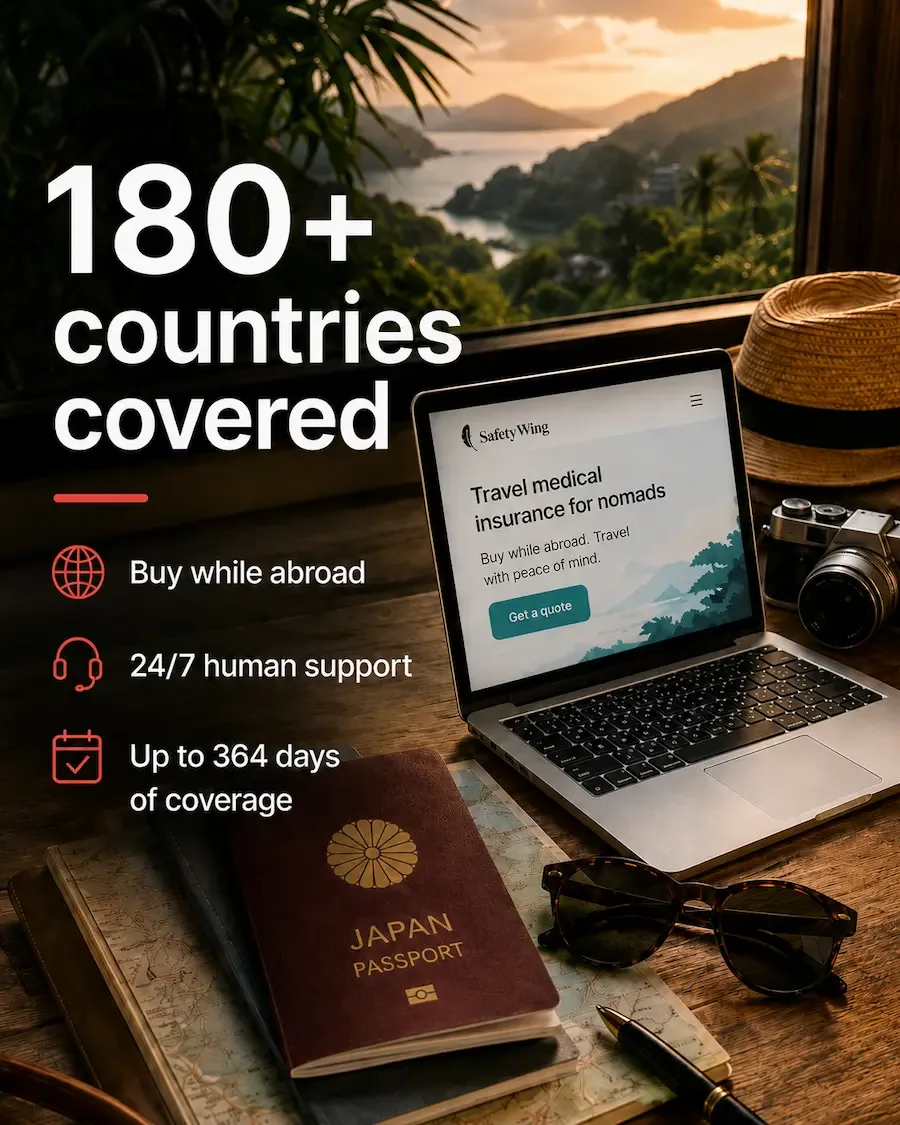 Flexible alternative
SafetyWing Nomad Insurance
For open-ended or already-started travel
Why it may fit
Flexible travel medical cover that can be bought while abroad. Choose it for trip flexibility, not because you assume it replaces strong cancellation protection for a costly prepaid itinerary.
Before booking
Check the live price, availability, eligibility, and terms before paying.
JAPANODE reader reward
8 weeks of Electronics Theft coverage free
Open SafetyWing through this link, tap the pink camera, and enter the code before creating your account.
Only for people who have never had a SafetyWing account, on Essential 28-day subscription or annual plans. After 8 weeks, the add-on auto-renews at the standard price; annual plans pay upfront with two months of the add-on deducted.
The claim sequence to save
- Get safe and follow official directions.
- Call the insurer or assistance service promptly.
- Ask the airline, hotel and operator to refund or rebook first.
- Download official delay, cancellation or closure evidence.
- Keep every reasonable extra-expense receipt.
- List refunds separately from unreimbursed costs.
- Submit before the claim deadline and retain originals.
The best cancellation policy is not the one with the longest feature list. It is the one bought before the event, with a limit that matches your actual non-refundable cost and rules you can document.
For most fixed-date Japan holidays, our decision remains straightforward: US residents can check Faye soon after the first trip deposit; non-US residents can get the Heymondo quote within 7 days of the first booking. In either case, verify the cancellation option, deadline and issued state- or residence-specific plan before buying.
Last verified: September 13, 2026. Sources: Faye coverage, Faye CFAR, JNTO typhoon guidance, JMA multilingual disaster information, ANA weather changes and refunds, JMA earthquake and tsunami guidance, JNTO Safe Travel, Heymondo international product details, Heymondo reviews, SafetyWing, and SafetyWing reviews. The certificate issued for your quote controls.
Make it your trip
Still planning your Japan trip?
Pick the question on your mind. Compare your options, check the details and take one more thing off your list.

Which eSIM fits your Japan trip?
Maps, messages, hotspot use: compare five providers by data allowance, network and plan limits before you choose.
Find my Japan eSIM
What should your travel insurance cover?
Compare medical cover, cancellation and activity limits across five options, with the exclusions worth checking.
Compare cover & limitsWould a JR Pass save you money?
Add your train journeys and compare individual tickets with the nationwide pass. See which costs less for your route.
Calculate my rail costsFrequently Asked Questions
Sometimes, but not simply because a typhoon exists or you no longer want to travel. Coverage depends on the policy's named reasons, when the event became known, whether your transport or accommodation became unusable, and what suppliers refund first. Read the cancellation, interruption, delay, natural-disaster, and known-event wording in your own certificate.
It can when the policy includes the relevant natural-disaster trigger and the earthquake creates a covered loss, such as an official evacuation, unusable accommodation, or cancelled transport. Fear of a future earthquake is generally not the same as a covered event. The exact trigger and exclusions vary by policy and country of residence.
The operating airline normally offers the remedy described in its conditions. For example, ANA states that affected flights may be changed or refunded when bad weather is expected, subject to ticket and booking-channel rules. That does not automatically reimburse a separate hotel, tour, rail booking, meal, or replacement flight, which is where supplier terms, card benefits, or travel insurance may matter.
You can sometimes buy a policy, but a storm, warning, disruption, or loss that was already known is normally excluded from cancellation cover. Insurance is designed for unforeseen covered events after the policy takes effect, not a problem already in progress.
Typically you should keep the policy certificate, booking and payment records, each supplier's refund or cancellation decision, an official delay or cancellation certificate when available, the evidence for the covered reason, and receipts for reasonable extra expenses. Contact the insurer promptly because deadlines and pre-authorization rules vary.
No. Standard cancellation pays only for covered reasons listed in the policy. Cancel For Any Reason, where available, is usually an optional benefit with its own purchase deadline, cancellation deadline, and partial reimbursement percentage. Availability depends on the product and the traveler's residence.

Written by
JAPANODE
Based in Japan, sharing real travel tips & local insights for visitors. Follow us on Instagram @thejapanode for daily Japan content.
You Might Also Like
PlanningBest Travel Insurance for Japan? 5 Options Compared (2026)
16 min read
 Planning
Japan Accommodation Types Explained: Hotels, Ryokan, Capsule Hotels & More
16 min read
 Planning
What to Wear in Japan in Summer: June, July & August Packing Guide
13 min read
 Transportation
The Complete Guide to Japan's Train System for First-Time Visitors
16 min read