On this page
This guide cannot diagnose symptoms. For a serious or life-threatening illness or injury, call Japan's ambulance and fire number, 119, now. Do not delay emergency care to contact an insurer or compare costs. For a non-emergency, the official medical institution finder and JNTO hotline below can help you find the right place.
A tourist can see a doctor in Japan without Japanese public health insurance. For a non-emergency, contact a suitable clinic and ask about language support, reception hours and the estimated private-pay charge. For a serious or rapidly worsening illness or injury, call 119 instead of comparing facilities or costs.
For many non-emergency problems, the next steps are manageable once you choose the right door. A pharmacy is useful for a minor, familiar symptom. A neighborhood clinic is usually the practical starting point for a non-emergency. An ambulance and emergency hospital are for serious situations.
This article explains that process, not medical treatment. Save it offline along with our first-time Japan guide and your insurer's assistance number.
Transparency: this article contains affiliate links for future insurance purchases. JAPANODE may earn a commission at no extra cost to you. A new policy will not cover an illness or injury that has already begun, and insurance shopping should never delay care.
Choose the right help first
| Situation | What to do |
|---|---|
| Serious, rapidly worsening or life-threatening | Call 119 |
| Symptoms may be serious, are rapidly worsening, or you are unsure if it is an emergency | Call 119; do not wait for an insurer or hotel to assess you |
| Non-life-threatening uncertainty about where to go | Use an official local consultation service or the JNTO finder; an insurer or hotel can help with logistics |
| Stable illness that needs a doctor | Contact a suitable clinic and confirm today's reception hours |
| Minor, familiar symptom | Ask a pharmacist; seek medical care if it worsens or remains unclear |
| Need a prescription medicine | Contact a clinic; a foreign prescription is not automatically fillable |
The Fire and Disaster Management Agency publishes a multilingual ambulance guide with examples of warning signs. Use that official guide rather than an online symptom checklist. The agency says ambulance service is available to anyone in Japan.
Numbers and official services to save
| Service | Contact | Use it for |
|---|---|---|
| Ambulance / fire | 119 | A serious emergency |
| Police | 110 | Crime, immediate police emergency |
| JNTO Japan Visitor Hotline | 050-3816-2787 | Illness referrals, accidents, disasters and visitor support |
| Official medical institution finder | JNTO “Guide for when you are feeling ill” | Finding care by area, specialty, language and hours |
JNTO operates its visitor hotline 24 hours a day, 365 days a year. From outside Japan, use +81-50-3816-2787.
You may see #7119 recommended for emergency consultation. It is not a single nationwide English medical line; implementation and language support vary by area. Check the local government or fire department page for the city where you are staying.
Japan's fire departments are expanding three-way interpretation and multilingual tools, but availability differs. When calling 119, say “ambulance,” state your location as clearly as possible and ask a hotel employee or nearby person to help if available.
How to find an English-speaking clinic
Use the official JNTO medical guide and institution search, then follow this order:
- Filter by your area, medical specialty, language and current opening time.
- Open the facility's website or call before traveling there.
- Confirm that it is accepting new patients today.
- Ask whether English support is available at that time.
- Confirm payment methods and whether an appointment or referral is required.
- If insured, ask the insurer whether it can arrange a participating facility or direct payment.
“English available” may mean a particular doctor, interpreter or shift — not every employee at every hour. A quick call from your hotel front desk can prevent a wasted journey.
Clinic or hospital?
For a stable non-emergency, a clinic matching the problem is usually the simpler first stop. Japanese clinics often specialize: internal medicine, dermatology, orthopedics, ear/nose/throat and so on. A general hospital has more departments and testing but can have longer waits, referral rules or additional charges.
For an emergency, do not shop for a clinic. Call 119 and let the emergency system select an appropriate hospital.
What to bring
- Passport or identification
- Travel insurance certificate and assistance number
- Payment card plus a backup method
- Current medicines in original packaging
- Generic ingredient names and doses
- Allergies and important medical conditions
- When the problem started and how it changed
- Local accommodation address and contact number
Keep this information in a phone note and as a screenshot. If you use Visit Japan Web, remember that it is an entry/customs service, not a medical record.
At reception, say that you are a visitor without Japanese public insurance. Ask about the estimated charge and payment method. The usual flow is registration, waiting, consultation and tests, payment, then a separate dispensing pharmacy if the doctor issues a prescription. Facilities vary.
Useful simple phrases:
Eigo wa daijobu desu ka?— Is English okay?Ryokosha desu. Hoken wa kaigai ryoko hoken desu.— I am a traveler. I have overseas travel insurance.Kyo, shinsatsu dekimasu ka?— Can I be seen today?Shiharai wa kaado de dekimasu ka?— Can I pay by card?
Use these only to start the conversation; for clinical details, use a professional interpreter, your insurer's assistance service or a reliable translation method.
How Much Does It Cost to See a Doctor in Japan as a Tourist?
There is no trustworthy nationwide tourist price list. Visitors outside Japan's public insurance system generally pay the medical institution's full charge. The total depends on the facility, visitor-pricing policy, tests, treatment, interpretation, time of visit and hospitalization.
In 2026, Japan's health ministry published a rule allowing certain designated medical corporations to set visitor private-pay pricing within a defined range up to three times the standard point-based amount, subject to regional standards. That rule does not mean every hospital charges three times the resident price.
Japan's official tourism guidance documents two serious composite cases:
- ¥7.5 million for surgery, 19 days in hospital and assisted return to the United States after a cycling collision.
- ¥10 million for surgery, 45 days in hospital and assisted return to Singapore after a heart attack.
Those are not ordinary consultation prices. They illustrate why adequate medical and evacuation cover matters even when routine care feels affordable.
Japanese residents enrolled in public health insurance typically pay only their applicable share, while an uninsured tourist may face the provider's full private-pay charge. That is why a resident's receipt should never be treated as a promised tourist price.
Paying first or using cashless treatment
Many visitors pay the facility and request reimbursement later. Some insurers can arrange “cashless” treatment, meaning the facility or assistance company bills the insurer directly. It is not guaranteed at every clinic and usually must be arranged in advance.
In an emergency, receive care first. When safe, call the insurer. For a non-emergency, contact the assistance line before the visit and ask:
- Which nearby facility can accept me?
- Can you arrange direct payment?
- Do I need pre-authorization?
- Which documents must the doctor complete?
Before leaving, request an itemized receipt, medical report or certificate, diagnosis/treatment description, prescription and proof of payment. Keep the originals until the claim is complete.
If you are reading this before departure, compare how a policy handles emergency medical care, evacuation, direct billing and reimbursement in our Japan travel insurance comparison. If you are already ill or injured, get care first: a policy bought now will not cover an event that has already begun.
Pharmacies and drugstores
A Japanese drugstore sells toiletries and over-the-counter products. A dispensing pharmacy (chouzai yakkyoku) fills prescriptions issued by a licensed Japanese clinician. Some businesses do both, but the services and staffed hours can differ.
Ask the pharmacist rather than selecting by packaging. Show the active ingredient and dose of medicines you already take. Similar-looking cold products can contain overlapping ingredients, and a brand sold at home may have a different formula or not exist in Japan.
This guide deliberately does not recommend specific drugs or doses. Pregnancy, allergies, chronic conditions and drug interactions make one-size-fits-all advice unsafe. If symptoms are severe, unfamiliar or worsening, use a clinic.
Can Japan refill a foreign prescription?
A prescription written abroad is not automatically valid at a Japanese dispensing pharmacy. A Japanese clinician may need to assess you and issue a local prescription, and the same medicine may not be approved or stocked.
Bring the original container, generic ingredient name, dose and a doctor's letter. Do not have medicine casually mailed from home; import rules still apply.
Bringing medicine into Japan
The Ministry of Health, Labour and Welfare says travelers can generally bring limited quantities for personal use without an Import Confirmation: up to a one-month supply for prescription drugs under the stated conditions, with different limits for other products. Controlled substances, stimulants, narcotics, injectable psychotropics and quantities above thresholds can require documents or advance permission. Some substances — including amphetamine and methamphetamine — cannot be imported even with a foreign prescription; Japan's Narcotics Control Department specifically says Adderall cannot be brought into Japan.
Rules apply to the ingredient and amount, not only the brand name. Check the current MHLW personal-import guidance and Narcotics Control Department guidance before travel. Our Japan customs guide covers the wider arrival process.
If you are admitted to hospital
Ask the insurer's assistance team to coordinate with the hospital as soon as practical. Confirm deposits, payment schedule, interpretation, medical reports and whether any transfer or return flight requires prior approval.
Do not arrange an expensive medical flight yourself unless immediate safety requires it. Evacuation and repatriation normally need the insurer to decide that the transport is medically necessary and approve the provider.
Keep your accommodation informed if belongings remain there. Ask the hospital for a discharge summary and a fit-to-fly assessment when relevant, then document every booking change for a possible interruption claim.
What insurance can do — and cannot do — after you get sick
If you already have insurance, call its assistance line and follow the claim process above.
If you are uninsured and already ill or injured, a new policy will not retroactively cover that event. Do not delay treatment to buy insurance. A policy available after departure can cover only new, eligible, unexpected events after its effective start, subject to its exclusions and any waiting rules. Our guide to buying travel insurance after departure lists which providers still sell mid-trip and how their first-72-hour rules work.
For your next trip — or the remaining future part of a long journey — our decision is simple:
| Trip type | Start with |
|---|---|
| Fixed dates, bought before departure | Heymondo |
| Long, open-ended or already abroad | SafetyWing |
Heymondo reports more than 3 million insured travelers and had a 4.2/5 Trustpilot score from over 3,500 reviews on August 15, 2026. SafetyWing had 4.3/5 from about 3,800 reviews on the same date. Both profiles include positive service experiences and negative claim complaints. These platform scores cover the whole customer journey, not audited claim-payment rates, so read the actual certificate.
 For future trips
Heymondo Travel Insurance
Arrange cover before your next fixed-date trip
Why it may fit
A straightforward starting point for medical assistance and available trip protection when your travel dates are known. It will not cover an illness or injury that has already begun. JAPANODE readers receive 5% off where eligible.
Before booking
Check the live price, availability, eligibility, and terms before paying.
 For future events only
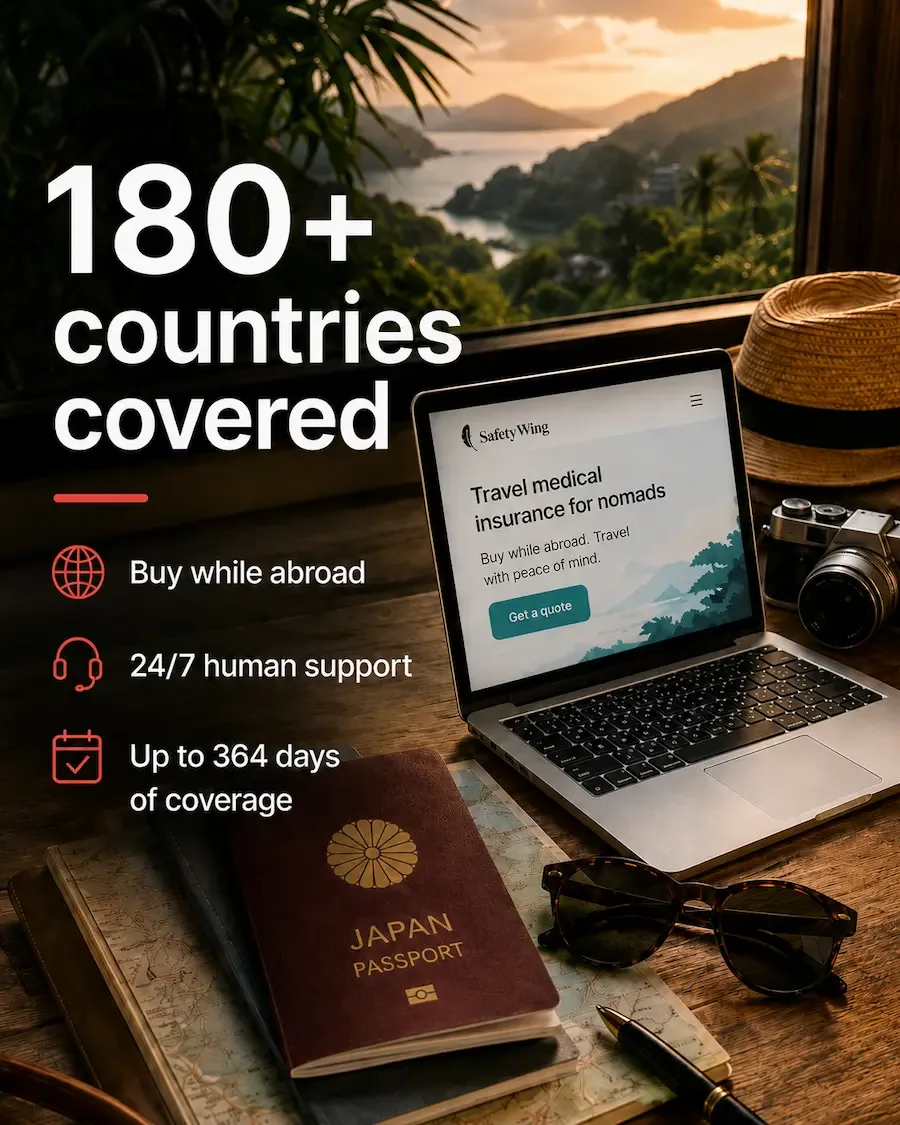
SafetyWing Nomad Insurance
For future eligible events on a long or already-started trip
Why it may fit
Flexible cover that can be purchased while abroad for new, unexpected eligible events after the policy takes effect. It will not cover the illness or injury you are dealing with now.
Before booking
Check the live price, availability, eligibility, and terms before paying.
JAPANODE reader reward
8 weeks of Electronics Theft coverage free
Open SafetyWing through this link, tap the pink camera, and enter the code before creating your account.
Only for people who have never had a SafetyWing account, on Essential 28-day subscription or annual plans. After 8 weeks, the add-on auto-renews at the standard price; annual plans pay upfront with two months of the add-on deducted.
For longer stays, read our long-stay insurance guide. Before departure, save a working Japan eSIM, the 119 number, the JNTO hotline and your policy certificate offline. Five minutes of preparation is much easier than searching from a clinic waiting room.
Last verified: August 15, 2026. Sources: FDMA ambulance guide, FDMA multilingual emergency initiatives, JNTO Japan Visitor Hotline, JNTO medical institution guide, MHLW visitor-pricing rule, MHLW medicine import rules, Heymondo reviews, and SafetyWing reviews. This is general travel information, not medical or insurance advice.
Make it your trip
Still planning your Japan trip?
Pick the question on your mind. Compare your options, check the details and take one more thing off your list.

Which eSIM fits your Japan trip?
Maps, messages, hotspot use: compare five providers by data allowance, network and plan limits before you choose.
Find my Japan eSIM
What should your travel insurance cover?
Compare medical cover, cancellation and activity limits across five options, with the exclusions worth checking.
Compare cover & limitsWould a JR Pass save you money?
Add your train journeys and compare individual tickets with the nationwide pass. See which costs less for your route.
Calculate my rail costsFrequently Asked Questions
Call 119 for a serious or life-threatening emergency. For non-emergency illness, use Japan's official medical institution search or ask the JNTO Japan Visitor Hotline at 050-3816-2787 for guidance, then contact a suitable clinic before visiting when possible. A pharmacy can help with minor symptoms, but it cannot replace medical assessment when symptoms are severe, worsening, or unclear.
Yes. Bring your passport, contact details, a list of medicines and allergies, and your travel insurance information. Visitors who are not covered by Japan's public health insurance generally pay the medical institution's full charge, often at the visit, and then claim from their insurer if eligible. Ask for an itemized receipt and medical documentation.
Dial 119 for an ambulance or fire emergency. The Fire and Disaster Management Agency states that ambulance service is available to anyone in Japan. If language is a concern, say 'ambulance' and your location clearly; multilingual support arrangements vary by local fire department.
Public ambulance transport itself is generally not billed to the patient, but the examination, treatment, hospitalization, and other services at the receiving medical institution are separate and can be charged in full. Do not use an ambulance as free transport for a minor illness; call 119 when emergency help is genuinely needed.
A foreign prescription is not automatically fillable in Japan, and the same brand or ingredient may not be approved or stocked. For an essential medicine, contact a clinic and show the original container, generic ingredient name, dose, and a doctor's letter if you have one. Do not substitute or combine medicines without professional advice.
Payment methods vary. Many large hospitals accept cards, while smaller clinics or pharmacies may have more limited options. Confirm before visiting when possible and carry a backup payment method. Even if your insurer offers cashless treatment, it normally needs to arrange that directly with a participating medical institution.
Written by
JAPANODE
Based in Japan, sharing real travel tips & local insights for visitors. Follow us on Instagram @thejapanode for daily Japan content.
You Might Also Like
PlanningBest Travel Insurance for Japan? 5 Options Compared (2026)
16 min read
 Planning
Visit Japan Web 2026: How to Register (Step-by-Step) + QR Code Guide
13 min read
 Planning
First Time in Japan: 15 Things You Need to Know Before You Go
19 min read
ConnectivityBest eSIM for Japan 2026: 5 Providers Compared
20 min read