
On this page
Spring & autumn (March-May, October-November) are the easiest to pack for — layers work perfectly. Summer (June-August) requires light, breathable fabrics and rain gear. Winter (December-February) needs a warm coat in Tokyo/Osaka and serious cold-weather gear for Hokkaido.
Three things first-time visitors often miss: (1) tattoos still bar entry at many public onsen, sento, and pools; (2) cedar pollen can be brutal from late February to early April; (3) the real climate split is Pacific side vs. Japan Sea side, not east vs. west.
"What should I wear in Japan?" is one of the most common questions first-time visitors ask — and the answer changes dramatically depending on when you go and where you're headed. Tokyo in August and Hokkaido in January are essentially different planets, weather-wise.
This guide gives you a quick month-by-month reference, then links to our detailed seasonal guides for everything you need to pack.
Japan's Climate: 4 Regions, 4 Seasons
Japan stretches roughly 3,000 km from north to south — comparable to the distance from Norway to Morocco. That means the weather varies enormously by region:
| Region | Climate Type | Key Characteristic |
|---|---|---|
| Hokkaido (Sapporo) | Subarctic | Cold winters with heavy snow, mild summers, no rainy season |
| Tokyo (Pacific Side) | Temperate | Hot humid summers, mild dry winters. Osaka, Kyoto, Fukuoka, and most major cities share this climate |
| Japan Sea Side (Kanazawa) | Temperate, heavy snow | Overcast winters with heavy snowfall. Includes Niigata, Toyama, Tottori — and inland Takayama, which is geographically in the mountains but shares the Sea Side's snowy winter climate |
| Okinawa (Naha) | Subtropical | Warm year-round, rainy season mid-May to mid-June, typhoon season July-October |
Osaka and Kyoto have very similar weather to Tokyo (just 1-2°C warmer). Follow the Tokyo (Pacific Side) section for Osaka, Kyoto, Hiroshima, Fukuoka, and all other Pacific-side cities. The real clothing difference in Japan isn't east vs. west — it's Pacific side vs. Japan Sea side, where winter weather is completely different.
If you're visiting Tokyo, Osaka, and Kyoto, one packing strategy works for all three. But if you're adding Kanazawa, Takayama, or Hokkaido, you'll need additional gear.
Which climate region is my destination?
Type a city or prefecture to find which section of this guide to follow.
Month-by-Month Quick Reference
Still choosing dates? Our best-time-to-visit guide compares the seasonal trade-offs before you decide what to pack.
Here's your at-a-glance guide. Tokyo temperatures are listed as the reference point — see regional notes for adjustments. Figures are rounded monthly average highs and lows for Tokyo based on long-term climate normals; actual weather can vary, so always check a 3-5 day forecast before departure. Note that the swing within a single month can be large — early March can still feel like winter, late March can feel like spring; early September is still summer, late November can feel like early winter at night.
| Month | Tokyo High/Low | What to Wear | Details |
|---|---|---|---|
| Jan | 10°C / 2°C | Warm coat, layers, scarf, gloves | Winter guide → |
| Feb | 11°C / 3°C | Same as January, slightly milder | Winter guide → |
| Mar | 14°C / 5°C | Light coat, layers for 10°C+ swings | Spring guide → |
| Apr | 19°C / 10°C | Light jacket + layers, cherry blossom season | Spring guide → |
| May | 24°C / 15°C | Light long sleeves, rain jacket | Spring guide → |
| Jun | 26°C / 19°C | Breathable fabrics, umbrella — rainy season | Summer guide → |
| Jul | 30°C / 23°C | Light quick-dry clothes, sun protection | Summer guide → |
| Aug | 31°C / 24°C | Same as July — peak heat and humidity | Summer guide → |
| Sep | 28°C / 21°C | Treat early Sep as summer (heat + typhoon risk); late Sep starts to cool | Summer guide → for early, Autumn guide → for late |
| Oct | 22°C / 15°C | Light jacket, layers — best travel month | Autumn guide → |
| Nov | 17°C / 9°C | Medium jacket, sweaters, autumn foliage season | Autumn guide → |
| Dec | 12°C / 4°C | Warm coat, layers, winter accessories | Winter guide → |
Regional adjustments:
- Hokkaido: Often 7-10°C colder than Tokyo in winter, and sometimes much colder inland or during cold waves. Plan for sub-zero temperatures in Sapporo from December through February; inland cities (Asahikawa, Furano) can drop below -20°C. Sapporo also gets more annual snowfall than almost any other major city in the world — pack insulated waterproof boots if you'll be there in winter.
- Japan Sea Side (Kanazawa, Niigata, Toyama, Takayama): Temperatures are often similar to Tokyo in spring, summer, and autumn, but winter is much wetter and snowier. Bring waterproof shoes or boots and a proper outer layer in winter. Outside winter, a compact umbrella or light rain jacket is usually enough.
- Osaka / Kyoto / Kyushu: Usually close to Tokyo, often 1-2°C warmer. For most trips, follow the Tokyo column.
- Okinawa: Much warmer year-round (add 8-12°C in winter). Beach-friendly weather often runs April through October, but May-June can be rainy and July-October can be disrupted by typhoons. Sun protection matters here far more than in Tokyo.
 Best Value
Airalo Japan eSIM
Check live forecasts on the go — data from ~$4
Why it may fit
Packing right is a forecast game: the 3-5 day outlook decides your layers, and once you land you'll be checking weather apps, rain radar, and train status constantly. An Airalo eSIM gets you online the moment you arrive — plans start from about $4 with app-based setup.
Before booking
Check the live price, availability, eligibility, and terms before paying.
Season Overviews
Spring (March - May)
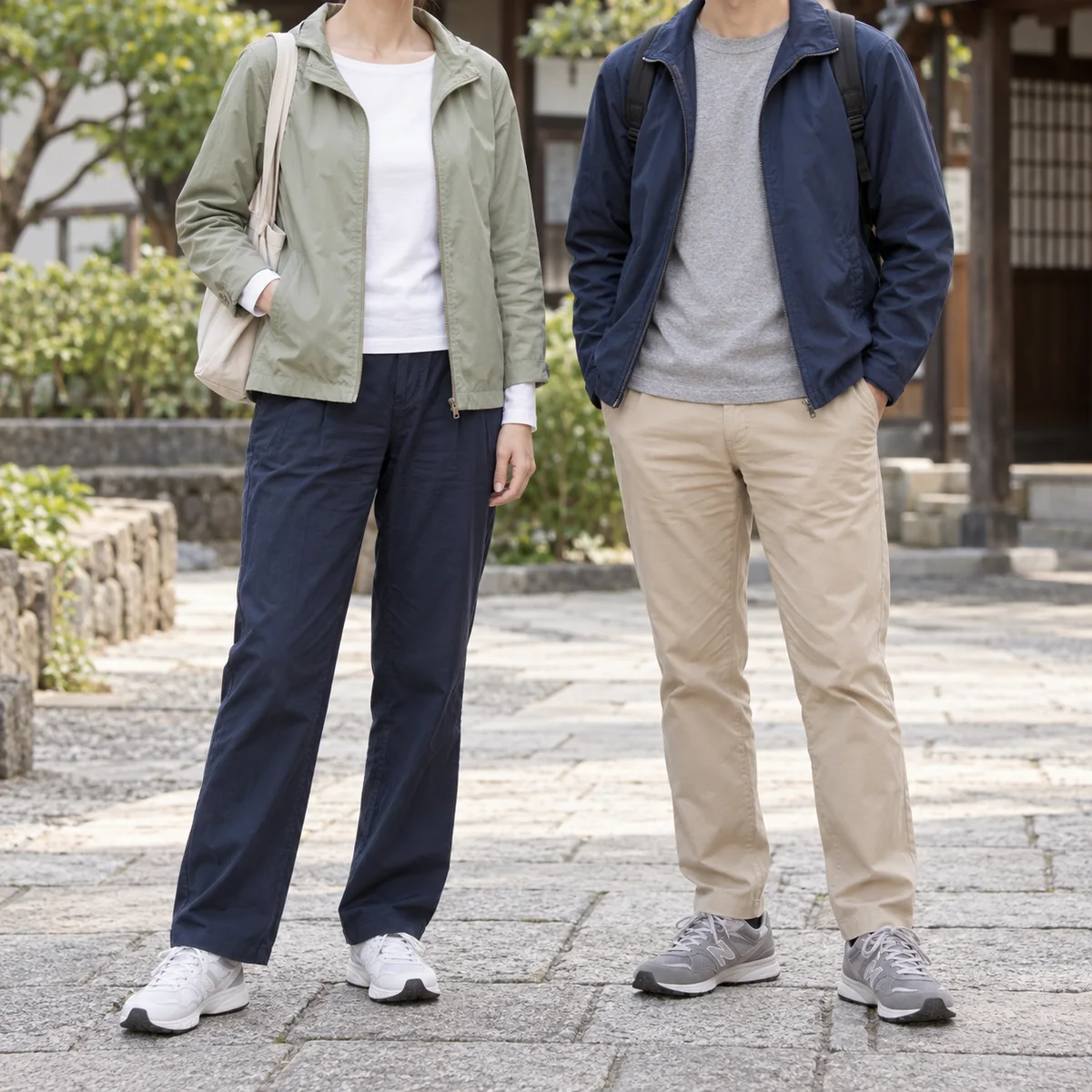
Spring is Japan's most popular travel season — and its trickiest to pack for. March mornings can be 5°C while April afternoons hit 20°C. The key is layers you can add and remove throughout the day.
Cherry blossom season (late March to mid-April in Tokyo/Osaka, early May in Hokkaido) means you'll be outdoors a lot. A packable jacket and comfortable walking shoes are essential. May starts to warm up with rising humidity.
→ Read our complete Spring clothing guide (March, April, May)
Summer (June - August)
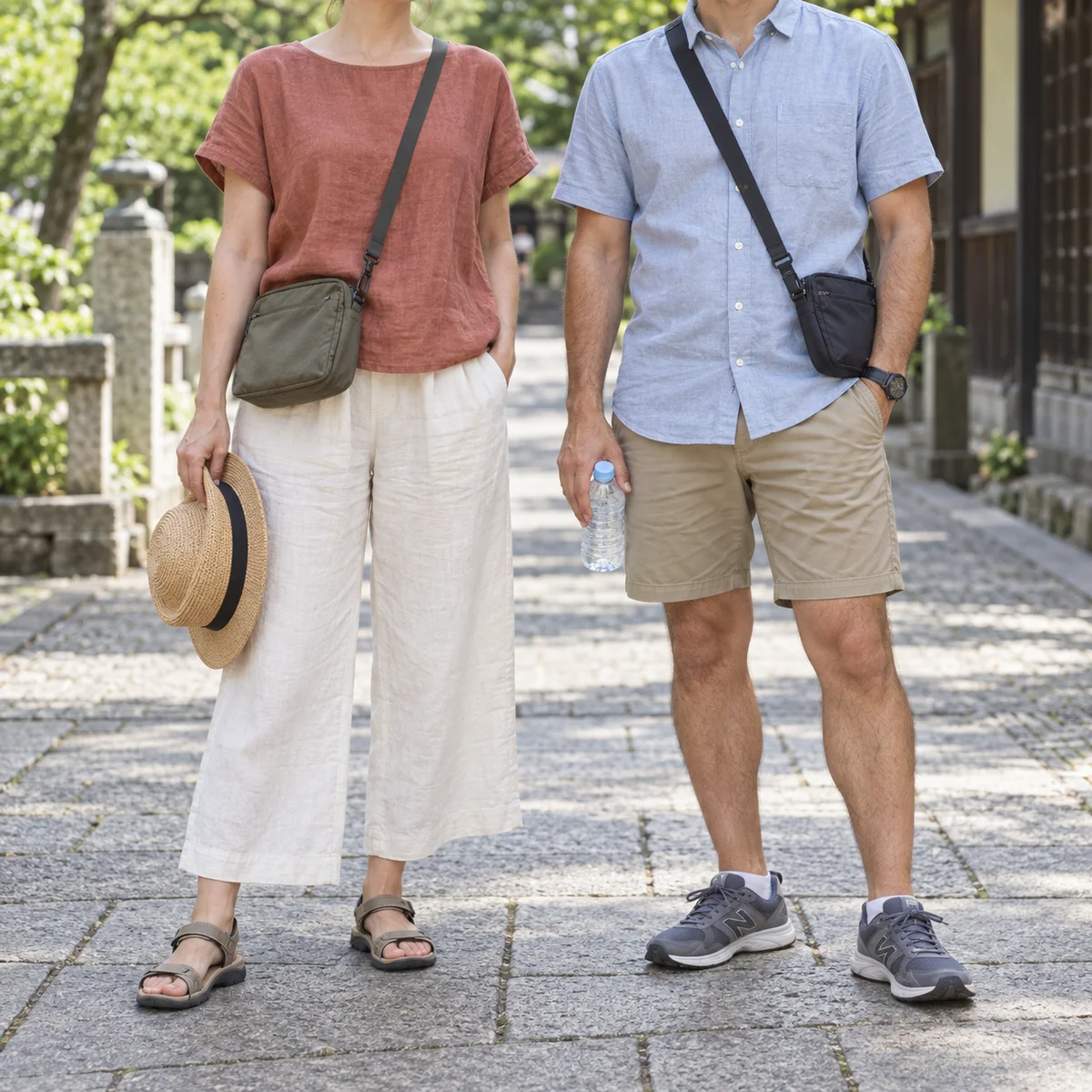
Japanese summers are no joke — 30°C+ with 75-80% humidity makes it feel significantly hotter than the thermometer reads. The rainy season (tsuyu) runs from early June to mid-July, bringing daily rain. Cotton becomes miserable; switch to quick-dry synthetic or linen fabrics.
Indoor air conditioning on trains, in shopping malls, and in many restaurants is significantly cooler than outside, so you'll want a light cardigan or thin hoodie to throw on when you duck inside. And always carry a compact umbrella.
→ Read our complete Summer clothing guide (June, July, August)
Autumn (September - November)
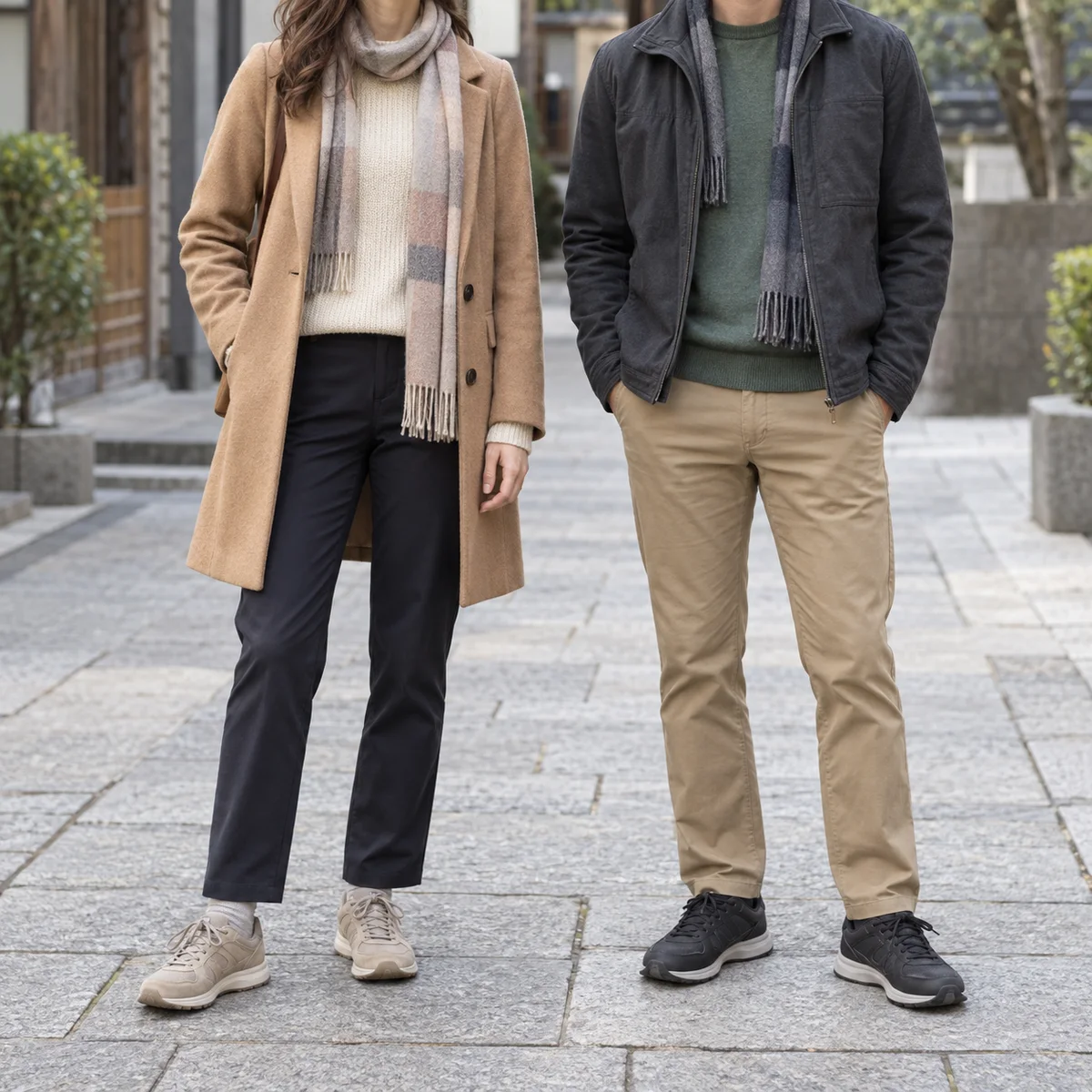
October is widely considered one of the best months to visit Japan — clear skies, mild temperatures, lower crowds than the cherry-blossom rush, and the start of autumn foliage. September is still hot (treat it as summer), but by November you'll need a proper jacket.
Autumn foliage peaks in mid-to-late November in Tokyo/Kyoto and late September-October in Hokkaido. Pack layers that let you adjust between warm days and cool evenings.
→ Read our complete Autumn clothing guide (September, October, November)
Winter (December - February)
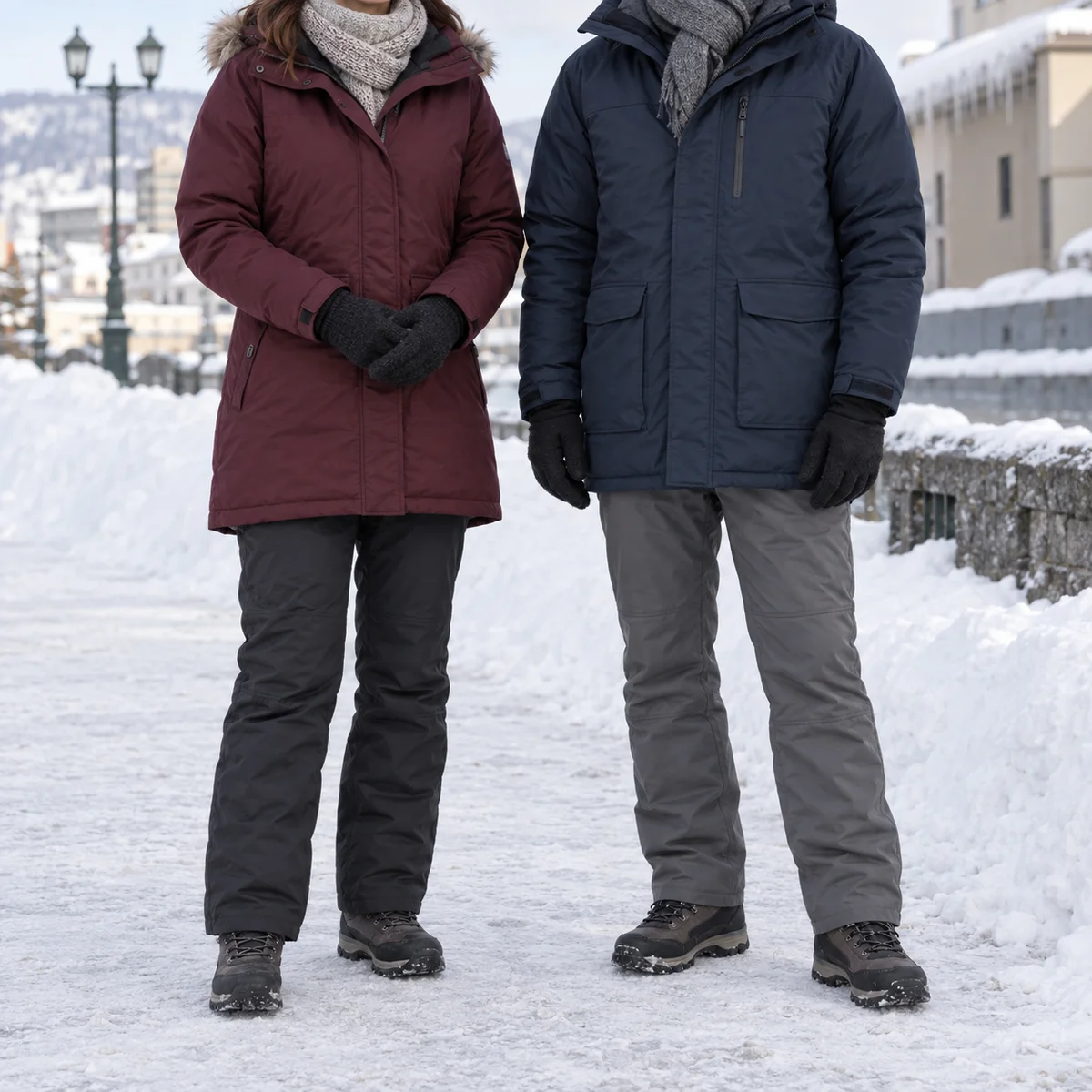
Tokyo and Osaka winters are cold but manageable — similar to a mild European winter. The real challenge is layering for heated trains and buildings. A single heavy parka with nothing underneath means you'll roast every time you step indoors.
Hokkaido is a completely different story: sub-zero temperatures, heavy snowfall, and icy sidewalks require insulated waterproof boots, thermal layers, and serious winter gear.
→ Read our complete Winter clothing guide (December, January, February)
Cultural Considerations: Temples, Onsen, and Tattoos
Japan is generally relaxed about tourist clothing, but a few cultural points are worth knowing in advance.
Temples & Shrines
Most temples and shrines in Japan do not have a strict dress code. Shorts and sleeveless tops are usually accepted, especially in summer. That said, for major religious sites, temple buildings, ceremonies, or more formal settings, slightly more modest clothing is a respectful choice. A light scarf, cardigan, or overshirt is useful if you want a quick cover-up.
- Socks matter. You'll remove shoes frequently. Clean, hole-free socks are a small detail that adds up. In summer, carry a pair in your bag if you're wearing sandals.
- Skip the "temple outfit" stress. Japanese visitors come in jeans and t-shirts. Neat casual is perfectly fine — no formal or traditional clothing required.
Onsen Basics
At a traditional onsen (hot spring) or sento (public bathhouse), swimwear is not worn in the bathing area. You bathe nude. Showering and rinsing thoroughly at the seated washing stations comes first; only then do you enter the communal bath.
A few practical notes:
- Towels: Many facilities provide or rent a small towel for ¥100-300, but at no-frills public sento and some day-use onsen, you should expect to bring your own. The small towel is used outside the bath and at the washing stations — it doesn't go into the water.
- Hair tie: If you have long hair, tie it up so it doesn't touch the water.
- Private alternatives: Most ryokan and many hotels offer in-room (private) baths or family baths (kashikiri-buro), which are an easy way around any onsen anxiety.
Tattoos: Onsen, Sento, Pools, Gyms, Beaches
This is the single biggest thing tattooed travelers miss. Many public onsen, sento, public pools, gyms, water parks, and some beaches in Japan still refuse entry to anyone with visible tattoos, regardless of size or design — a historical association between tattoos and organized crime persists in older facility policies. Things are loosening, but unevenly.
How to handle it:
- Carry adhesive tattoo cover stickers for small tattoos (¥500-1,500 at most drugstores and on Amazon Japan). They peel cleanly and work for most ankle / wrist / shoulder-blade-sized pieces.
- Look up tattoo-friendly onsen in advance. "Tattoo OK" or "tattoo friendly" search on Tattoo Friendly Japan (
tattoo-friendly.jp) and Tabelog reviews will surface options. - Choose a private bath. A ryokan with an in-room rotenburo (open-air bath) or any kashikiri-buro (reservable family bath) bypasses the question entirely.
- Cover up in transit areas. Even if tattoos are permitted in the bath itself, some facilities ask that you cover up in changing rooms and lobby areas.
Crowded Trains: Wear Your Bag in Front
Rush-hour trains in Tokyo, Osaka, and Kyoto get packed. A small etiquette point that surprises visitors: when a train is crowded, locals shift their backpack or shoulder bag to the front of their body rather than wearing it on the back. This reduces the chance of bumping passengers behind you and keeps your bag in sight in the press of bodies. It's a small move that signals you understand the room.
The Right Shoes: Walking 20,000 Steps a Day
Footwear is the single most important packing decision for Japan. Expect to walk 15,000-25,000 steps per day across concrete sidewalks, cobblestone streets, temple stairs, and uneven paths.
What Works
- Broken-in walking shoes or sneakers — comfort and support are non-negotiable
- Slip-on shoes — you remove footwear at temples, ryokan, some restaurants, and fitting rooms. Easy on/off saves frustration
- Waterproof or water-resistant — for rainy season and unpredictable showers
What Doesn't
- Brand new shoes — blisters by day two. Break them in before your trip.
- High heels or fashion boots — cobblestone in Kyoto, temple stairs, and station concourses will punish them
- Flimsy flip-flops — fine at the beach in Okinawa, miserable for a day of sightseeing in Tokyo
Slip-on sneakers (Vans Slip-On, certain Nike models, Allbirds Wool Lounger) give you the best of both worlds — comfortable for walking and easy to remove at temples. Practical sneakers are extremely common in daily life in Japan, and slip-on styles are especially convenient for travelers who'll be removing shoes several times a day.
Spring Pollen Allergies (February-April)
If you're sensitive to pollen, this is worth packing for. Cedar (sugi) and cypress (hinoki) pollen peaks from late February through early April across most of mainland Japan, and it can be brutal on warm, sunny days even for people who don't normally have hay fever. Symptoms: runny nose, itchy eyes, sneezing fits, sometimes a sore throat.
What helps:
- Disposable masks are cheap and effective (¥300-500 for a pack of 30 at any drugstore). Japanese pollen masks fit better than most international ones because the population uses them so heavily.
- Eye drops — drugstores carry pollen-specific drops (花粉用目薬 / kafun-yo megusuri). Brands like Rohto, Sante, and Visine work.
- Over-the-counter antihistamines — Allegra (フェキソフェナジン) and Claritin (ロラタジン) are available at any Matsumoto Kiyoshi, Sundrug, or Welcia drugstore without a prescription.
- Glasses over contacts — contact lenses make pollen worse.
- Escape options — Hokkaido has far less cedar pollen. Okinawa also avoids the worst of it. If you're severely sensitive, time a few days there.
Sensitivity varies wildly — many travelers feel nothing, others get hit hard. Stop by a drugstore on day one if you start noticing symptoms.
Japan Packing Essentials (Every Season)
Regardless of when you visit, these items earn their luggage space:
| Item | Why You Need It |
|---|---|
| Compact folding umbrella | Rain is common year-round. Convenience stores sell them for ¥500-700 as backup |
| Small towel / tenugui | Especially in summer. Many restrooms don't have hand dryers or paper towels |
| Light cardigan or hoodie | For AC in summer, layering in spring/autumn, or quick temple cover-up |
| Slip-on shoes | For the constant shoe-on/shoe-off at temples, restaurants, and hotels |
| Reusable shopping bag | Plastic bags cost ¥3-10 at most stores since Japan's bag charge law (¥3-5 at convenience stores, slightly more at supermarkets and specialty shops) |
| Comfortable day bag | A small backpack or crossbody for daily sightseeing. Worn on the front in crowded trains. Keep it manageable |
Smart Packing: Use Coin Laundry
Japan's coin laundromats (コインランドリー, coin randorī) are common in cities and near most business hotels. In rural areas, resort hotels, ryokan, and remote islands, availability varies — confirm with your accommodation in advance.
- Wash: ¥200-300 per load
- Dry: ¥100 per 10 minutes (usually 30-40 min total)
- Detergent: Usually included in the machine, or available from a vending machine for ¥50
This means you can pack 4-5 days of clothes for any trip length — a 5-day and a 21-day trip need roughly the same luggage. Pack light, do laundry, and leave room for all the shopping you'll do. Carrying too much between hotels? Yamato's TA-Q-BIN (takkyubin) baggage delivery service can forward suitcases between hotels for roughly ¥2,000-3,000 — ask the front desk or look for a Yamato counter at airports and major stations.
Packing light doesn't just save effort — it makes the Shinkansen easier too. The Tokaido / Sanyo / Kyushu Shinkansen requires a (free) advance reservation for oversized luggage; carrying oversized baggage without one can result in a ¥1,000 on-board fee. Smaller bags skip the reservation step entirely. See our JR Pass calculator for cost-benefit planning, and Japan's hidden travel costs for what else to budget for.
 Code JAPANODE · 6% off
Radical Storage — Luggage Storage Across Japan
Why it may fit
Between hotels, before check-in, or on a last-day shopping run, dragging a suitcase through station crowds gets old fast — and coin lockers won't fit a big case. Radical Storage lets you drop bags by the day at vetted shops and cafés near the sights. Use code JAPANODE for 6% off.
Before booking
Check the live price, availability, eligibility, and terms before paying.
What's Easy and Hard to Find in Japan
If you forget something, much of it can be replaced in Japan cheaply and quickly. A few things are harder to source — especially for travelers with non-Japanese body types.
| Easy to find (often cheaper or better than home) | Harder to find (consider packing) |
|---|---|
| Folding umbrellas (¥500-700 at any conbini) | Larger Western clothing sizes (XL+, US 10+ in shoes) |
| Pocket hand warmers (kairo, winter) | Wide-fit shoes |
| Disposable masks and pollen-specific eye drops | Western-sized bras (most stores stop around D cup) |
| UNIQLO HeatTech (incl. Extra Warm / Ultra Warm) and AIRism base layers, tax-free | Plus-size outdoor and rain gear |
| Tattoo cover stickers (drugstores, Don Quijote) | Specific medications you rely on (bring your own) |
| Compact towels, tenugui, and socks | Large-frame sunglasses for wide faces |
| Cheap drugstore skincare and sunscreen | Deodorant strong enough for very hot/sweaty conditions |
UNIQLO and Don Quijote (often called "Donki") cover most quick replacements. UNIQLO offers tax-free shopping for purchases of ¥5,000 or more in a single store.
Trip-Style Adjustments
Different itineraries call for different packing. A quick read on the common patterns:
| Trip style | What to add or change |
|---|---|
| Tokyo / Osaka / Kyoto only | The Tokyo column in the table above is enough. No special regional gear needed. |
| Golden Route + Kanazawa or Takayama | Add waterproof shoes and a proper rain or snow outer layer if winter. |
| Hokkaido in winter (Dec-Feb) | Treat it as a separate trip — insulated waterproof boots, thermal base layers, a real winter parka, hat and gloves. Heavy snow days are normal. |
| Okinawa or beach focus | Light cottons, reef-safe sunscreen, sun hat, light long sleeves for sun protection. Watch typhoon forecasts July-October. |
| Lots of temples and ryokan | Slip-on shoes save you 30 seconds at every threshold. Bring a clean spare pair of socks. |
| Spring (Feb-Apr) and pollen-sensitive | Pack masks, eye drops, and antihistamines from home; restock at any drugstore on arrival. |
Last verified May 16, 2026. Climate ranges based on long-term JMA monthly normals for Tokyo (1991-2020). Time-sensitive items (tsuyu and typhoon timing, pollen severity, specific store policies on tattoos) can vary year to year and facility to facility — always cross-check operator websites and forecasts close to travel day.
Make it your trip
Still planning your Japan trip?
Pick the question on your mind. Compare your options, check the details and take one more thing off your list.

Which eSIM fits your Japan trip?
Maps, messages, hotspot use: compare five providers by data allowance, network and plan limits before you choose.
Find my Japan eSIM
What should your travel insurance cover?
Compare medical cover, cancellation and activity limits across five options, with the exclusions worth checking.
Compare cover & limitsWould a JR Pass save you money?
Add your train journeys and compare individual tickets with the nationwide pass. See which costs less for your route.
Calculate my rail costsFrequently Asked Questions
Yes — Japan has no formal dress code for tourists in public, and shorts and tank tops are common in summer. Most temples and shrines do not enforce a strict dress code either, though slightly more modest clothing is a respectful choice at major religious sites, temple buildings, or formal ceremonies.
It depends on the facility. Many public onsen, sento (bathhouses), public pools, gyms, and beaches in Japan still refuse entry to people with visible tattoos — regardless of size. Some onsen accept tattoos, especially those marketed to international visitors. Carry adhesive cover stickers for small tattoos, or look up tattoo-friendly onsen in advance. Private in-room baths at ryokan and hotels are always fine.
Yes, if you're sensitive to pollen. Cedar (sugi) and cypress (hinoki) pollen peaks from late February through early April in most of mainland Japan and can be severe on warm, sunny days. Drugstores like Matsumoto Kiyoshi sell masks, eye drops, and over-the-counter antihistamines. Hokkaido has far less cedar pollen — a reasonable escape if you're very sensitive.
Comfortable, broken-in walking shoes with good support. Expect 15,000-25,000 steps per day on concrete, cobblestone, and temple paths. Slip-on styles also help since you remove footwear frequently at temples, restaurants, and ryokan. Avoid brand-new shoes and high heels.
No — pack light. Coin laundromats are common in cities and near business hotels, typically ¥200-300 per wash. In rural areas, resort hotels, ryokan, or remote islands, check with your accommodation in advance. Most travelers pack 4-5 days' worth of clothes regardless of trip length and do laundry mid-trip, leaving room for shopping.
Yes. The rainy season (tsuyu) typically runs from early June to mid-July across most Pacific-side cities including Tokyo, Osaka, and Kyoto. Okinawa's tsuyu starts earlier (mid-May to mid-June). Hokkaido has no official rainy season. Pack a compact umbrella and quick-dry clothing if visiting during these periods.
Sapporo runs about 7-10°C colder than Tokyo in winter on average, with much heavier snowfall — it's one of the snowiest major cities in the world. Inland Hokkaido (Asahikawa, Furano) can drop well below -20°C during cold waves. Plan for insulated waterproof boots, thermal layers, and serious cold-weather gear December through February.
In winter, the Japan Sea Side (Kanazawa, Niigata, Toyama, and the inland Takayama area which shares Sea-Side climate) gets significantly more snow and overcast weather than Tokyo, while the Pacific Side stays drier and sunnier. Bring waterproof footwear and a proper waterproof outer layer for winter Sea-Side travel. Outside winter, a compact umbrella or light rain jacket usually covers it.
Most business hotels (Toyoko Inn, APA, Dormy Inn) have coin laundry machines for guests. Some hotels offer paid laundry service. Standalone coin laundromats are also within walking distance of most urban accommodations. Rural ryokan and resort hotels vary — confirm in advance.
UNIQLO's HeatTech (winter base layers, with Extra Warm and Ultra Warm versions for serious cold) and AIRism (summer cooling base layers) are popular for good reason — affordable, effective, and lighter than packing your own. Drugstore items like masks, hand warmers, and folding umbrellas are also cheap and convenient. Larger Western clothing sizes and wide-fitting shoes can be harder to find.
Written by
JAPANODE
Based in Japan, sharing real travel tips & local insights for visitors. Follow us on Instagram @thejapanode for daily Japan content.


