On this page
A regional JR pass is worth considering when several longer journeys fit inside one operator's coverage area and the pass's valid days. It is often a more relevant comparison than the nationwide pass, but buying no pass can still be the best answer.
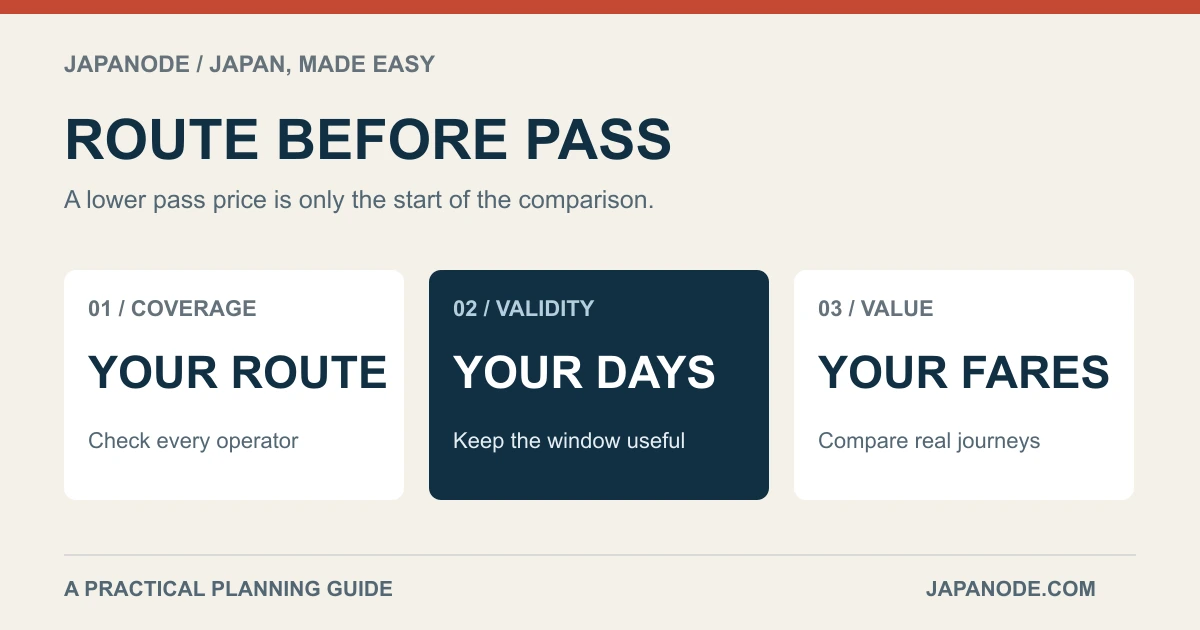
Start with the route you want to travel. Then check the eligible lines, trains, dates and normal fares. A pass should fit the itinerary; the itinerary should not be stretched merely to justify a pass.
The examples below use operator information checked on October 17, 2026. Prices, sales channels and conditions can change. This guide is a selection framework rather than an exhaustive catalogue of every regional ticket.
Choose the Region Before Comparing the Price
| Your planned journey | First product family to investigate | Common mistake |
|---|---|---|
| Kyoto or Osaka plus Hiroshima and Miyajima | JR-West Kansai-Hiroshima | Assuming the Shinkansen from Kyoto is included |
| Tokyo to Kansai through the Hokuriku region | Hokuriku Arch | Treating it as a direct Tokyo–Kyoto Shinkansen pass |
| Multiple longer trips in eastern Japan | Current JR EAST PASS | Using an old Tohoku-only or Nagano/Niigata-only comparison |
| Several destinations in northern Kyushu | Northern Kyushu | Paying for all Kyushu when you stay in the north |
| Longer travel across northern and southern Kyushu | All Kyushu | Counting a train outside the valid map as covered |
An operator's map is more important than a familiar destination name. A city can be served by several railway companies, and a pass may cover only one of the routes to it. A line that appears geographically between two covered places is not automatically included.
For the nationwide alternative, use our JR Pass value guide. Keep the nationwide and regional comparisons separate until you have checked what each actually covers.
Current Examples to Put on Your Shortlist
| Product | Adult example price | Validity example |
|---|---|---|
| Kansai-Hiroshima Area Pass | ¥17,000 | 5 days |
| Hokuriku Arch Pass | ¥35,000 | 7 days |
| JR EAST PASS | ¥35,000 / ¥50,000 | 5 / 10 consecutive days |
| Northern Kyushu Rail Pass | ¥15,000 / ¥17,000 | 3 / 5 days |
| All Kyushu Rail Pass | ¥22,000 / ¥24,000 / ¥26,000 | 3 / 5 / 7 days |
Sources: JR-West Kansai-Hiroshima, Hokuriku Arch, JR EAST PASS and JR Kyushu's pass comparison. JR Kyushu notes that prices through its online booking service can differ; compare the final quote and channel.
These adult figures are not a price list for every traveler. Check child ages, purchase timing, eligibility and any sales-channel difference. Do not assume the age threshold for a railway product is the same as the threshold for a museum or hotel.
Kansai-Hiroshima: Check the Kyoto Connection
This product is a natural candidate when a Kansai stay includes Hiroshima and Miyajima within its valid period. The crucial boundary is that its Sanyo Shinkansen coverage begins at Shin-Osaka. The Tokaido Shinkansen between Kyoto and Shin-Osaka is not part of that coverage.
If you start in Kyoto, compare an included conventional JR connection to Shin-Osaka with paying for a different route. Do not price an itinerary using one train and then assume the pass covers it simply because the endpoints look right.
The JR-West Miyajima Ferry is included in the published product, but separate destination charges still need checking. A pass does not automatically pay every cost of visiting the island. Use the Hiroshima and Miyajima guide to decide whether the outing belongs in your trip and how much time it needs.
One return journey can be more relevant to the calculation than many inexpensive urban rides. Compare the major intercity legs first, then add only smaller journeys you genuinely intend to make.
Hokuriku Arch: For the Route Through Hokuriku
The Hokuriku Arch Pass is a candidate for an itinerary connecting Tokyo and Kansai through the Hokuriku region. It should not be compared as though it were a ticket for the direct Tokaido Shinkansen route.
Choose it only after deciding that the northern route is part of the trip you want. A pass that requires an unwanted detour is not necessarily a saving, even when the covered journeys have a high nominal fare.
Check local excursions separately. Rail coverage toward Kanazawa does not imply that every bus to a mountain village is included. If your plan continues through Shirakawa-go and Takayama, write those bus journeys in a separate column and inspect their operators and reservation requirements.
Also allow enough time at the places between Tokyo and Kansai. Traveling a long way through a region merely to say the pass was used can leave little time for the reason you chose the route.
JR EAST PASS: Use the Current Product
JR East's current product page lists a five-day pass at ¥35,000 and a ten-day pass at ¥50,000, both using consecutive days. Old articles comparing separate Tohoku and Nagano/Niigata products can describe a different product generation.
Check the current map and exceptions before paying. The operator explicitly excludes the Tokaido Shinkansen, and the present product is not a universal ticket for every private railway in eastern Japan.
A series of longer rail journeys can create a different value calculation from a Tokyo stay with only one short excursion. Include the trips you will actually complete within the selected window, then compare individual tickets. If an outing is merely a possibility, calculate the total both with and without it.
Avoid counting a full-fare return journey when your itinerary only travels one way. An open-jaw trip can have substantially less covered travel than a route that returns to its starting point.
Kyushu: Match the North, South or Whole-Island Product
JR Kyushu offers distinct coverage choices. Start by marking your overnight bases and longer train journeys, then choose the smallest relevant area to investigate. A familiar “all” product is not automatically the right default.
Read the exact valid train map, seat-reservation rules and exclusions. Travel between Hakata and another city should be checked against the operator and train you intend to use, rather than assuming every train departing Hakata belongs to the same pass system.
Kyushu can reward a slower itinerary. If you spend several nights in one place, a shorter pass window for the expensive transfer days may make more sense than paying for the longest option. The normal fare for a local journey outside that window can be lower than the price difference between products.
Fit the Validity Window to a Real Itinerary
Our 14-day Japan itinerary shows why a two-week holiday does not necessarily need two weeks of pass validity. On the Hiroshima route, the costly western extension happens near the end of the trip. Tokyo sightseeing and the earlier Tokyo–Kyoto transfer are separate decisions.
Consider the five calendar days from itinerary day 9 through day 13: move to Osaka, continue west via Himeji, spend time in Hiroshima, visit Miyajima and return to Kansai. That is the block to compare with the Kansai-Hiroshima product. If your airport departure is day 14, its rail fare falls outside that five-day window and must be budgeted separately. Starting the pass one day later changes which journey is excluded; calculate both versions.
This is a scheduling example, not a guaranteed saving or a promise that every local service in those cities is covered. The JR-West map and train conditions decide coverage. Local tram rides, non-JR ferries and the Miyajima visitor tax must not be silently added to the covered total.
Why the Alps Route Needs a Different Comparison
The alternative route travels Tokyo–Kanazawa–Shirakawa-go–Takayama–Kyoto. Its shape does not match an arch-shaped rail journey simply because Kanazawa appears in both. The mountain buses and the onward Takayama leg need their own coverage checks. A pass that gets you to Kanazawa but not along the route you intend to take may be less useful than ordinary tickets.
If a pass advertises access to a destination by one corridor, do not assume another corridor is included. Trace the entire journey on the official coverage map, including the connection to your hotel or bus terminal. Compare the itinerary you want, not a replacement route selected to rescue a purchase.
Make a Reservation Checklist Before Paying
Record the pass name, seller, traveler eligibility, start date, collection point and the specific trains you want to reserve. Check whether seat reservations can be made before collection and which confirmation, passport or purchase card must be presented. Those instructions can differ by operator and sales channel.
For a group, check every traveler's eligibility and child fare separately. Confirm the seats before promising that everyone will sit together. An entitlement to travel and an available block of adjacent reserved seats are different things, especially around the New Year travel period.
Use This Break-Even Worksheet
| Journey | Travel date | Normal fare for intended service | Fully covered? | Extra cost |
|---|---|---|---|---|
| Main intercity leg | Your date | Current quote | Yes / no / partly | Quote |
| Return or onward leg | Your date | Current quote | Yes / no / partly | Quote |
| Airport journey | Your date | Current quote | Yes / no / partly | Quote |
| Local excursion | Your date | Current quote | Yes / no / partly | Quote |
The comparison is:
Pass cost + uncovered fares + required extras versus the individual tickets you would otherwise buy.
For an illustrative example, suppose the actual covered tickets you need total ¥23,000 and a suitable pass costs ¥17,000. Before extras, the difference is ¥6,000. If the same planned tickets total ¥15,000, the pass costs ¥2,000 more. These are hypothetical totals, not quoted fares for a named route.
Do not add attractions, buses or surcharges to the covered total unless the terms include them. Do not count optional trips at full value if you are unlikely to take them. Run a second calculation for the more relaxed itinerary; that can reveal whether the pass is encouraging unnecessary movement.
Valid Days, Eligibility and Reservations
A multi-day pass is not necessarily a collection of separate day tickets. Check whether the period is consecutive and when the first and last days begin and end. Avoid activating it for a cheap airport or local journey if that pushes an expensive trip outside the useful window.
Check who can buy the product and which documents must be shown. Conditions differ across operators and products, so a rule remembered from the nationwide pass should not be copied into every regional recommendation.
Included reserved seating still requires obtaining the reservation. It does not promise that your preferred train has seats available. Read the purchase and collection instructions before departure, including where the pass can be received and what is required at the counter or machine.
Our Shinkansen booking guide explains the wider booking decisions. Use the operator's own instructions for the pass-specific steps, especially when booking through a reseller.
When Separate Tickets Are the Better Choice
Separate tickets deserve serious consideration when you have only one long journey, spend most days in one city, cross the pass boundary repeatedly or prefer trains the pass does not cover. They can also make sense when a discounted fare is available for the exact service you want, subject to its conditions.
Use the JR Pass Calculator for the fares and products it actually models, then verify regional coverage independently. Do not treat a nationwide break-even result as proof that a regional ticket works.
Finally, compare the booking experience as well as the yen total. If the saving is small, flexibility, collection requirements and the time spent on different routes may decide the result. The best pass is the one that supports the trip you already want to take.
Make it your trip
Still planning your Japan trip?
Pick the question on your mind. Compare your options, check the details and take one more thing off your list.
Would a JR Pass save you money?
Add your train journeys and compare individual tickets with the nationwide pass. See which costs less for your route.
Calculate my rail costs
Which eSIM fits your Japan trip?
Maps, messages, hotspot use: compare five providers by data allowance, network and plan limits before you choose.
Find my Japan eSIM
How much can you fit into one week?
Connect Tokyo, a Fuji or Hakone day trip, Kyoto and Osaka with a day-by-day route, travel costs and booking advice.
Explore the 7-day routeFrequently Asked Questions
No. A regional pass is useful only when your eligible journeys fit its area and validity period and cost more than the pass. Separate tickets can be better than either option.
Its Sanyo Shinkansen coverage starts at Shin-Osaka. The Tokaido Shinkansen between Kyoto and Shin-Osaka is outside that coverage; use an included conventional JR service or pay separately.
Do not assume that. Many products use consecutive calendar days, and the current JR EAST PASS explicitly uses five or ten consecutive days. Read the exact product terms.
Use it only for the fares and products it actually models. Regional eligibility, covered routes and exceptions still need to be checked against the operator's current map and conditions.

Written by
JAPANODE
Based in Japan, sharing practical travel planning guides for visitors.
You Might Also Like
 Day Trips
Hiroshima and Miyajima in One Day: Tour or DIY?
12 min read
 Transportation
How to Book Shinkansen Tickets in Japan: SmartEX, Seats & Luggage (2026)
12 min read
 Transportation
Is the JR Pass Worth It in 2026? Prices & Break-Even Routes
15 min read
 Transportation
The Complete Guide to Japan's Train System for First-Time Visitors
16 min read