Shodo / The way of writing
A moment,
in ink.
Before it becomes a character, it is a movement. A brush touches paper. Your hand leaves a trace.
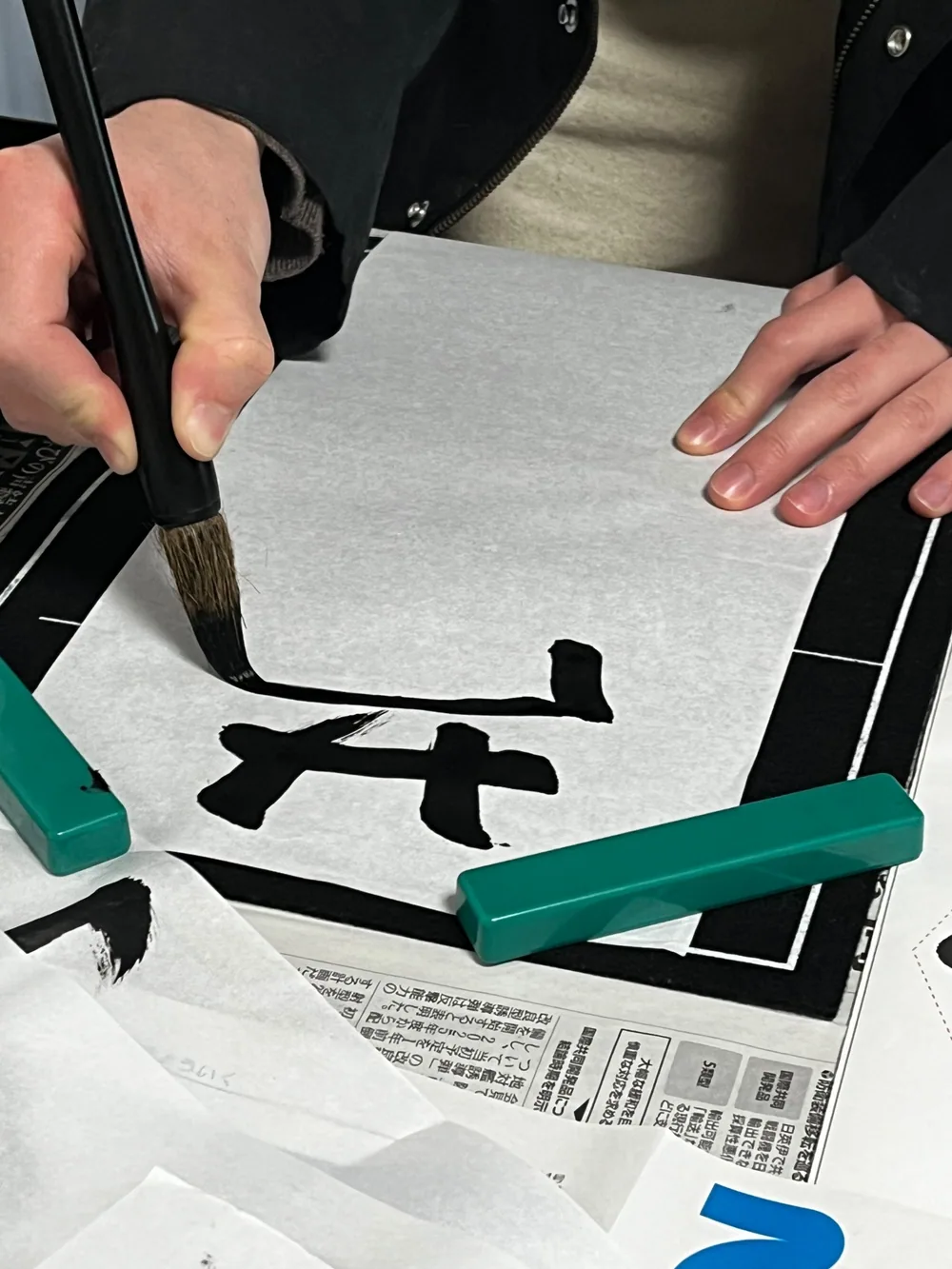
A small world on the desk
Four tools.
A thousand
possibilities.
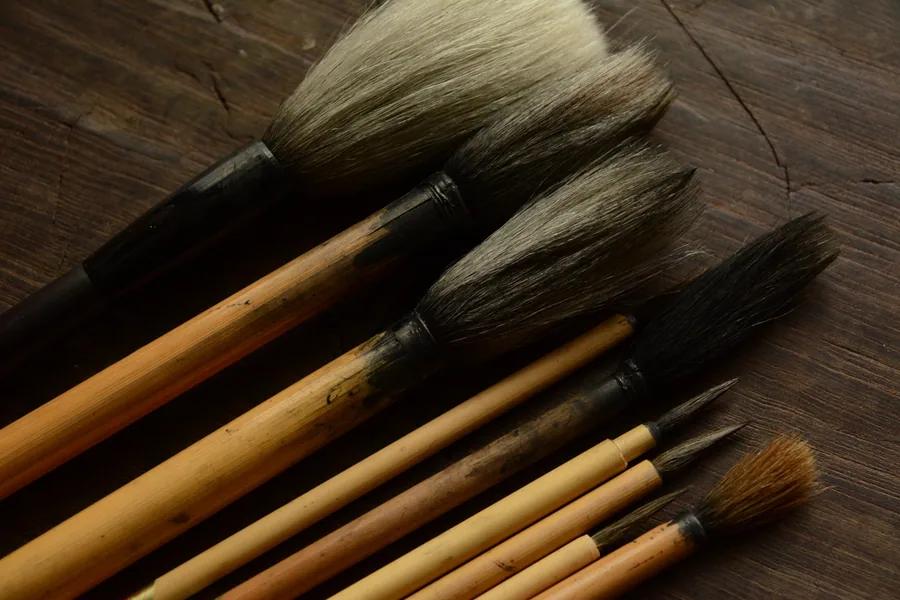
- Fude / 筆
- The brush. Its flexible tip changes the line as the hand moves.
- Sumi / 墨
- The ink. Traditionally made with soot and a binder.
- Suzuri / 硯
- The inkstone. A surface for grinding an inkstick with water.
- Kami / 紙
- The paper. A surface that receives both ink and movement.
Look at a brush before looking at a finished work. The handle is rigid; the tip is not. That small difference changes everything you can ask a line to do.
Pressure gives the bristles room to spread. Lifting brings them together again. A turn of the hand can change a stroke without lifting the brush from the page. What looks like a simple black mark contains a sequence of decisions.
The brush, ink, inkstone and paper are traditionally known as the four treasures of writing. In a contemporary beginner class, liquid ink or a brush pen may join those tools. Ask what you will use if grinding an inkstick is a particular part of the experience you want.
You do not need to buy a set before your first lesson. Handling the materials with a teacher is a better way to discover which part holds your attention: the brush itself, the shape of a character, or the space around it.
A tradition that still moves
From written word
to personal
expression.
Brush writing reached Japan from China, along with the materials needed to practice it. Over time, Japanese calligraphers developed expressions using both kanji, the characters of Chinese origin, and kana, the Japanese phonetic scripts.
The story continues beyond old manuscripts. Children practice writing in school; New Year calligraphy, called kakizome, gives the beginning of a year a visible form. Contemporary exhibitions also include large-character works, poetry and experimental calligraphy.
In other words, the tradition is alive enough to include careful copying and new expression. Your first page belongs at the beginning of that learning process. You are not expected to arrive with a style of your own.
Read the movement
The end of a line
changes its voice.
In regular-script practice, notice how a stroke finishes. Open each study below, then look for the same movement when your teacher demonstrates a character.
Stop / 止め
The brush comes to a deliberate finish. Watch how the teacher settles the tip before lifting. A stop gives the ending weight and definition.
Hook / はね
A change of direction sends the tip outward. The little hook is connected to the stroke before it; watch the transition, not only the final point.
Sweep / 払い
The brush gradually leaves the paper, tapering the mark. Compare the start with the finish: the movement continues as the ink line becomes thinner.
Schematic stroke studies, not complete characters or a substitute for a teacher's demonstration.
Your first sheet
Give yourself
something to notice.
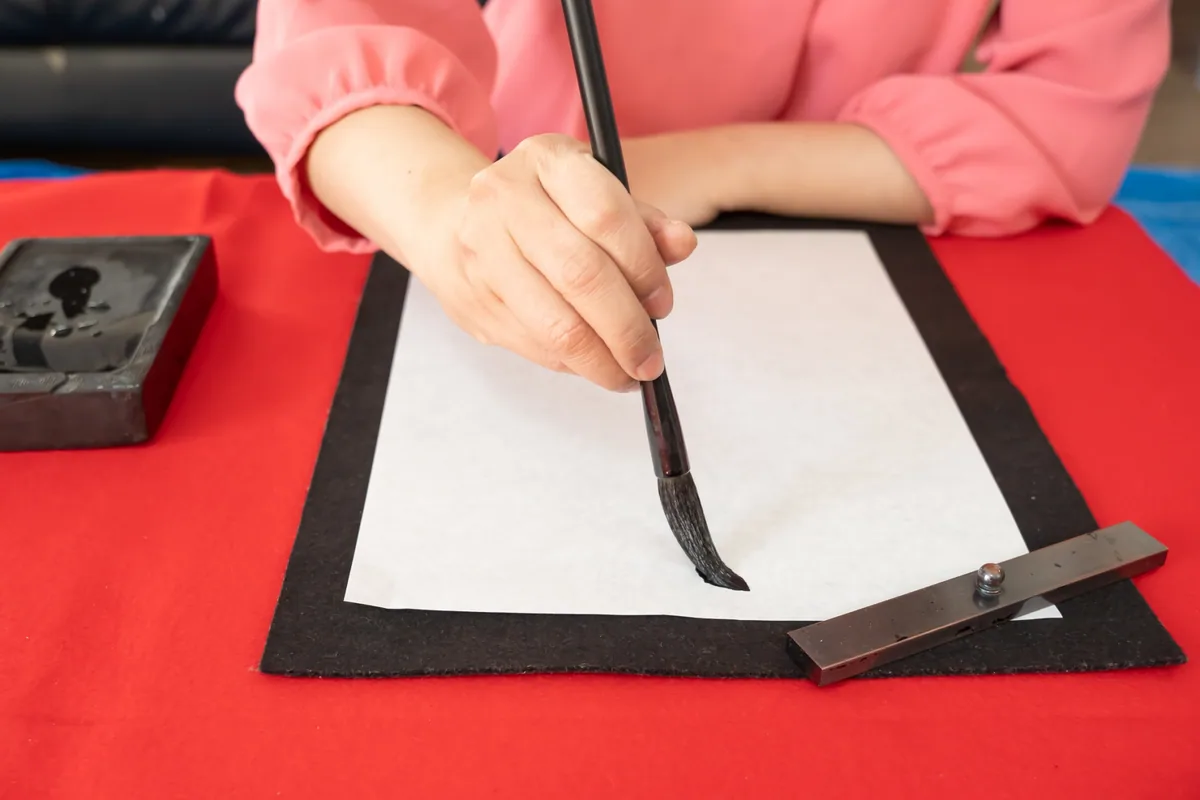
Ink. Space. One red mark.
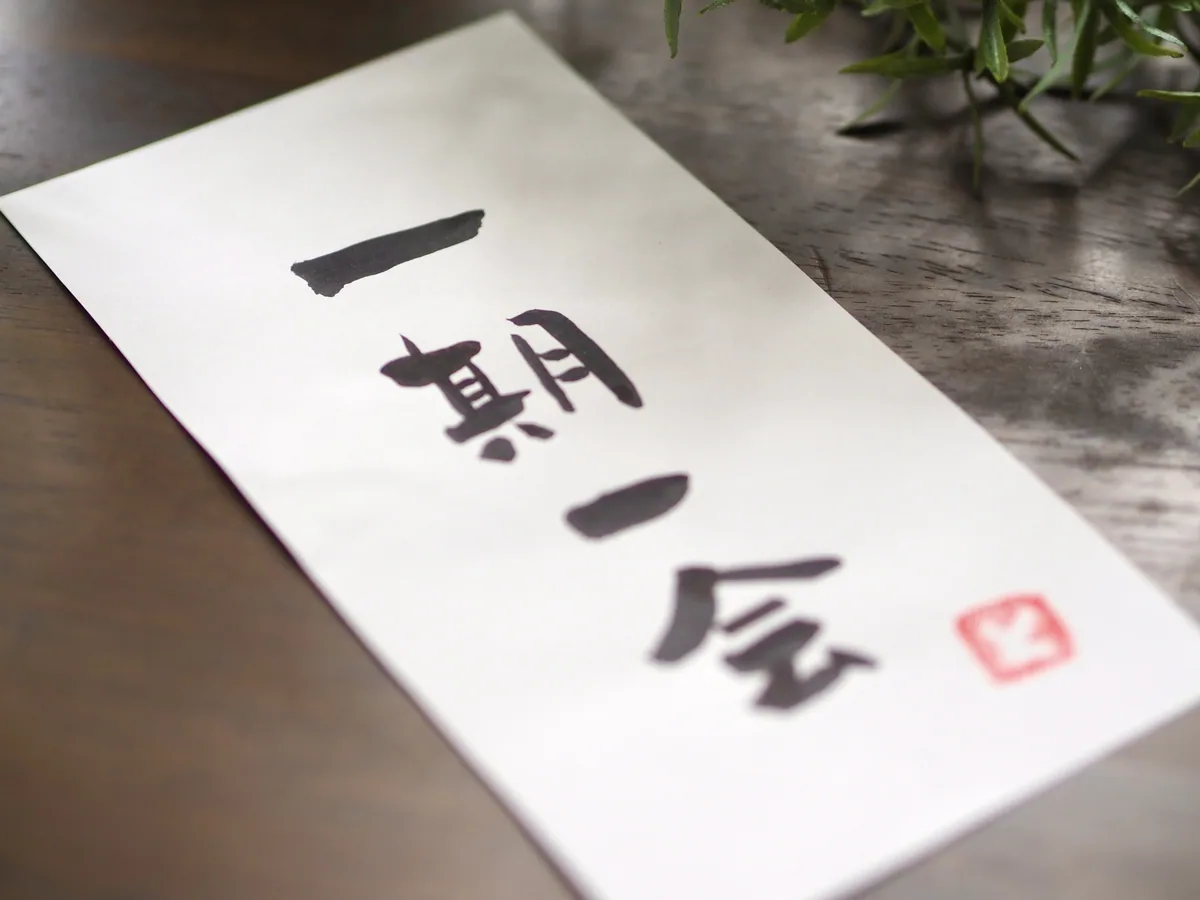
Choose a meaning.
Ask your instructor about a word you would like to carry home. Let them explain its reading, nuance and form before you start copying it.
Watch one stroke.
Follow the order and direction of the demonstration. Try to remember a movement rather than memorize an entire finished shape at once.
Keep an early attempt.
Place it beside a later one. You may notice a different ending, a calmer spacing, or a clearer shape. That difference is a souvenir, too.
“What should I look at in the empty space?” The gaps within a character and around it are part of how the whole sheet is composed.
From the story to your itinerary
One brush.
Two cities.
Try calligraphy in Tokyo or Kyoto. Choose a temple setting, a focused first lesson or a cafe with a playful take on what you bring home.
Kyoto / Calligraphy in a Buddhist temple
Let the setting become part of the memory.
Take the brush into a tatami room at Seigan-ji, a Buddhist temple in central Kyoto. The place you learn becomes part of what you remember.
The current listing describes a 70-minute class, with English instruction offered and a group of up to six. Choose a kanji, practice the basic strokes and finish your work on a shikishi board. A teacher-made key ring featuring your chosen character is also included.
Choose this when the temple setting is part of the appeal. Most seats are floor cushions; desk seating is limited, so confirm arrangements before booking if sitting on the floor is difficult.
The GetYourGuide link is an affiliate link. JAPANODE may earn a commission at no extra cost to you. Check the selected date, inclusions and cancellation terms before booking.
Tokyo / A first lesson in Asakusa
Make your first mark in Asakusa.
A beginner workshop makes the tools tangible. Practice with an instructor, choose your characters and leave with a piece you made.
The current listing describes English instruction, a small group and a session of around 1–1.5 hours, with brushes, a brush pen and a take-home work.
Choose this for patient practice and a personal keepsake. The experience is quiet and detail-focused; it makes sense to leave some unhurried time around it.
Make it part of an Asakusa walk ↗The GetYourGuide link is an affiliate link. JAPANODE may earn a commission at no extra cost to you. Check the selected date, inclusions and cancellation terms before booking.
Tokyo / Our pick for something different
A scroll. A fan. A stamp with your name.
At a calligraphy cafe in Roppongi, your first brushstrokes become things you can keep. This is our pick for a creative twist on the usual workshop.
The current listing describes an 80-minute experience with English instruction. After practice, write on both a hanging scroll and an uchiwa fan to take home the same day. A personalized hiragana name stamp, a tote bag and one drink are included.
The stamp is prepared for you; this is not a stamp-carving lesson. Provide participants' first names in the Latin alphabet when booking so the personalized gifts can be prepared.
Choose this for the pleasure of making a souvenir you can display or use, with a cafe setting and a drink alongside the brushwork.
The GetYourGuide link is an affiliate link. JAPANODE may earn a commission at no extra cost to you. Check the selected date, inclusions and cancellation terms before booking.
A little preparation
Before you go.
Do I need to read Japanese?
These experiences welcome beginners and offer English instruction. Ask the instructor to explain the meaning and reading of your chosen characters. Understanding the word makes the finished piece more personal. Check the language offered for your selected session before booking.
Which setting should I choose?
Choose Kyoto for a class inside a Buddhist temple, Asakusa for a small-group introduction to the tools, or Roppongi for a cafe experience with a scroll, fan and personalized hiragana name stamp. In Kyoto, confirm seating in advance if floor cushions would be uncomfortable.
Will I grind my own ink?
Not every workshop includes ink grinding, and none is presented here as an ink-grinding session. The Asakusa listing includes traditional brushes and a modern brush pen. Confirm the exact tools and activities with your chosen operator if this matters to you.
How do I take the work home?
Ask the instructor how long the ink needs to dry and how the finished work will be packed. Keep it protected from moisture and bending. Check whether a board or protective sleeve is included before relying on it.
Bring home a word.
Remember the movement.