On this page
How much is a hotel in Japan? In our August 30, 2026 snapshot, the cheapest APA Hotel branch we found for one adult on an ordinary December Tuesday was ¥12,510 in Shinjuku, ¥7,700 in Kyoto, ¥6,750 in Osaka and ¥5,400 in Kanazawa. These are examples from a defined search, not citywide averages or prices you can still book today.
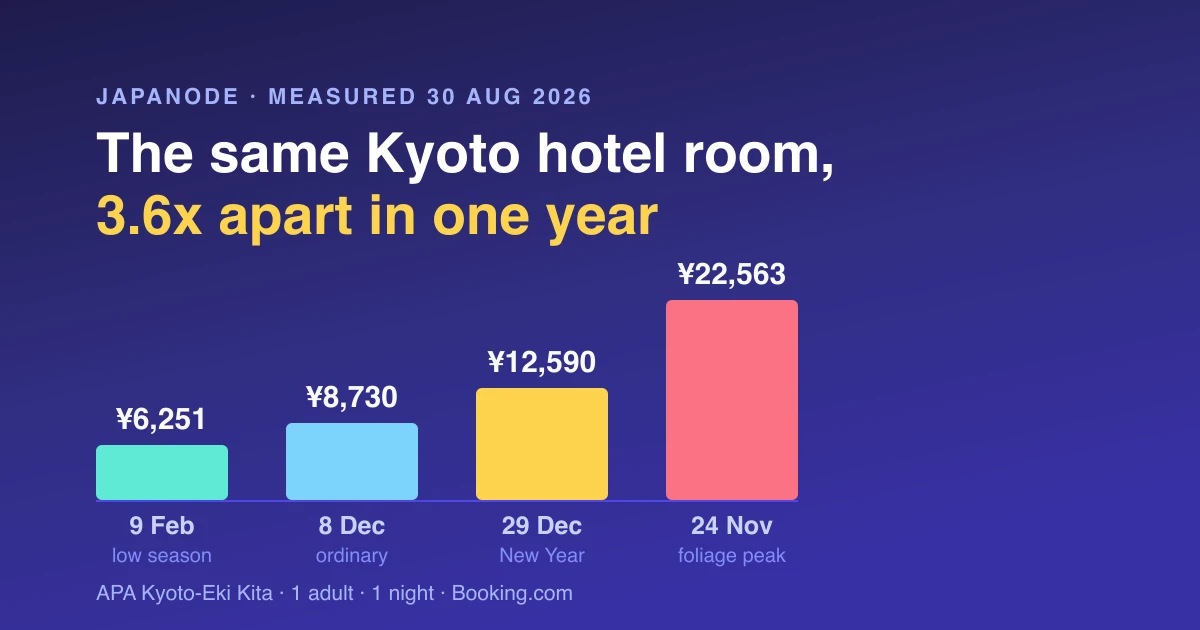
The same Kyoto branch changed from ¥6,251 in February to ¥22,563 during the November foliage week. Before choosing a city or a room type, compare the price for your actual dates. The search below carries your destination, dates, trip length and guest count to Booking.com; check the final room conditions and total there.
On August 30, 2026, we also priced the same hotel chains across four cities and four travel dates, plus hostel dorms and capsule pods for a specific night. The dated tables below show exactly what we compared and where the results have limits.
How We Measured
- Platform: Booking.com, signed out, prices in yen. The three-platform comparison further down also used Rakuten Travel and Jalan.
- Occupancy: one adult, one room, one night, cheapest available rate.
- Dates: Tuesday 24 November 2026 (Kyoto foliage peak), Tuesday 8 December 2026 (ordinary winter weeknight, our baseline), Tuesday 29 December 2026 (New Year), Tuesday 9 February 2027 (low season). All weeknights, to keep the day of the week out of it.
- Properties: every branch of APA Hotel, Toyoko Inn, Super Hotel and Dormy Inn that appeared in each city's search results, so we are comparing the same brands rather than whatever happened to be cheapest.
- Checked: 30 August 2026.
That last line matters more than any number below. Hotel pricing moves daily. Treat the sizes and directions of the gaps as the finding, and the individual yen figures as a snapshot.
Where You Sleep Costs More Than What You Sleep In
Here is the same chain, on the same ordinary Tuesday in December, in four cities.
| Chain | Tokyo (Shinjuku) | Kyoto | Osaka | Kanazawa |
|---|---|---|---|---|
| APA Hotel — cheapest branch listed | ¥12,510 | ¥7,700 | ¥6,750 | ¥5,400 |
| APA Hotel — dearest branch listed | ¥17,010 | ¥12,420 | ¥9,900 | ¥7,920 |
| Toyoko Inn | ¥11,550 | ¥7,031 | — | ¥6,143 |
| Super Hotel | ¥15,763 | — | ¥9,072 | ¥7,805 |
| Dormy Inn | — | ¥19,000 | — | ¥10,000 |
The same brand cost 2.3 times more in Shinjuku than in Kanazawa. Not a nicer room, not a different category — the same standard single, twelve hours apart on the map.
And in Shinjuku that night, none of those four chains had anything under ¥11,550. That is more than double the ¥5,000 floor of the range every guide quotes for "business hotel."
The comparison that should change your itinerary
We also priced every hostel dorm bed and every capsule pod on sale in Tokyo for that same night.
| What you get | One night, one adult |
|---|---|
| Tokyo hostel dorm bed — a bunk in a shared room | ¥4,265 (median of 20) |
| Tokyo capsule pod | ¥4,950 (median of 20) |
| Kanazawa business hotel — private room, private bathroom | ¥5,400 |
A bunk in a shared Tokyo dorm is about ¥1,100 less than a private room with your own bathroom in Kanazawa. The pod is ¥450 less.
This is the finding worth acting on. If you are trying to bring a Japan trip in under budget, moving a night out of central Tokyo does more than downgrading what you sleep in — and it does it without putting you in a bunk.
Book the nights you genuinely need in central Tokyo first and accept the price. Take your comfort upgrades everywhere else, because that is where the same money buys a materially better room. Doing it in the other order is how people end up in a capsule for a week and still over budget.
When You Go Moves the Price More Than Where
Now the same Kyoto branches, across four dates.
| Kyoto branch | 9 Feb (low) | 8 Dec (ordinary) | 29 Dec (New Year) | 24 Nov (foliage) | Swing |
|---|---|---|---|---|---|
| APA Kyoto-Eki Horikawadori | ¥5,808 | ¥8,460 | ¥11,111 | ¥20,081 | 3.5x |
| APA Kyoto-Eki Kita | ¥6,251 | ¥8,730 | ¥12,590 | ¥22,563 | 3.6x |
| APA Kyoto-Ekimae | ¥6,999 | ¥12,420 | ¥12,420 | ¥22,955 | 3.3x |
| APA Kyoto-Eki Higashi | ¥9,180 | ¥10,350 | ¥14,670 | ¥26,948 | 2.9x |
| APA Kyoto Gojo-Omiya | ¥6,144 | ¥7,700 | ¥12,863 | — | 2.1x |
| Toyoko Inn Kyoto Nijojo-minami | — | ¥7,031 | ¥8,984 | ¥22,050 | 3.1x |
| Dormy Inn PREMIUM Kyoto-Ekimae | ¥14,500 | ¥19,000 | ¥24,500 | — | 1.7x |
The same Kyoto room ran from ¥5,808 to ¥22,563 depending only on which week you show up. That is a bigger multiplier than the gap between a capsule pod and a five-star suite in most of the world.
Tokyo swings too, but only about half as hard.
| Shinjuku branch | 9 Feb | 8 Dec | 24 Nov | 29 Dec (New Year) | Swing |
|---|---|---|---|---|---|
| APA Shinjuku-Gyoemmae | ¥13,680 | ¥15,930 | ¥20,520 | ¥27,270 | 2.0x |
| APA Higashi-Shinjuku Ekimae | ¥12,510 | ¥13,770 | ¥15,930 | ¥22,770 | 1.8x |
| APA Shinjuku Kabukicho Tower | ¥13,680 | ¥15,930 | ¥19,350 | ¥25,020 | 1.8x |
| APA Nishi-Shinjuku Gochome Tower | ¥12,510 | ¥12,510 | ¥14,760 | ¥20,520 | 1.6x |
| Super Hotel Shinjuku-Kabukicho | — | ¥15,763 | ¥16,801 | ¥22,816 | 1.5x |
| Toyoko Inn Shinjuku-Kabukicho | ¥11,550 | ¥11,550 | ¥13,650 | — | 1.2x |
Kyoto's swing is roughly twice Tokyo's. Tokyo has enough year-round business demand to keep a floor under its rates. Kyoto's demand is seasonal, so its prices are free to collapse in February and spike in November.
For About a Week, Kyoto Costs More Than Shinjuku
Look at 24 November against 8 December in the two tables above and the ranking flips.
| Cheapest APA branch | 8 Dec (ordinary) | 24 Nov (foliage peak) |
|---|---|---|
| Tokyo (Shinjuku) | ¥12,510 | ¥14,760 |
| Kyoto | ¥7,700 | ¥20,081 |
| Which city is dearer | Tokyo, by 1.6x | Kyoto, by 1.4x |
On an ordinary weeknight, Shinjuku costs 1.6 times what Kyoto costs. During foliage week, Kyoto's cheapest branch of that chain costs 36% more than Shinjuku's — and Kyoto's dearest ran ¥26,948 against Shinjuku's ¥20,520.
"Tokyo is the expensive one" is true for roughly fifty weeks of the year and badly wrong for the other two. If your trip lands in mid-to-late November, plan your Kyoto nights first and your Tokyo nights second, which is the reverse of how almost everyone sequences a Japan itinerary. Our Japan autumn leaves guide has the regional timing if you are trying to catch colour without paying peak for it.
Every City Peaks on a Different Date
This is the other thing a single national range destroys.
- Kyoto's most expensive night of the four we tested was 24 November — foliage.
- Tokyo's most expensive night was 29 December — New Year.
In Kyoto, New Year was cheaper than foliage week at every branch we could compare: ¥11,111 against ¥20,081, ¥12,590 against ¥22,563, ¥8,984 against ¥22,050. The received wisdom that New Year is Japan's most expensive week is a Tokyo observation that does not travel.
There is usually a version of your itinerary that dodges each city's own peak rather than trying to dodge one national high season. A late-November trip that puts Kyoto early and Tokyo late, or vice versa, can land both cities off their spike. Price your route in two orders before you book anything, and use the JR Pass Calculator to check that the reordered route still pays for the rail pass you were planning on.
No Booking Platform Wins Reliably
The standard advice is that Japanese platforms undercut international ones by 10–20%. We priced eight Shinjuku hotels on the same night across Rakuten Travel, Jalan and Booking.com, signed out of all three.
| Hotel | Rakuten Travel | Jalan | Booking.com | Cheapest | Spread |
|---|---|---|---|---|---|
| Hotel Listel Shinjuku | ¥9,300 | ¥10,500 | ¥10,500 | Rakuten | 11.4% |
| Super Hotel Shinjuku-Kabukicho | ¥14,000 | ¥14,000 | ¥15,763 | tie | 11.2% |
| Nishitetsu Inn Shinjuku | ¥17,820 | — | ¥16,038 | Booking.com | 10.0% |
| Keio Presso Inn Shinjuku | ¥17,480 | — | ¥19,044 | Rakuten | 8.2% |
| APA Shinjuku-Gyoemmae | ¥15,840 | ¥15,133 | ¥15,930 | Jalan | 5.0% |
| APA Higashi-Shinjuku Kabukicho Tower | ¥13,590 | — | ¥13,680 | Rakuten | 0.7% |
| APA Nishi-Shinjuku Gochome Tower | ¥12,420 | — | ¥12,510 | Rakuten | 0.7% |
| Shinjuku Washington Annex | ¥18,700 | — | ¥18,576 | Booking.com | 0.7% |
Six to the Japanese platforms, two to Booking.com — one of those by 10%. The "10–20% cheaper" rule held in three cases out of eight. Three others landed under 1% apart, which is noise.
Two patterns are usable. APA priced within 0.6–5% everywhere, so for tightly price-controlled chains the cross-check earns you almost nothing. The wide gaps showed up at independents and smaller chains, where each platform negotiates its own allocation. If you are booking a big chain, book wherever you like. If you are booking anything else, open three tabs.
Use the live search near the top of this guide to check Booking.com for your dates, then cross-check Rakuten Travel and Jalan if you choose an independent hotel or smaller chain. That is where we found the gaps worth chasing.
What the Sticker Price Is Hiding
Three things surfaced while we were collecting the numbers, and all three cost real money.
1. That price already includes a service charge — but not the accommodation tax. Every Booking.com rate we opened was labelled "consumption tax 10% and property service fee 10% included, city tax excluded." The local accommodation tax is collected at check-in on top of everything quoted, and in Kyoto's tiered system it can run into thousands of yen a night at the upper end. Our tourist taxes guide has the city-by-city rates.
2. Booking.com quoted us two different prices for the same room minutes apart. Super Hotel Shinjuku-Kabukicho's non-smoking twin showed ¥15,763 on the search results page and ¥16,593 on the hotel's own page, in the same session. Price the room on the page you will actually book from, not the one you found it on.
3. Rakuten and Jalan points are not equivalent, and the gap is enormous. Both quoted Super Hotel at exactly ¥14,000. Jalan's online-payment plan returned 1,400 points — 10%. Rakuten returned 127 — 1%. On identical prices, that is the entire decision. Points only count if you already shop in that ecosystem, so this is worth nothing to most visitors and worth 10% to anyone who lives here.
What to Actually Budget in 2026
Using the measurements above, per person per night, cheapest available:
| Low season (Feb) | Ordinary weeknight | City's own peak | |
|---|---|---|---|
| Tokyo business hotel | ¥11,500–13,700 | ¥12,500–17,000 | ¥20,500–29,500 |
| Kyoto business hotel | ¥5,800–9,200 | ¥7,700–12,400 | ¥20,000–27,000 |
| Osaka business hotel | — | ¥6,750–9,900 | — |
| Kanazawa business hotel | — | ¥5,400–10,000 | — |
| Tokyo hostel dorm | — | ¥3,250–8,800 (median ¥4,265) | — |
| Tokyo capsule | — | ¥2,660–7,450 (median ¥4,950) | — |
| Osaka capsule | — | ¥2,700–6,930 (median ¥4,600) | — |
Budget ¥4,000–5,000 for a Tokyo dorm bed, not the ¥2,500 that still circulates. Not one Tokyo dorm was available under ¥3,000 on our date, and six of twenty were over ¥5,000 — UNPLAN Shinjuku, a genuinely good hostel, priced at ¥6,598, which is business hotel money in Kanazawa.
Six Rules That Fall Out of the Data
- Price the city before the room type. A 2.3x city gap beats any saving from downgrading your accommodation.
- Price the week before the city. A 3.6x seasonal swing beats the city gap.
- Check each city's own peak, not one national high season. Kyoto peaks at foliage, Tokyo at New Year.
- If your trip is mid-to-late November, book Kyoto first. It is the expensive city that week, not Tokyo.
- Cross-check platforms on independents, skip it on big chains. APA landed within 0.6–5% everywhere; the gaps live at smaller properties.
- Add the accommodation tax to every quote you compare. It is excluded from all three platforms' headline prices.
If you want the difference between a ryokan, a minshuku, a shukubo and a capsule before you decide what you are pricing, our accommodation types guide covers what each one is actually like. Families of four should also compare the exact beds, not only the nightly price, because “sleeps four” can mean four fixed beds, sofa beds, or two children sharing. If you are still shaping the route these prices apply to, start with the 7-day first-timer itinerary.
Method and Limits
Four cities, four dates, one occupancy, three platforms, checked on 30 August 2026. We priced every branch of four business hotel chains that appeared in each city's search results, plus all twenty hostel dorms and all twenty capsule properties Booking.com listed in Tokyo for 8 December 2026 and nine capsule properties in Osaka.
What this is not: we did not test logged-in member rates, which can move all three platforms; we did not test weekends, since every date was a Tuesday; and four dates cannot describe a whole year. Osaka and Kanazawa were priced on the baseline date only, so their seasonal swings are unmeasured — we would expect Kanazawa to behave like Kyoto rather than Tokyo, but we have not checked.
Rates change daily and yours will differ. The multiples — 2.3x between cities, 3.6x across seasons, the November reversal — are the part we would expect to reproduce.
Make it your trip
Still planning your Japan trip?
Pick the question on your mind. Compare your options, check the details and take one more thing off your list.

Which eSIM fits your Japan trip?
Maps, messages, hotspot use: compare five providers by data allowance, network and plan limits before you choose.
Find my Japan eSIM
What should your travel insurance cover?
Compare medical cover, cancellation and activity limits across five options, with the exclusions worth checking.
Compare cover & limitsWould a JR Pass save you money?
Add your train journeys and compare individual tickets with the nationwide pass. See which costs less for your route.
Calculate my rail costsFrequently Asked Questions
It depends far more on the city and the date than on the type of hotel. Measuring the same business hotel chains on an ordinary Tuesday in December 2026, the cheapest branch ran about 12,500 yen in Shinjuku, 7,700 yen in Kyoto, 6,750 yen in Osaka and 5,400 yen in Kanazawa. The same Kyoto branches rose above 20,000 yen during autumn foliage week and fell below 6,500 yen in February.
Usually, but not always. On an ordinary December weeknight the cheapest APA branch in Shinjuku cost about 1.6 times the cheapest one in Kyoto. During Kyoto's autumn foliage peak that reversed: Kyoto's cheapest APA was around 20,000 yen against roughly 14,800 yen in Shinjuku. For about a week each November, Kyoto is the more expensive city.
In our measurements, early February was the cheapest date tested in both Tokyo and Kyoto. A Kyoto branch that cost about 22,600 yen during foliage week cost about 6,250 yen in February — roughly a third of the price for the same room.
Not reliably. Across eight Shinjuku hotels priced on the same night, the Japanese platforms were cheaper for six and Booking.com was cheaper for two, once by 10 percent. Three of the eight came in less than one percent apart. The cheapest platform changes by property, so check all three rather than assuming one wins.
It includes the 10 percent consumption tax and, at many hotels, a 10 percent property service charge. It does not include the local accommodation tax, which is collected at check-in. Every rate we checked was labelled consumption tax and service fee included, city tax excluded.
Barely. The median Tokyo capsule pod we priced was about 4,950 yen and the median Tokyo hostel dorm bed about 4,265 yen, against 5,400 yen for a private business hotel room with a private bathroom in Kanazawa. On a multi-city route, moving a night out of central Tokyo saves more than downgrading the room type.

Written by
JAPANODE
Based in Japan, sharing real travel tips & local insights for visitors. Follow us on Instagram @thejapanode for daily Japan content.
You Might Also Like
 Planning
Japan Autumn Leaves 2026: Forecast & Booking Guide
11 min read
 Itinerary
7-Day Japan Itinerary for First-Timers: Tokyo, Hakone, Kyoto & Osaka (2026)
20 min read
 Planning
Japan Accommodation Types Explained: Hotels, Ryokan, Capsule Hotels & More
16 min read
 Planning
Japan Tourist Taxes 2026: What You'll Actually Pay
15 min read
 Planning
First Time in Japan: 15 Things You Need to Know Before You Go
19 min read