On this page
Build your Arashiyama autumn day around one reserved train ride, then choose the gardens that fit around it. The Sagano Romantic Train is an optional scenic experience, not the transport you need to reach Arashiyama. You can still have a worthwhile day if reservations are unavailable.
The most useful distinction is between the sightseeing railway, the ordinary JR line and the walking area around the temples. Their stations have similar names, but they serve different purposes. Once you understand the connections, a one-way scenic ride becomes easier to plan than a complicated round trip.
This guide covers a daytime circuit, the 2026 illuminated train and a garden-only alternative. For other districts, use our Kyoto autumn leaves guide; for a broader stay, see the four-day Kansai itinerary.
My June Ride: Finish in Arashiyama for Cafes and a Walk
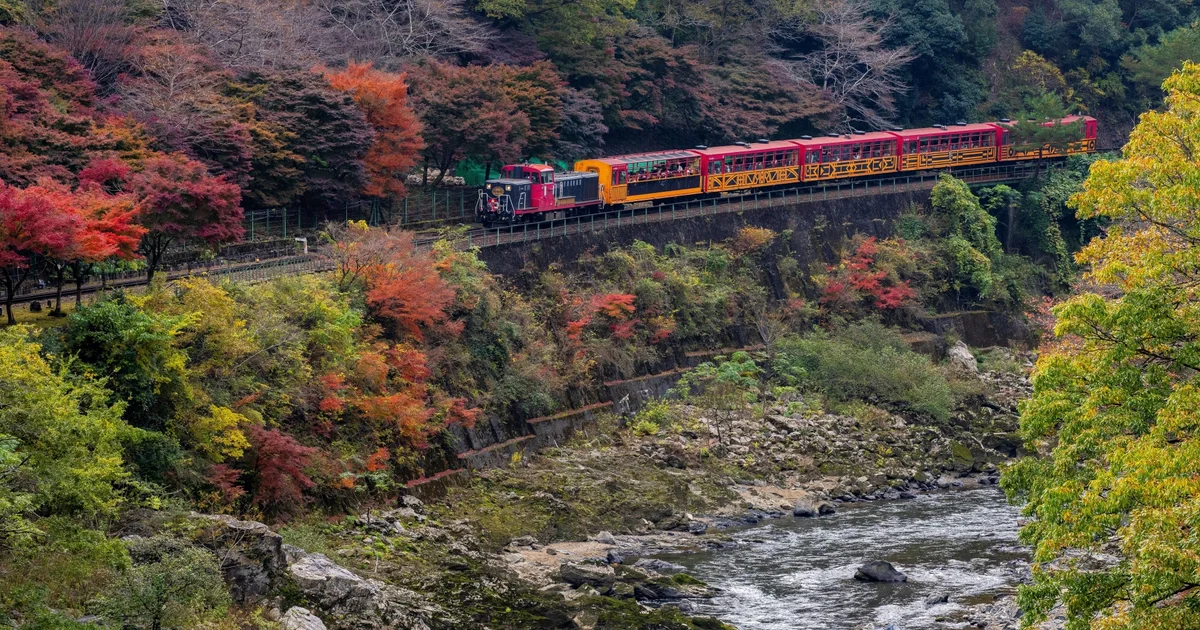
I rode the Sagano Romantic Train around June, starting at the Kameoka end and heading toward Arashiyama. It was outside the autumn foliage season, and I still thoroughly enjoyed the views from the window. For our family, the ride was a good length for traveling with children: there was plenty to look at, and they enjoyed it without getting bored.
After reaching Arashiyama, we went to a cafe and spent time walking around before heading back. That combination worked well for us: a scenic train ride followed by a relaxed outing, rather than making the railway the whole day. If you want cafes and a stroll after the train, finishing on the Arashiyama side is a useful choice.
I also remember that the view felt different depending on the side of the carriage. Some stretches offered more river scenery; others spent longer beside the hillside, with fewer open views. I cannot reliably remember which side we sat on, so the seat advice below comes from checked traveler reviews and the operator's information, rather than a claim about my own seat.
The reverse direction can suit a different mood. The immediate Torokko Kameoka area is a quieter, more rural endpoint, rather than another busy Arashiyama-style sightseeing center. Consider it for a slower local atmosphere, a separately planned boat connection or a JR return. Kameoka has its own attractions, but check their location and onward transport rather than assuming they are beside the train terminus. The station's official page also lists a cafe and a souvenir shop.
My experience above is from a ride around June, not an autumn visit. The photographs in this guide are separate reference images and are not presented as photographs of that family trip.
Choose Your Arashiyama Autumn Experience
| Your priority | Best starting plan | Main booking decision |
|---|---|---|
| Gorge scenery and a first Arashiyama visit | One scenic train ride plus one temple garden | Reserve the scenic train; use ordinary JR for the other direction |
| Gardens and unhurried photography | Tenryu-ji, one smaller temple and the river | Skip the train if its departure would rush your day |
| Evening illumination | Gardens in daylight, a break, then a confirmed evening train | Check the actual operating date and departure, not just the event period |
| Visiting with uncertain weather or energy | Keep the garden route flexible | Avoid stacking several fixed departures into one day |
A bamboo-grove photograph, a garden visit and a gorge ride offer different experiences. Give the part you care about most the best time of day. The bamboo grove itself is evergreen; maple color comes from other trees and surrounding gardens, so a crowded bamboo path is not a substitute for choosing a foliage spot.
When to Go: Typical Season, 2026 and Previous Years
The Sagano Railway's official FAQ describes the usual autumn-color period as mid-November to early December, while emphasizing that it changes with the weather. This is a broad planning window, not a guarantee for every garden or every day along the gorge.
On October 11, Kyoto's English foliage calendar still displayed its completed 2025 season. Read the year and observation date before treating a colorful photograph or “best viewing” label as current. Check Arashiyama-area entries when the new season's updates begin.
What Can the 2023–2025 Comparison Tell You?
Kyoto's JMA sample-tree maple observations fell on December 13 in 2023, December 20 in 2024 and December 10 in 2025. The October 1 forecast for 2026 is December 11. These are city sample-tree markers, not measured peak dates for Arashiyama or the Sagano gorge.
Sources: JMA's historical maple record, page 8, and JMC's October 1, 2026 forecast. Their value is showing that autumn timing varies. They cannot justify booking a particular garden for December 11 or concluding that November visitors will be too early.
For a fixed trip, reserve the experience you would enjoy even with mixed green, yellow and red leaves. For a flexible trip, use recent reports from the actual garden or railway corridor, then check seat availability. We do not have a consistent three-year series of Arashiyama garden peak dates to present as an exact comparison.
Understand the Stations before Booking
The sightseeing stations use Torokko in their names. Ordinary JR services use the JR Sagano Line. An online map search for “Arashiyama Station” can also bring up other railway companies, so save the full station name on your booking.
| Station | Role in the trip |
|---|---|
| JR Saga-Arashiyama | Ordinary JR access from Kyoto and a convenient base for the walking area |
| Torokko Saga | Sightseeing-train terminal beside JR Saga-Arashiyama |
| Torokko Arashiyama | Sightseeing stop nearer the bamboo-grove side; different from the JR station |
| Torokko Kameoka | Other end of the sightseeing line; connect on foot to JR Umahori |
| JR Umahori | Ordinary JR connection for returning toward Saga-Arashiyama or Kyoto |

The official Kameoka station page gives the walk to JR Umahori as approximately ten minutes. Allow extra time to find the entrance, buy a ticket if needed and reach the correct platform. JR Kameoka is not the station at the sightseeing railway's endpoint.
For access from central Kyoto, compare the rail routes in Kyoto City's Arashiyama access guide. Your accommodation location matters: Kyoto Station is a useful JR starting point, but a traveler near a Hankyu station may approach the district differently.
Look Out for the Shigaraki Pottery Tanuki
One small detail I would encourage you to photograph is the family of large pottery tanuki, or Japanese raccoon dogs, along the route. The operator identifies them as Shigaraki pottery on the platform at Torokko Hozukyo Station in its official station guide. Watch for them as your train calls there, with your camera ready if they are visible from your seat.

The official FAQ says that after getting off at an intermediate station, you cannot board again with the same ticket. If you intend to continue, photograph the tanuki from aboard when possible instead of stepping off for a photo. You can choose to end a Kameoka-to-Saga ride at Torokko Arashiyama for the bamboo-grove area, but you then give up the remaining segment. If planning separate train journeys, arrange the additional ticket and departure in advance; do not assume a later seat will be available.
Booking the Sagano Romantic Train
Use the operator's ticket page to enter the official reservation system. Sales normally open at 00:00 Japan Standard Time on the same date one month before travel; check the operator's exception rule when the previous month has no equivalent date.
For a simple circuit, reserve a one-way journey and use JR for the other direction. The operator sells each direction separately. Confirm the date, boarding station, destination and departure before paying, especially when comparing services in opposite directions.
The standard adult one-way fare is ¥880, checked in the official reservation listing on October 11, 2026. The full terminal-to-terminal ride takes about 25 minutes. Bundles and third-party options have their own totals and conditions, so compare the final booking price for your chosen journey.
For official online bookings, display the E-ticket on your smartphone to station staff. A printed booking confirmation alone does not work as a boarding ticket; the QR code is displayed on the travel day. Keep enough phone battery for the journey. The operator's FAQ explains the process; if booking through Klook, follow the specific electronic-ticket instructions issued with that booking.
The sightseeing train is not included in the Japan Rail Pass. Check the current fare in the official booking flow instead of assuming it is covered because you arrived on JR. Our JR Pass calculator can help with the wider intercity itinerary; it does not turn this separate railway into an included ride.
Book a Train Ticket for Your Own Itinerary
If you prefer booking through an English-language travel platform, the Klook option below offers a one-way train ticket, with directions from Saga to Kameoka or Kameoka to Saga. Choose the direction that fits your garden visit and JR connection. Check your exact departure, seat information and cancellation terms before paying; availability for the additional illuminated trains must be checked separately.
Klook is a major travel-booking platform with a substantial presence across Asia-Pacific; its regional impact report describes its scale. You can review this ticket and its booking conditions in English. Check the final price and confirmation details for your selected departure before paying.
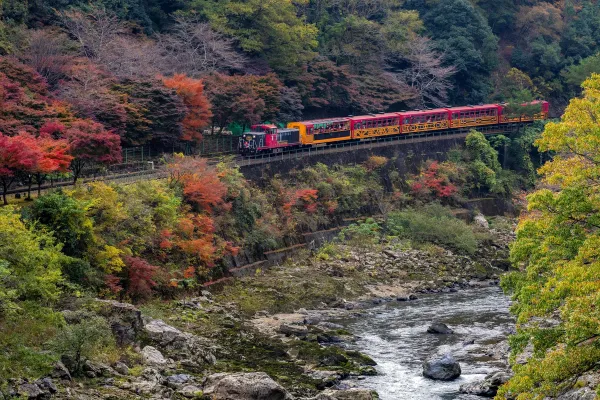
Sagano Romantic Train — One-Way Ticket on Klook
Build your own garden day around one scenic ride
Best for
Independent travelers who want a train ride with their own walking route.
Before booking
One-way travel only. Your JR return, temple visits and any boat ride are separate; check evening-train availability.
Why it may fit
Reserve the scenic railway separately and build your own Arashiyama garden day around it. Select Saga to Kameoka or the reverse direction.
Seats, Weather and Accessibility
Ordinary seats are reserved. The operator may offer a limited number of same-day standing tickets when seats have sold out, but these are a fallback with uncertain availability. Do not build an entire day around obtaining one.
For the current 2026 train, the open-air Rich carriage has no glass windows and can get wet in rain. Choose it for that exposure if you want it, not because it is automatically the comfortable option. The operator's FAQ says umbrellas cannot be used aboard, and rain does not allow a refund or a same-day seat or train change. Cancellation deadlines can differ by seller: the checked Klook single-ticket listing gives 48 hours' notice, while the official standard booking policy gives until 11:59 p.m. the day before boarding, subject to product-specific terms.

Torokko Arashiyama has a substantial stair approach. Travelers needing easier access should check boarding at Torokko Saga and discuss their requirements directly with the operator. A bookable seat alone does not confirm that every station or connection suits a wheelchair or stroller.
Which Side to Choose: Traveler Reviews and the Seat Map
A recurring suggestion in the Tripadvisor seating discussion and the traveler reviews we checked is to favor the following side for river views. Left and right here mean facing the direction the train is traveling, not facing forward from your particular seat.
| Direction | A recurring traveler preference |
|---|---|
| Torokko Saga / Arashiyama → Torokko Kameoka | Right-hand side |
| Torokko Kameoka → Torokko Arashiyama / Saga | Left-hand side |
The same reviews give reasons to keep expectations realistic. A May 2026 visitor reported a long stretch facing rock; an April 2026 visitor riding from Kameoka still enjoyed the right-hand side, while noticing a little more river view across the carriage. Some travelers value the scenery and atmosphere, while others feel the banks, tunnels or limited window view make the ride less rewarding. These are individual observations, not a survey proving that one side is always better.
The views change along the route, so treat the table as a preference when suitable seats are available. It is not a promise of uninterrupted river scenery. The operator's seat guidance in its FAQ identifies A and D as window seats in the current layout. Use the current seat map to confirm your carriage, side and whether you face the direction of travel; those are separate choices. Recheck this advice when the new trains enter service.
A Practical Daytime Train and Garden Route
This is a suggested sequence, not a promise that every departure connects neatly. Book the scenic ride first, then choose a manageable amount of walking around it.
Option A: Train First, Gardens after Lunch
To follow the direction of my June ride, take ordinary JR toward Umahori, walk to Torokko Kameoka, then ride the scenic train toward Arashiyama. Choose Torokko Arashiyama if you want to end your ride near the bamboo grove and can manage its stairs, or continue to Torokko Saga for the JR station area. End your train journey before going out for cafes and a walk; the same ticket does not let you reboard afterward.
Another workable circuit is to board at Torokko Saga, ride to Torokko Kameoka, then walk to JR Umahori and return by ordinary JR to Saga-Arashiyama. Both patterns bring you to the Arashiyama walking area for lunch and gardens without a second scenic-train reservation. Allow enough time to reach your first boarding station.
Choose Tenryu-ji as the main garden, then decide whether to continue toward the bamboo grove or the river. Add another paid temple only if its last-entry time and your walking pace make sense. Returning from the scenic ride later than expected should reduce the optional sightseeing, not your meal break.
Option B: Gardens First, Train Later
Start with a garden visit, eat lunch and leave a clear buffer before the reserved train. Boarding at Torokko Saga gives you a straightforward station meeting point; boarding at Torokko Arashiyama needs a deliberate walk to that station and its stairs.
After the one-way ride, connect through JR Umahori for Kyoto. This avoids returning to the same gardens just to retrieve something you left behind. Carry only what you need, or choose a storage location you can reach again on your actual route. See our luggage storage guide for the tradeoffs.
Do not add a boat return simply because a package photograph shows one. The Hozugawa boat operator has its own sailing arrangements and operating conditions. Check its current schedule and transfer instructions separately, particularly if considering a later train.
A Coordinated Train and Hozugawa Boat Day
For travelers who want both the railway and river journey arranged together, the Klook tour below combines the Sagano train, Hozugawa boat ride and time in Arashiyama. The checked listing gives a 9:00 a.m. departure and a duration of about 6 hours 45 minutes. Confirm the meeting point, transport, language arrangements and exact inclusions for your selected option.
Choose the date for the scenery you most want to see: the railway's usual foliage window is mid-November to early December, but the gorge and temple gardens can peak at different times. Booking photographs show seasonal possibilities, not the color guaranteed on your date.
The listing says high river levels or other conditions can cancel the boat ride and change part of the itinerary; suspension of the train cancels the entire tour. Any road transfers can also face autumn congestion, while queues and conditions at the stops can affect timings. Check the provider's disruption and refund arrangements, and allow room for a later finish before reserving dinner or onward transport.
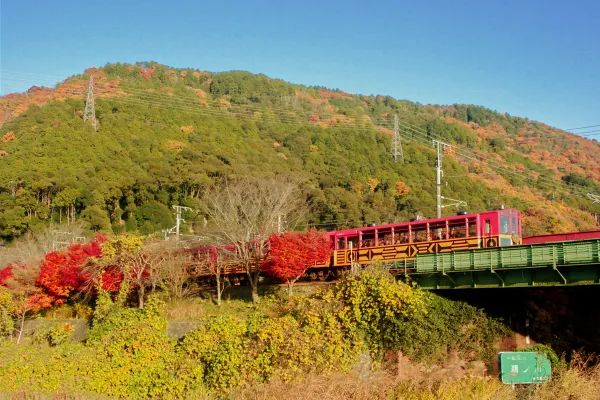
Sagano Train, Hozugawa Boat Ride & Arashiyama on Klook
See the Hozu gorge by train and boat
Best for
Travelers who want both scenic journeys coordinated in one booking.
Before booking
A longer, more structured day. River conditions can change the boat portion, and delays can affect the finish time.
Why it may fit
A coordinated sightseeing day for travelers who want the gorge by train and boat, plus time in Arashiyama. Compare the selected itinerary with the independent JR-return route above.
These are affiliate links: JAPANODE may earn a commission if you book, at no additional cost to you. We have checked the listings, but do not claim to have taken this tour or booked these tickets through Klook.
Which Gardens Fit around the Ride?
Tenryu-ji: The Most Straightforward Main Garden
Tenryu-ji is a useful anchor because a focused garden visit can fit around either train sequence. According to its official visitor information, the garden opens from 8:30 a.m. to 5:00 p.m., with last admission at 4:50 p.m. Adult garden admission is ¥500; buildings and the Hatto are separate additions.
For 2026, the notice lists building closures on October 29–30 and Hatto closures on October 28–30. Those are not a notice that the entire garden is closed. Check which part of the temple you want to enter before changing your day.
Plan time to sit or look carefully rather than treating the garden as a corridor to the bamboo grove. A single garden visited attentively can be the strongest autumn experience of the day.
Jojakko-ji: An Optional Second Temple
Jojakko-ji is an alternative for travelers who want another temple setting and have time for the walk. Its official grounds information lists 9:00 a.m.–5:00 p.m., last entry 4:30 p.m., and ¥500 admission.
Keep it optional if you have already booked a late-afternoon train. A clock-driven visit can remove the pleasure of following a small path or waiting for a scene to clear. Check access details directly if slopes or steps would affect your group.
Togetsukyo Bridge: A Flexible River Stop
Use the bridge and river scenery as the flexible part of the day. Unlike a reserved departure, you can shorten this stop if lunch or a garden visit takes longer. The broader hillsides give a different view of autumn from close-up maples inside a temple.
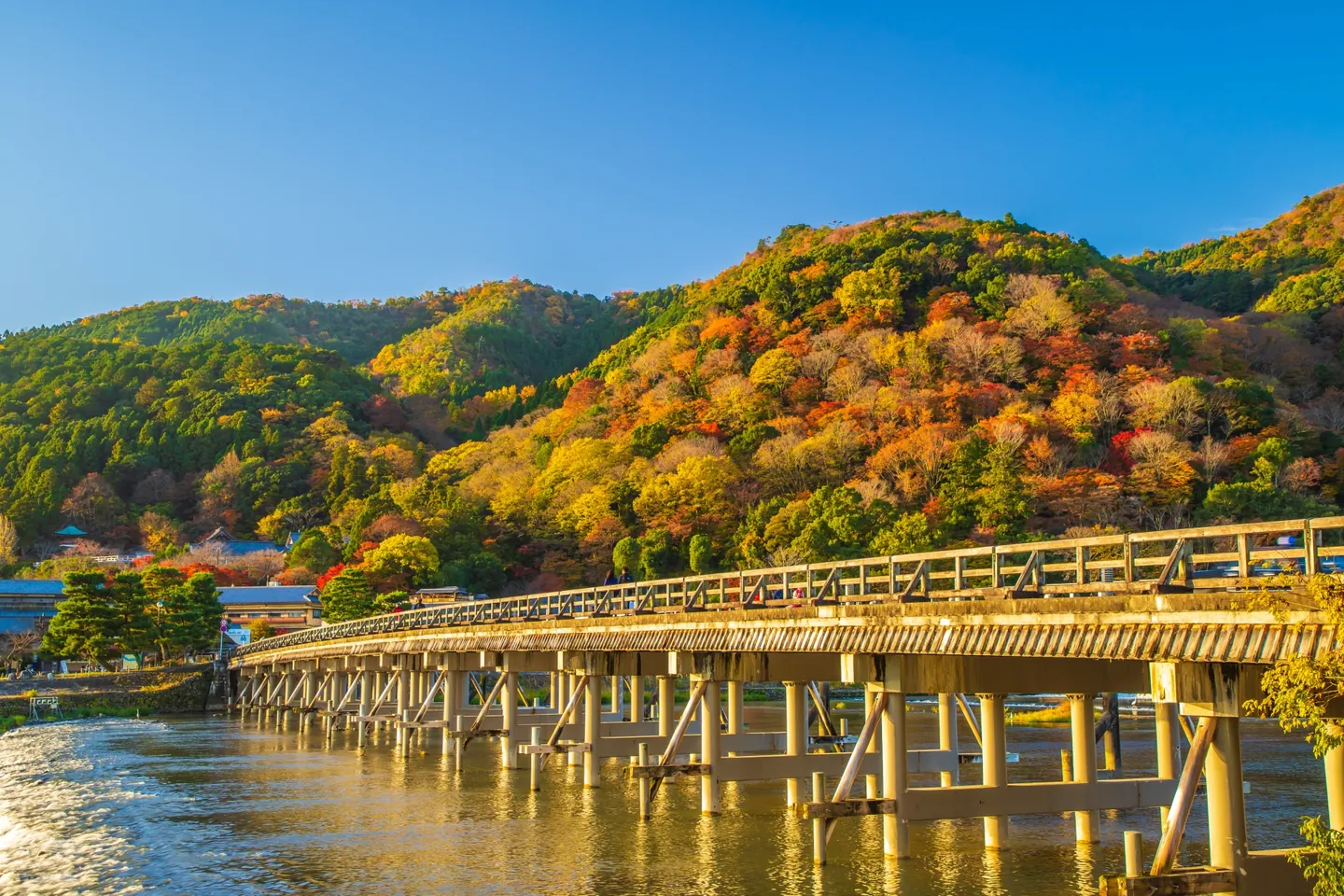
Do not schedule every photographic stop for the few minutes before the train. Finish the river walk, check your map and move toward the correct station with time to spare.
The 2026 Illuminated Sagano Train
The operator's September 18 announcement gives the illumination period as October 24–December 29, 2026, with lighting from 4:30 p.m. until the last train, excluding the December 16 non-operating day. Additional evening services run on selected dates within that period.
For example, the announced No. 81 service leaves Torokko Saga at 5:10 p.m. and reaches Torokko Kameoka at 5:38 p.m. on its operating dates; No. 82 runs back at 5:43 p.m., arriving at Saga at 6:12 p.m. These are examples from the event timetable, not daily departures throughout the entire season. Confirm your travel date in the live timetable.
| Extra service | Announced 2026 operating dates | Terminal departure |
|---|---|---|
| 81 / 82 | Oct 24–Dec 13; Dec 26–27 | Saga 5:10 p.m. / Kameoka 5:43 p.m. |
| 91 / 92 | Nov 14–30; Dec 5–6 | Saga 6:26 p.m. / Kameoka 6:59 p.m. |
Dates and departures above come from the timetable attached to the official announcement. Confirm operation and a seat for the specific train you want before building the rest of your evening around it.
A daytime ride emphasizes the landscape; an evening ride emphasizes the lit sections and darkness around them. Choose intentionally rather than assuming a late ticket provides the same view with fewer people. If you want gardens too, visit them first, then take a break before boarding.
Plan the return from the far endpoint before reserving. Do not assume an evening boat connection or a spontaneous return seat will be available. A one-way ticket and an ordinary JR return can be simpler.
What Changes for 2027?
The same announcement says the current carriages are scheduled to finish service on December 29, 2026, with new trains planned for spring 2027. This is a rolling-stock change, not an announcement that the sightseeing route is closing permanently.
For a later trip, recheck carriage features, operating dates and reservations. Keep the station-connection logic in this guide, but do not carry the 2026 Rich-carriage description or evening timetable forward without verification.
For another evening during your Kyoto stay, compare the temple night visits in our Kyoto autumn guide. A western Kyoto train evening and an eastern Kyoto temple night usually deserve separate plans.
If the Train Is Sold Out or the Weather Changes
Keep a complete garden day as your fallback: arrive in Arashiyama, visit one main temple, have lunch, then choose the river or another garden. This prevents a missing train ticket from turning into a day spent checking counters.
If you find a reverse-direction seat, redraw the journey before booking: ordinary JR toward Umahori, the walk to Torokko Kameoka, then the scenic train back toward Arashiyama. Check the approach time and your later plans rather than accepting any available departure.
In rain, review the operator's service status and ticket terms, especially for an open carriage. Garden paths and station steps may take longer. Bring a suitable layer, protect your phone and keep the itinerary short enough to enjoy; our autumn packing guide covers clothing choices.
Information checked October 11, 2026. The June family ride and cafe-and-walk memory are the author's own experience. Autumn timing, current rules and the tanuki's location are sourced research. Seat preferences summarize linked traveler comments, not the author's remembered seat or a statistical survey. Photographs are separate reference images. We do not claim a current on-site inspection or participation in the listed Klook tour.
Make it your trip
Still planning your Japan trip?
Pick the question on your mind. Compare your options, check the details and take one more thing off your list.

Which eSIM fits your Japan trip?
Maps, messages, hotspot use: compare five providers by data allowance, network and plan limits before you choose.
Find my Japan eSIM
What should your travel insurance cover?
Compare medical cover, cancellation and activity limits across five options, with the exclusions worth checking.
Compare cover & limitsWould a JR Pass save you money?
Add your train journeys and compare individual tickets with the nationwide pass. See which costs less for your route.
Calculate my rail costsFrequently Asked Questions
The Sagano Railway describes mid-November to early December as the usual foliage season along its route, with annual variation. Temple gardens and the river gorge do not all change together. Use recent local reports to choose a day rather than treating a Kyoto city forecast as a garden peak date.
The official booking window normally opens at midnight Japan Standard Time on the same date one month before travel. Consult the operator's rules for months without the equivalent date. Check the current sales notice before booking for a future season.
No. The sightseeing train requires its own ticket. A qualifying JR pass may cover the separate JR train used to reach or return from the area, subject to that pass's rules.
Walk to JR Umahori Station, approximately ten minutes according to Sagano Railway, then take the appropriate JR service. JR Kameoka and Torokko Kameoka are different stations; do not navigate to JR Kameoka by mistake.
Yes. Tenryu-ji, the bamboo grove, Togetsukyo Bridge and nearby temple gardens can form a full day without the sightseeing train. Limited same-day standing tickets may be offered, but availability is not guaranteed.
The operator announces lighting from October 24 to December 29, from 4:30 p.m. until the last train, excluding the December 16 non-operating day. Extra evening trains run on selected dates. Check the timetable for your exact day and reserve the particular service you intend to ride.
A recurring recommendation in traveler reviews and discussions is the right-hand side facing the direction of travel from Saga toward Kameoka, or the left-hand side from Kameoka toward Saga. Views change along the route, and opinions differ. Use this as a seat preference, then check the current booking seat map; it is not a guarantee of continuous river views.
No. Once you get off at an intermediate station, you cannot board again using the same ticket. You may end your ride at Torokko Arashiyama to explore the bamboo-grove area, but the remaining part of the journey is then forfeited. Staying aboard is the simplest option if you want to continue to the booked destination.

Written by
JAPANODE
Based in Japan, researching practical travel routes, seasonal events and booking decisions for visitors.
You Might Also Like
 Planning
Kyoto Autumn Leaves: 9 Places, Best Time & Area Routes
14 min read
 Planning
Japan Autumn Leaves 2026: Forecast & Booking Guide
11 min read
 Day Trips
10 Best Autumn Leaves Day Trips from Osaka in 2026: Kyoto, Nara, Koyasan & More
8 min read
 Itinerary
4-Day Kansai Itinerary: Kyoto, Osaka & Nara (2026 Local's Guide)
18 min read