On this page
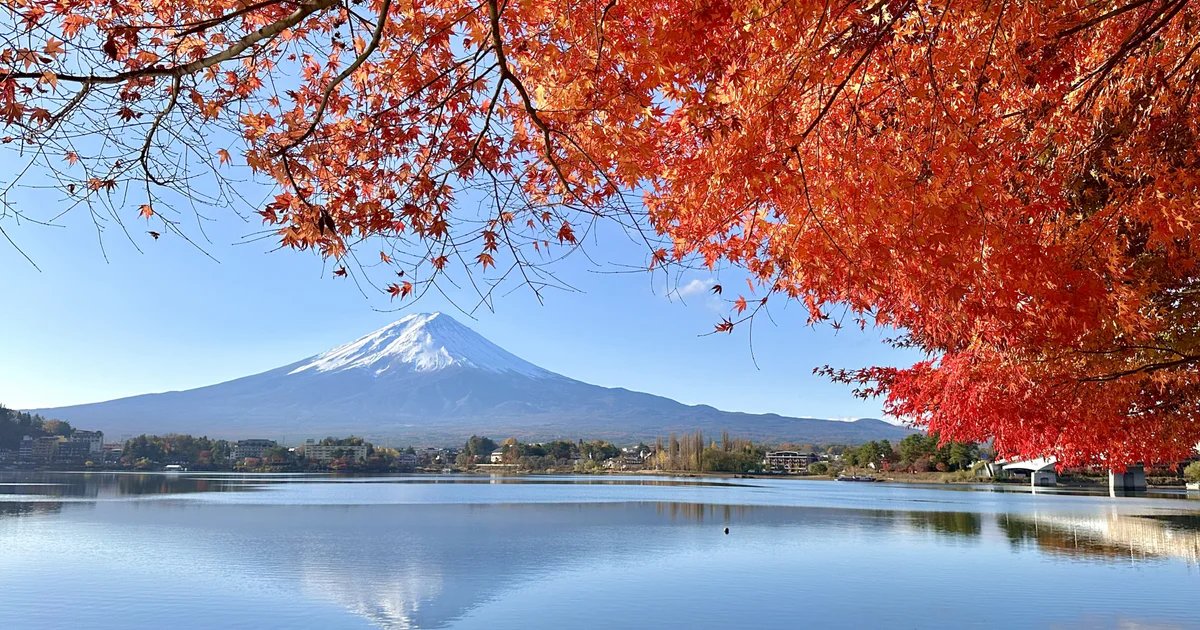
Kawaguchiko works as an autumn day trip when you choose one north-shore area and a return journey first. The Maple Corridor is the main festival destination; Oishi Park is a separate lakeside stop for a possible Mount Fuji view. Trying to add every viewpoint, a ropeway ride and an evening illumination to the same Tokyo day trip makes the return unnecessarily difficult.
For 2026, the Fujikawaguchiko Autumn Leaves Festival runs November 7–29, with lights from sunset until 9 p.m. The regular sightseeing bus does not run until the lights finish, and the final direct Fuji Excursion train leaves earlier still. Choose a daylight visit, or plan an evening stay with transport and accommodation already settled.
This is a research-based planning guide. Photographs show seasonal scenery, not current conditions, and the suggested routes are not accounts of a personal visit. For the journey from Tokyo and a comparison of transport options, start with our Mount Fuji day-trip guide.
- Festival: November 7–29; illumination from sunset to 9 p.m.
- Regular Red Line return: last listed departure from Itchiku Kubota Art Museum, near the corridor, at 6:32 p.m.; Kawaguchiko Station arrival 6:54 p.m.
- Direct train: last listed Fuji Excursion to Shinjuku at 5:41 p.m.
- Current color: no dated local observation is claimed here. Festival opening and peak foliage are separate facts.
Sources: the festival organizer, Fujikyu Bus sightseeing timetable and Kawaguchiko Station timetable. Recheck the applicable date and service notices before departure.
Choose Between a Day Trip and an Evening Stay
The first decision is how you want the day to end. A daylight trip gives you a clearer connection back to Tokyo and avoids waiting beside the lake after the sightseeing buses finish. An evening stay lets you see the illumination without measuring the visit against an early train, but adds a hotel booking and a separate way back from the corridor.
| Your priority | A workable starting plan | Main compromise |
|---|---|---|
| Autumn leaves on a Tokyo day trip | Maple Corridor, nearby lunch and an early return to the station | Less time for other Fuji attractions |
| A mountain-and-lake photograph | Oishi Park first if visibility is good, then the corridor if time permits | Fuji may remain behind cloud |
| The illuminated corridor | Stay locally and confirm the trip between your hotel and the venue | Accommodation and evening transport need planning |
| Several widely separated viewpoints | Compare a tour's actual stops or an overnight route | A tour may not include the corridor or evening lights |
| A relaxed afternoon with few transport dependencies | Consider Tokyo city gardens instead | No Fuji view or lakeside setting |
Do not choose a product because its title says “autumn” or “Mount Fuji.” Read the actual stops, the time allowed at each one and the return arrangements. A tour that visits a different lake or ends before dark will not deliver a Maple Corridor illumination visit. A self-guided outing offers flexibility, but you carry the responsibility for the connections.
When to Visit: Typical Season, Festival Dates and Actual Color
Yamanashi's official foliage guide gives early to late November as the broad Kawaguchiko season. Treat that as a planning window. The condition of a particular tree can change within it, and sheltered areas do not necessarily develop at the same pace as exposed lakeside trees.
Keep three questions separate. Is the festival operating? Is the foliage at the place you want to visit currently attractive? Is Mount Fuji likely to be visible? The event notice answers the first. A recent local report or dated photograph helps with the second. A near-term weather forecast informs the third without promising a clear summit.
As of the October 31 check, this guide does not verify a current peak-color observation for the corridor. Use the organizer's latest updates and Yamanashi's autumn information shortly before travel, looking at the observation date as well as the publication date. An undated promotional photograph is useful for understanding the setting, not deciding tomorrow's route.
If your dates are fixed, build an enjoyable day around the lake rather than trying to predict one perfect tree. If the only reason for the journey is a clear mountain photograph, keep a city plan ready and compare the forecast close to departure. The national autumn guide helps you compare regions when the broader itinerary is still flexible.
Maple Corridor, Maple Tunnel and Oishi Park Are Different Stops
Maple Corridor: The Festival Area
The Maple Corridor, also called Momiji Kairo, is near the Itchiku Kubota Art Museum on the north shore. This is the place to use when planning around the festival and its illumination. Search for the corridor or the museum area specifically; a generic “Kawaguchiko autumn” map search may take you to a different photograph location.
Allow time to move through the area without treating it as a quick roadside photo stop. Crowds, a meal and the walk to the correct bus stop all use part of the afternoon. If you add the museum itself, check its separate admission and opening details and remove another activity from the plan. Being near a museum does not mean admission is included in a festival visit.
Oishi Park: A Lakeside Viewpoint
Oishi Park is farther west along the north shore, around the Red Line's Kawaguchiko Natural Living Center terminus. It provides a different reason to stop: open lake-and-mountain scenery when visibility cooperates. It is not the same location as the corridor, so allow for another bus journey rather than assuming both sights are beside one stop.
For a first visit, make Oishi Park an optional addition. When Fuji is visible and the buses are running comfortably, it can fit before the corridor. When arrival is late or traffic is building, one unhurried area is more useful than a checklist of distant viewpoints. The lake remains the same destination even if you choose fewer stops.
Maple Tunnel: A Separate Western Location
The Maple Tunnel, or Momiji Tunnel, is farther west beyond Oishi Park. The prefectural tourism guide distinguishes it from the corridor. Do not use its photographs as proof of what the festival venue looks like, or expect the museum-area bus stop to serve both places as one short visit.
This guide's bus-based day plan omits the tunnel. Adding it needs its own checked access and return arrangement; it is not a necessary extra to make the trip worthwhile. On a short autumn day, concentrating on the corridor and one possible lake view also leaves more room for queues and slower travel.
Getting to the North Shore and Back
From Kawaguchiko Station, the Red Line sightseeing bus serves the north shore. The operator's route and timetable lists Itchiku Kubota Art Museum as stop 17 and Kawaguchiko Natural Living Center as stop 20. Keep those names available on your phone so that the outward and return stops are easy to identify.
Check the direction before boarding. The return you need is toward Kawaguchiko Station, not farther along the north shore. Also distinguish a scheduled arrival from a guaranteed connection: a timetable cannot remove road congestion or a queue for the next bus. Leave room to abandon an optional stop rather than using every spare minute before your train.
For ticket choice, compare the trips you will actually take with the operator's current fare and pass options. A pass can simplify a multi-stop day, but it does not reserve a seat or make a delayed bus faster. The same principle applies to a rail pass from Tokyo: check coverage for the specific service rather than assuming every Fuji-area train is included.
The regular timetable checked October 31 lists the last museum-stop return at 18:32, reaching the station at 18:54. That is later than the last direct Fuji Excursion, 17:41, in the station timetable. These are two separate limits: catching the last sightseeing bus does not mean you can still catch the last direct train.
Later local trains appear in the railway timetable, but a journey involving Otsuki needs its own onward connection check. Likewise, a highway bus reservation has a particular departure time and boarding point. Plan that complete return before leaving Tokyo; do not arrive at the station after dark assuming any remaining service will get you to your hotel.
A Daylight Route with Time Reserved for the Return
The following is an editorial planning example, not a packaged itinerary or a promise about traffic. It uses a reserved 17:41 Fuji Excursion as the return constraint. If you book a different service, work backward from that departure instead.
- Arrive in the morning. Check the return ticket, local bus notices and actual weather before heading to the north shore. If you arrive much later than planned, drop Oishi Park.
- Choose an optional lake-view stop. Visit Oishi Park if Fuji is visible and the transport timing still leaves a comfortable afternoon. Otherwise go directly to the corridor area.
- Have lunch and visit the corridor. Keep this as the main autumn stop. Avoid adding the ropeway or another distant attraction simply because it appears nearby on a regional map.
- Aim for an early return bus. In the checked regular timetable, the museum-stop departure at 16:02 reaches the station at 16:24. That leaves 77 scheduled minutes before a 17:41 train, though congestion can consume the margin.
- Use the station buffer deliberately. Collect bags if necessary, buy food and find your platform. If traffic is already severe, head back earlier instead of treating the sample bus as a deadline.
This route prioritizes having a complete day that ends with the booked journey. It does not promise a night visit. Even if dusk arrives while you are still near the corridor, do not extend the stop without recalculating the whole return, including the bus queue and any onward connection in Tokyo.
For other destinations when this journey feels too constrained, compare the autumn day trips from Tokyo. Choose based on the current conditions and the time you have, rather than assuming Kawaguchiko is always the strongest foliage option.
Seeing the Illumination Without Depending on a Late Bus
For an evening visit, the simplest starting point is accommodation whose location and transport arrangement work with the corridor. “Kawaguchiko hotel” can mean somewhere quite far around the lake. Confirm the exact route, any pickup deadline and whether the hotel actually offers the transfer you need.
The regular Red Line timetable does not cover the festival's 21:00 finish. This check has not established a later festival bus, so do not build an itinerary around one unless the operator publishes it for your date. A taxi is also something to arrange or verify in advance; its possible availability is not a confirmed return plan.
If you plan to walk back to nearby accommodation, check the actual pedestrian route and distance in daylight. A short line across a map is not enough to establish a comfortable night walk. Choose a route and stopping time that suit your group, particularly with children, luggage or anyone who finds prolonged standing difficult.
You also do not need to stay until closing. An earlier evening visit followed by dinner can be a more comfortable use of an overnight stay. Make the next morning an additional opportunity to look at the lake, while accepting that an extra night still cannot guarantee clear views of Fuji.
Driving, Clothing and Bags
The organizer's 2026 notice introduces paid, cashless-only parking at Parking Lot 1, with a ¥1,000 standard-car fee. This applies to that named lot; do not extend it to every parking area around the lake. Check the current map and payment instructions before arriving, and avoid assuming that a museum or business car park is available for festival visitors.
A car changes the connection problem but does not remove congestion. Leave room in the day for parking and the onward drive. If your main goal is an evening stroll, a local stay may still be more comfortable than driving back to Tokyo immediately afterward.
Dress for standing outdoors by the lake and for the return after sunset, rather than copying the outfit that felt comfortable in central Tokyo at lunchtime. A removable warm layer and wind protection make it easier to adapt. Our autumn clothing guide separates city sightseeing from higher or more exposed destinations.
Keep large luggage out of the walking plan when possible. If you are changing hotels, arrange storage or forwarding before committing to a sequence of buses and narrow walking areas. The Japan luggage storage guide compares the practical options; availability at a particular station still needs checking.
Before leaving, save the return booking, the correct bus-stop name, the current event notice and a simpler route you can use if delayed. Those four items are more useful on the day than a long list of additional photo spots.
Compare the journey from Tokyo
Choose the train, highway bus or tour that fits your actual stops.
Plan your Fuji day tripKeep a city alternative
Choose a Tokyo garden or ginkgo route when the lake trip does not fit.
See Tokyo autumn routesFestival notice and linked local bus and rail timetables checked October 31, 2026. Seasonal timing comes from Yamanashi's tourism guidance; no current peak-color observation or personal visit is claimed. Recheck date-specific service changes before travel.
Frequently Asked Questions
The organizer lists November 7–29, 2026, with illumination from sunset until 9 p.m. These are festival dates, not a guarantee that the trees will be at peak throughout the event.
No. The Maple Corridor is near the Itchiku Kubota Art Museum on the north shore. The Maple Tunnel is farther west, beyond Oishi Park. They require separate route planning and should not be treated as two names for the festival venue.
The regular timetable checked October 31 lists the last Red Line departure from Itchiku Kubota Art Museum toward Kawaguchiko Station at 6:32 p.m., arriving at 6:54 p.m. It does not cover the festival's 9 p.m. finish. Confirm any later service directly, or arrange accommodation and transport in advance.
The Kawaguchiko Station timetable checked October 31 lists the final direct Fuji Excursion departure at 5:41 p.m. on both weekday and weekend schedules. Later local trains are different journeys and require checking onward connections; they are not later direct trains to Shinjuku.
Yes. The Maple Corridor and nearby gardens can still provide an autumn outing, but the mountain view depends on visibility. Choose whether foliage alone would justify the journey before booking, and keep a flexible city alternative if seeing Fuji is your main priority.
No. The organizer says Parking Lot 1 becomes paid and cashless only in 2026, with a standard-car fee of 1,000 yen. Check the current festival map and payment instructions rather than assuming every nearby parking area follows the same arrangement.

Written by
JAPANODE
Based in Japan, researching practical routes and official visitor information for travelers.
You Might Also Like
 Planning
Japan Autumn Leaves 2026: Forecast & Booking Guide
16 min read
 Day Trips
9 Best Autumn Leaves Day Trips from Tokyo in 2026: Nikko, Mt. Fuji, Hakone & More
9 min read
 Day Trips
Mt Fuji Day Trip from Tokyo: Tour, Train & Bus Compared (2026)
17 min read
 Planning
What to Wear in Japan in Autumn: September, October & November Packing Guide
13 min read