
On this page
Kyoto by bike is appealing for what happens between the famous sights: a stretch of river, a small neighborhood shrine, the change from a busy avenue to a quieter residential street. A bicycle gives those spaces a place in the day. You can travel farther than on foot while still stopping to look around.
The most enjoyable plan is usually one area, a manageable ride and time off the bike. A morning around northern Kyoto or Arashiyama can be a complete experience. Trying to connect every major temple in one day adds distance, traffic and parking decisions without necessarily making the visit better.
This guide compares independent rental with guided tours, explains how to choose an area, and covers the practical details that booking photographs leave out. It is based on city, police and operator information checked on November 8, 2026, rather than a JAPANODE test ride of the listed tours.
The Viator booking buttons are affiliate links. JAPANODE may earn a commission at no extra cost to you. Official city resources and direct operator links are also included.
Is cycling the right way to see Kyoto?
Choose a bicycle when riding is part of the experience you want. A good cycling day has room for a pause, a missed turn and an unhurried visit. It should not depend on reaching a timed admission immediately after a long ride across town.
You need to be comfortable starting, stopping, turning and checking your surroundings in an unfamiliar place. Remember that a quiet-looking lane can still have cars, deliveries and people stepping out of buildings. A tour advertised as easy describes an itinerary; it does not teach a complete beginner to ride in traffic.
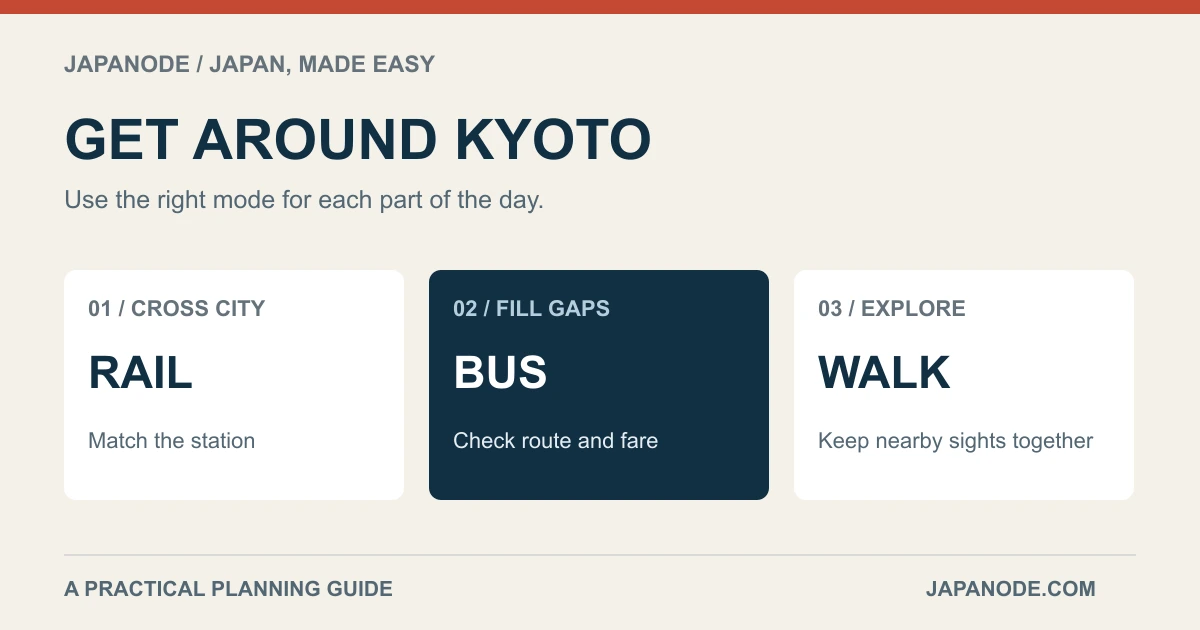
For a day mostly around crowded shopping lanes and temple stairways, walking may be simpler. For a long transfer, use the Kyoto transport guide to compare trains and buses, then rent near the area you want to explore. There is no requirement to cycle from your hotel just because you have booked a cycling activity.
| Your main priority | A sensible starting choice |
|---|---|
| Stop whenever you like and explore at your own pace | Independent rental, with a short route and parking planned |
| Understand neighborhoods and sites as you ride | A guided tour with a route that interests you |
| Reduce effort on inclines or a longer outing | A pedal-assist bike, after checking fit and handling |
| Visit Arashiyama without riding across Kyoto first | Travel there by train and join or rent locally |
| Spend hours in narrow lanes, shops and temple grounds | Walk between nearby sights and use public transport for transfers |
| Ride with children | Ask about a dedicated family format and suitable equipment |
Rent independently or join a guided tour?
Renting: freedom, with a little preparation
Renting makes sense if you enjoy navigating and want control over the day. You choose when to stop for lunch, how long to spend in a garden and whether to turn back. The work you take on is practical: checking restrictions, securing the bike, finding parking and returning before the agreed deadline.
Start with the city's rental and parking directory. Kyoto's certified rental-shop information identifies standards including bicycle insurance, mechanical inspections, traffic-rule explanations and English support. It is a useful starting filter, though you still need to check the particular bike and booking terms.
Before paying, confirm the rental period, last return time, helmet availability, lock, lights, insurance, damage charges and help if the bicycle breaks down. Ask whether a different return location is possible. KCTP's rental instructions show why this matters: its return arrangements must be chosen in advance and have conditions. A one-way plan should be agreed with the shop, not improvised at the end of the day.
Guided tours: a route and someone to explain it
A guide can give the places between landmarks more meaning and take much of the route planning off your hands. You still ride your own bicycle, obey your own traffic signal and decide whether you are comfortable continuing.
Compare the actual itinerary, language, group size, riding time and time spent visiting places on foot. A four-hour experience is not necessarily four hours of pedaling. Ask where the group regathers if a traffic light separates you. Also check whether temple admissions, drinks and equipment are included in your chosen option.
A private tour can be worth investigating when the group has different interests or abilities. It does not automatically permit younger children, eliminate road riding or provide a child seat: those arrangements need explicit confirmation.
What to budget: rental and tour examples
These are published direct-provider prices checked on November 8, 2026, not citywide averages or guaranteed Viator checkout prices. Compare the selected date, bike model and inclusions before booking.
| Example | Published price per person | Time covered |
|---|---|---|
| KCTP Middle-class city bike, three gears | ¥1,400 | One rental day, 9 a.m.–6 p.m.; not 24 hours |
| KCTP standard electric-assist bike | ¥2,700 | One rental day, 9 a.m.–6 p.m.; not 24 hours |
| NORU Secret Kyoto tour | ¥15,000 | About 3 hours 45 minutes |
| Kyoto Bike Tour Early Bird Arashiyama | ¥16,000 | About 3.5 hours |
KCTP's price guide lists free helmets for these two rental models; its service information includes liability insurance and treats theft-and-damage cover as an option. Allow extra for parking and attraction admissions. Its return instructions list a ¥600 different-terminal fee for eligible bikes, while the standard electric-assist model must return to its original terminal.
Tour fees pay for a guided itinerary as well as equipment. Check admission inclusions for the actual product; NORU's direct Secret Kyoto description and the Hidden Kyoto marketplace listing also differ in distance, as explained below.
Regular bicycle or electric-assist bike?
A regular bicycle can be a good choice for a shorter outing if you are happy pedaling and the bike fits. It can also be easier to lift or maneuver when you need to dismount. Pedal assistance is useful when you want help on an incline or need to conserve energy for walking later.
For either type, ask to adjust the saddle and test the brakes and steering before leaving. With an e-bike, learn how assistance engages and how the controls work. Do this somewhere the rental staff considers appropriate, rather than learning at the first busy crossing.
Assistance changes the effort, not the need for riding skill. Do not choose a long itinerary solely because the word “electric” appears in the description. Ask about the actual model, suitable rider heights, battery arrangements and how much of the route is on ordinary roads.
A shorter ride that everyone enjoys is a better use of the day than a long route with a worried rider struggling to keep up.
Three ways to plan a Kyoto cycling day
These are planning areas, not turn-by-turn routes. Use current signs and the city's maps, and ask a rental shop to check your route. A pedestrian shortcut on a map is not automatically somewhere you can cycle.
1. Northern Kyoto: give the neighborhoods time
A ride centered on the northern part of the city works well if you want a mixture of residential streets and cultural stops. Kitano Tenmangu and the Kinkaku-ji area provide two possible anchors; both appear in the Hidden Kyoto listing below. For an independent outing, have the rental shop confirm a suitable connection and parking at each stop.
If you pick a tour that includes the Kinkaku-ji area, keep the remainder of your day nearby. Leave time after the ride for a meal or a further visit on foot. If you want a tea experience as well, compare locations in our Kyoto tea ceremony guide before reserving something on the other side of the city.
2. Arashiyama: start in the west
For an Arashiyama-focused day, travel to the area first. Togetsukyo Bridge, the bamboo area and Tenryu-ji's garden are useful anchors for planning; they appear in Kyoto Bike Tour's published Early Bird program. Starting locally leaves more time for the area itself, and a guide can connect those recognizable places with less obvious stops.
Expect to get off the bicycle. A popular bamboo lane, a temple garden and a narrow passage need different behavior from an open road. An early departure may help with the rhythm of the day, but it cannot promise an empty bamboo grove.
After returning the bike, leave the afternoon flexible for lunch and walking. This fits more comfortably than racing from a morning ride to a distant attraction with a fixed admission time.
3. A short central outing: ride, park, then walk
Independent cycling can also be a modest part of the day: rent for a limited period, make one or two stops, and return. A café, a neighborhood visit and a riverside walking break can be enough.
Central Kyoto requires particular attention to riding restrictions and parking. Treat Gion's narrow lanes and the shopping arcades as places to check signs, park lawfully nearby and explore on foot where appropriate. Do not follow another cyclist as evidence that riding is permitted.
If your route uses a riverside path, check access and local signs, slow down around people and avoid assuming the whole path is a dedicated cycle lane. Consider returning to a suitable road or walking when it is busy. A river view is still enjoyable with the bike parked.
Two guided Kyoto bike tours to compare
These options serve different days: one explores Kyoto with pedal assistance; the other starts in Arashiyama on standard bicycles. Check the selected date and option before comparing totals.
| Tour | Format to check | Why consider it | Main trade-off |
|---|---|---|---|
| NORU Hidden Kyoto E-Biking | About 3 hours 45 minutes; e-bike | A guided introduction to neighborhoods and cultural stops | Route distances differ between published descriptions |
| Kyoto Bike Tour Early Bird Arashiyama | About 3–4 hours; standard bike | A morning based around Arashiyama | Requires an early journey to the meeting point; no electric assistance in this listing |
NORU: Hidden Kyoto E-Biking
The Viator listing describes a small-group ride of about 3 hours 45 minutes, with a bicycle and helmet, a minimum age of 13 and a maximum of eight travelers. The meeting point is NORU's shop in Kamigyo, rather than Kyoto Station.
The listing asks you to arrive 15 minutes before departure. NORU also asks riders under 145 cm to contact the company, so confirm bike fit before booking. Allow for the journey to the shop when choosing a departure time.
There is a material discrepancy worth checking: the marketplace description refers to approximately 7–8 km, while NORU's current site describes its Secret Kyoto itinerary as 14 km. Ask which route and distance your booking uses, along with the actual temple stops and inclusions. Do not choose this on the assumption that it is necessarily the shorter ride.
Kyoto · Electric-assist cycling
Hidden Kyoto E-Biking Tour
Operated by NORU Kyoto Bike Tours
A guided e-bike outing through Kyoto neighborhoods and cultural stops. Confirm the itinerary and riding distance for your departure.
- Approximately 3 hours 45 minutes
- Bicycle and helmet listed
- Small-group format
Best forConfident cyclists who want local explanation and pedal assistance.
Before you bookPublished distances differ. Confirm the current route, bike fit and age conditions before booking.
Choose your date
Check the total for your date, group size and selected option.
Confirm inclusions and cancellation terms before paying.
Kyoto Bike Tour: Early Bird Arashiyama
The operator's Early Bird description lists roughly 11 km plus walking and about 3.5 hours, starting at 8 a.m. and finishing around 11:30 a.m. Check your booking's meeting instructions and early-morning transport before reserving. It gives the morning a clear geographic focus rather than trying to cover the whole city.
The Viator product uses standard Cannondale city bikes, lists Saga-Arashiyama Station as the meeting point, and asks for all riders' heights. Its minimum age is 10, with younger families directed to a different product. Confirm the meeting instructions and admissions in the booking you select; do not assume a similarly named family or private tour has identical terms.
Arashiyama · Morning ride
Arashiyama Bamboo Forest & Hidden Gems Bike Tour — Early Bird
Operated by Kyoto Bike Tour
A morning cycling and walking experience based around Arashiyama, using standard city bicycles.
- Approximately 3–4 hours
- Bicycle and helmet listed
- Arashiyama meeting point
Best forTravelers who want an Arashiyama morning and are comfortable pedaling a standard bicycle.
Before you bookThis listing is not an e-bike tour. Check the age rule, rider heights and early meeting arrangements.
Choose your date
Check the total for your date, group size and selected option.
Confirm inclusions and cancellation terms before paying.
Road rules and parking: make these part of the plan
Kyoto Prefecture's cycling guidance sets out the basics: ride on the left of the roadway, obey signals and stop signs, use lights at night, wear a helmet and never ride after drinking. Sidewalk riding is an exception; wherever it is allowed, pedestrians have priority. Do not ride side by side.
Keep your phone put away while moving. Stop somewhere appropriate before checking directions or taking a photograph. On a guided ride, a green light for the guide is not permission for everyone behind to cross after it changes.
For central streets, use the rules and restrictions map on the city's parking and riding-restrictions page, then follow the signs you encounter. Restrictions can depend on the street and time. A general sightseeing map is not enough.
Parking deserves the same planning as the ride. Kyoto's official visitor guidance directs riders to designated bicycle parking. Budget time and any parking charge at your stops. Do not leave a bicycle outside a shop, beside a temple entrance or against someone's home because it seems out of the way.
These streets are everyday routes for people who live and work here. Leave entrances clear, avoid blocking a lane while waiting for your group, and ask before photographing people at close range.
Insurance, weather and what to bring
Kyoto's official insurance FAQ includes visiting riders in the liability-insurance requirement. It explains that an insured rental bike can meet the relevant requirement: confirm this with the provider. Ask separately about your own injuries, damage to the bicycle, theft and any amount you would have to pay. “Insurance included” does not answer all those questions.
If you are relying on a travel policy, check the cycling activity and circumstances with the insurer. Our Japan travel insurance guide explains the broader coverage questions.
Choose weather you can ride comfortably in. Allow more breaks in heat and reconsider a ride in heavy rain, strong wind or poor visibility. Ask the operator how it decides to cancel and what happens to your payment. Your decision not to ride in a forecast and the operator's cancellation can have different terms.
Bring comfortable closed shoes, water, weather-appropriate layers and a small bag that stays secure. Keep loose clothing clear of the chain and wheels. Leave large luggage at your accommodation or use luggage storage; a basket is not a solution for a suitcase.
Before departure, check that every rider understands the brakes, route, return arrangements and what to do if separated. If the bike does not fit or someone cannot handle it confidently, resolve that before entering traffic.
Fit the ride into your Kyoto visit
Use our three-day Kyoto itinerary as a geographic framework, then replace one sightseeing block with a ride. Avoid adding a full cycling tour on top of an already full day.
For a first ride, choose the area you most want to understand, confirm the equipment and keep the rest of the day light. Kyoto has enough detail in a single neighborhood to reward that slower pace: the bicycle gets you between places, and the pauses give you time to notice them.
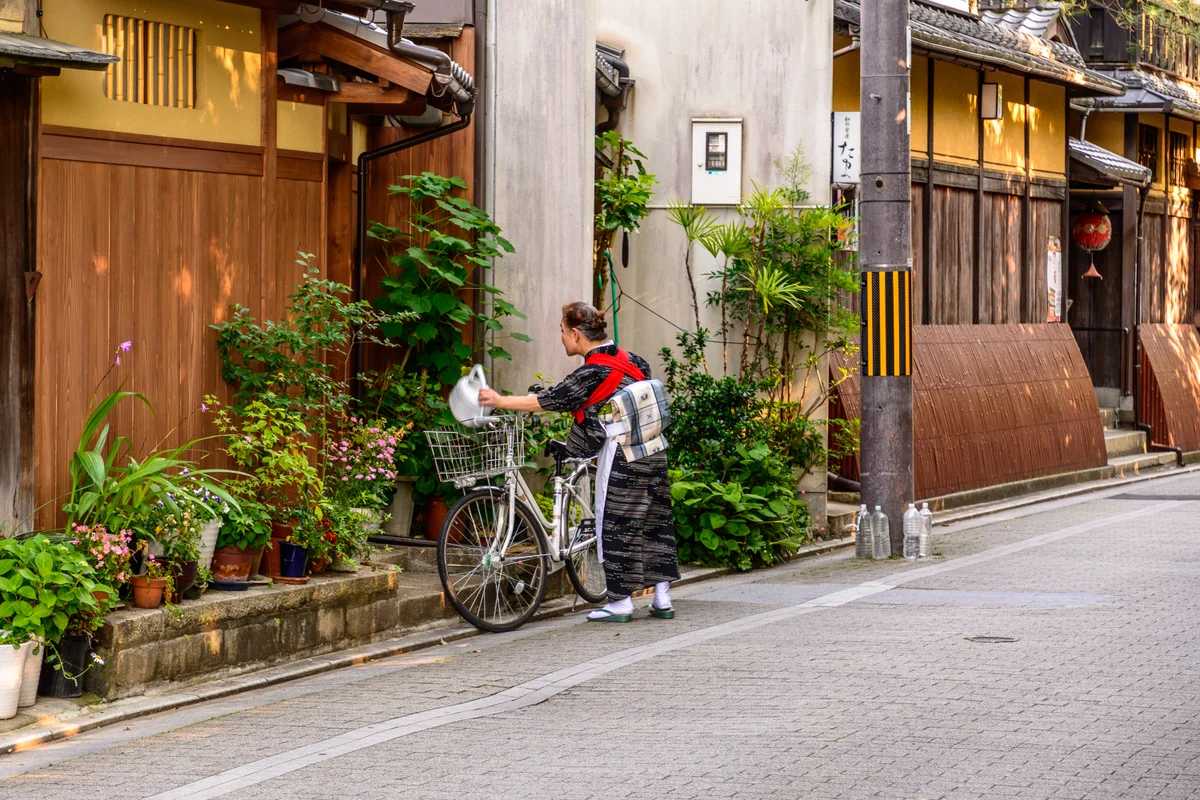
Photo credit: dconvertini, Gion, Kyoto, Japan, CC BY-SA 2.0. Resized and converted to WebP; the adapted image is available under the same license.
Make it your trip
Still planning your Japan trip?
Pick the question on your mind. Compare your options, check the details and take one more thing off your list.
Would a JR Pass save you money?
Add your train journeys and compare individual tickets with the nationwide pass. See which costs less for your route.
Calculate my rail costs
Which eSIM fits your Japan trip?
Maps, messages, hotspot use: compare five providers by data allowance, network and plan limits before you choose.
Find my Japan eSIM
How much can you fit into one week?
Connect Tokyo, a Fuji or Hakone day trip, Kyoto and Osaka with a day-by-day route, travel costs and booking advice.
Explore the 7-day routeFrequently Asked Questions
Cycling can work well when you choose one area, can ride confidently in traffic and plan legal parking. It is less useful for a day concentrated on crowded pedestrian lanes, temple steps or widely separated attractions. Combine a ride with walking and public transport when that makes the day easier.
Rent if you are comfortable navigating, checking road restrictions and finding parking. Choose a guided tour if you want local explanation and a planned route. A guide does not replace the ability to ride, stop and follow traffic rules independently.
Not for every ride. A regular bicycle can suit a short route, while pedal assistance can be useful on longer outings or inclines. Check the route, bike fit and rental conditions. An e-bike still requires balance, pedaling, braking and attention to traffic.
Rules depend on the exact product and equipment. The Hidden Kyoto listing checked for this guide specifies a minimum age of 13. The Early Bird Arashiyama listing specifies age 10 and asks for every rider's height. Confirm the child's ability and bike fit with the operator before paying; family tours are separate products.
Use designated bicycle parking and confirm arrangements at each attraction. Kyoto City's official cycling site provides parking information and warns that bicycles left on the road can be removed even after a brief stop. A locked bicycle is not automatically legally parked.
Kyoto's liability-insurance requirement also covers visiting cyclists. The city's FAQ says an insured rental bicycle can satisfy the relevant requirement, so confirm the rental provider's coverage. Liability coverage is separate from your own medical costs, theft and damage charges.

Written by
JAPANODE
Based in Japan, sharing practical travel planning guides and independently researched comparisons for visitors.
You Might Also Like
Planning
Where to Stay in Kyoto: Match Your Hotel Area to Your Route
10 min read
Itinerary
Kyoto 3-Day Itinerary: Higashiyama, Arashiyama and Fushimi
10 min read
Transportation
Kyoto Transport: Trains, Buses, IC Cards and Day Passes
7 min read
Culture
7 Tea Ceremony Experiences in Kyoto (2026 Comparison)
17 min read