On this page
Buy a Tokyo Subway Ticket when the eligible subway journeys you actually want to make cost more than the pass. Keep paying normally when your days involve only a few rides, substantial walking, or several journeys on JR and other operators.
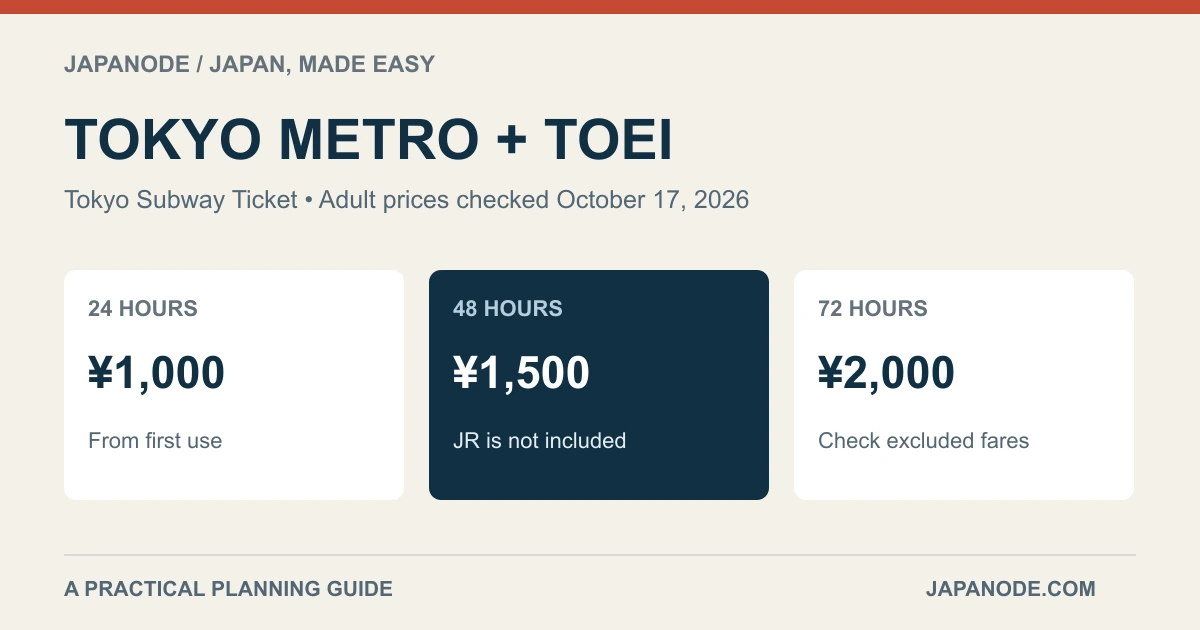
The current adult prices are ¥1,000 for 24 hours, ¥1,500 for 48 hours and ¥2,000 for 72 hours, according to Tokyo Metro's official ticket page, checked October 17, 2026. Older comparisons using ¥800, ¥1,200 and ¥1,500 should not be used to make a new purchase decision.
The pass can make a busy sightseeing schedule simpler. It does not make every Tokyo train journey free, and saving a small fare is rarely a good reason to add inconvenient transfers.
Disclosure: The GetYourGuide booking option below is an affiliate link. JAPANODE may earn a commission at no extra cost to you.
What the Ticket Covers
The product covers the Tokyo Metro and Toei Subway networks. These are extensive, but they are only part of Tokyo's rail system.
| Journey or service | How to treat it |
|---|---|
| Tokyo Metro subway journey | Within the pass network |
| Toei Subway journey | Within the pass network |
| JR Yamanote or Chuo Line | Separate fare or other valid ticket |
| Keikyu, Keisei, Odakyu or other private-rail section | Separate fare or applicable bundle |
| Airport train | Check the exact operator and every section |
| Bus, monorail or other urban transport | Do not assume inclusion |
A train can continue from a subway line onto another operator's tracks. The fact that you remain in the same carriage does not expand the pass boundary. Check the operator and covered section in the route result, especially for airport travel.
Use the Japan train-system guide if the distinction between JR, subway and private rail is unfamiliar. It is more useful than trying to identify coverage by the color of a route line alone.
The Current Prices and Time Windows
| Ticket | Adult | Child | Planning window |
|---|---|---|---|
| 24 hours | ¥1,000 | ¥500 | Consecutive hours from first use |
| 48 hours | ¥1,500 | ¥750 | Consecutive hours from first use |
| 72 hours | ¥2,000 | ¥1,000 | Consecutive hours from first use |
These are the operator's listed prices for this product, not the price of every reseller bundle. Check age rules and the product you are buying if you travel with children.
An hourly ticket can span more than one calendar date. For example, a first use in the afternoon can leave part of the following afternoon within a 24-hour window. Follow the activation and expiry instructions for the actual ticket; do not apply a rule from another city's calendar-day pass.
The official Tokyo Subway Ticket site also explains purchase eligibility. Overseas visitors should check the required status and identification rather than assuming every resident and visitor qualifies on identical terms.
If You Only Need Tokyo Metro
The separate Tokyo Metro 24-hour Ticket costs ¥700 for adults and ¥350 for children. It covers Tokyo Metro only, excluding Toei and JR. If your planned rides all use Metro, compare this cheaper ticket before choosing the ¥1,000 Metro-and-Toei product.
For example, four Metro journeys at the hypothetical ¥220 average total ¥880: the ¥700 ticket saves ¥180, while the ¥1,000 ticket costs ¥120 more than ordinary fares. If you also need Toei, add those separate fares before deciding. Check the format's activation rule: the conventional Metro ticket starts at first use, whereas the PASMO-loaded version runs from purchase.
Calculate Savings From Fares, Not a Magic Ride Count
List the journeys you would take without a pass. Mark which are fully covered, then compare their normal fares with the ticket price. Keep excluded journeys in both versions of the budget.
For a simple hypothetical average fare of ¥220 per covered journey, the arithmetic is:
| Ticket | Example break-even calculation | First whole ride count above its price |
|---|---|---|
| 24-hour, ¥1,000 | 4 × ¥220 = ¥880; 5 × ¥220 = ¥1,100 | 5 |
| 48-hour, ¥1,500 | 6 × ¥220 = ¥1,320; 7 × ¥220 = ¥1,540 | 7 across the whole window |
| 72-hour, ¥2,000 | 9 × ¥220 = ¥1,980; 10 × ¥220 = ¥2,200 | 10 across the whole window |
¥220 is an illustration, not a statement that every subway journey has that fare. A trip involving both subway operators or different distances needs its actual fare. Use the operator's route search to price the journeys you plan.
The table also shows why the 24-hour product can be difficult to justify on a day built around one neighborhood. Traveling to an area, walking for several hours and returning to the hotel may not generate enough eligible fares.
Booking the Metro-and-Toei Ticket
Once your fare comparison supports this product, the option below lets you choose 24, 48 or 72 hours. This seller requires a non-Japanese passport and exchange of its voucher at a subway ticket machine with a QR reader. Select the subway-only option unless you also need the separate Skyliner bundle. The listing shows conflicting refund wording, so confirm the applicable cancellation terms before paying.
Tokyo Subway Ticket: 24, 48 or 72 Hours
Compare the Metro-and-Toei ticket after pricing your planned journeys. Choose the duration that matches your busiest subway days.
Best for
Eligible visitors whose covered fares exceed the chosen pass price.
Before booking
JR and other operators are excluded. Metro-only travel may cost less with the ¥700 ticket; do not assume free cancellation.
Live price & availability
Powered by GetYourGuide · we may earn a commission at no extra cost to you.
Three Itinerary Patterns
A Walking Day With Two Main Rides
You travel from the hotel to an area, spend most of the day on foot and return. Paying separately is likely to deserve the first comparison. Do not add extra subway rides merely to make the pass look successful.
The same applies when a day is dominated by a booked attraction. A timed museum visit, lunch nearby and a relaxed evening can involve less transport than a list of famous neighborhoods suggests.
A Dense Day Across Several Subway-Connected Areas
A day with multiple genuine stops can make the 24-hour ticket useful. Price the connections between them and the journey back to the hotel. Count a journey according to the fare you would actually pay, not the number of train changes shown on the map.
Leave time to walk through stations and find exits. A pass does not remove the physical effort of a complicated route. If two stops are close enough for a pleasant walk, keep that option in the plan.
Three Days With Mixed Operators
A 72-hour ticket can work well when most journeys use the two subway systems. It becomes less compelling when one day uses JR, another is a day trip and the third has only a couple of rides.
For a mixed itinerary, write down the excluded fares explicitly. “Unlimited travel” on one network does not mean that the entire local-transport budget is now zero.
A Route Worksheet for the Five-Day Tokyo Plan
The Tokyo five-day itinerary is deliberately organized around walking areas. That means the pass decision depends heavily on your hotel and which optional stops you choose. Use this worksheet with the official Tokyo Metro network map; the connections below describe network choices, not a priced journey quotation.
| Sightseeing block | Subway option to investigate | What could change the calculation |
|---|---|---|
| Asakusa and Ueno | Ginza Line between Asakusa and Ueno | Walking locally means few other paid journeys |
| Harajuku and Shibuya | Fukutoshin Line between Meiji-jingumae and Shibuya | Walking between the areas or taking JR instead |
| Shinjuku | Marunouchi or Oedo access, depending on the hotel | The best entrance for the attraction may be far from the JR station |
| Borderless / Azabudai | Hibiya Line access at Kamiyacho | The hotel's line and the actual venue entrance |
| Planets / Toyosu | Yurakucho Line to Toyosu, then the appropriate final connection | Yurikamome is outside the subway ticket |
Do not turn this into five compulsory rides. Use the route you would choose with ordinary tickets, then ask whether the covered fares justify a pass. A subway-only detour that saves a small amount but adds an awkward interchange may be a poor choice with luggage or tired children.
Compare Three Versions of the Same Day
Write down an IC-card version, a subway-ticket version and a walking-heavy version. The first follows the most practical available services; the second adds the ticket price plus every excluded journey; the third removes journeys that can comfortably become part of the sightseeing walk.
For example, if your eligible fares total ¥880, excluded fares total ¥500 and you are considering the ¥1,000 ticket, ordinary payment totals ¥1,380 while the ticket version totals ¥1,500. The pass costs ¥120 more. These are illustrative totals, but the method avoids a common mistake: comparing the pass price with all transport spending, including journeys it cannot pay for.
Activate Around the Expensive Block
For a longer stay, compare the busiest consecutive subway window rather than automatically starting a 72-hour pass on arrival. An airport evening followed by a day trip may consume much of its useful time. A later start can make sense if it aligns with several subway-heavy days, provided you follow the ticket's separate purchase and activation deadlines.
Keep the expiry time somewhere easy to find. After expiry, use a valid ticket or IC payment for the next ride. If you are already traveling near the boundary or need to cross onto another operator, ask staff about the applicable fare rather than assuming an unlimited label resolves it.
Airport Travel Is a Separate Calculation
Do not assume that a ticket covering the Asakusa Line also covers the whole journey to Haneda or Narita. Through-running trains and airport bundles can make the purchase page look simpler than the underlying coverage.
Compare the airport component and subway component separately. An attractive package may be useful, but only if both parts match your travel days and destination. If the package adds a subway pass you would not otherwise buy, include that in the value judgment.
Use the Haneda airport guide or Narita airport guide to choose the airport route first. A hotel on the other side of a large station can change the practical answer even when the train fare is similar.
Paper, QR and Purchase Instructions
Tokyo Metro lists both the conventional ticket and a QR version. Read the instructions attached to the format you buy, including when it must be used, how it is activated and how multiple travelers' tickets are handled.
Before paying a reseller, confirm these details:
- Is this the Tokyo Metro-and-Toei product, or a different ticket?
- Does it require exchange for a physical ticket?
- Where can you exchange it, and will that place be open when you arrive?
- What are the purchase, activation and travel deadlines?
- Is the booking for the correct number of adults and children?
- What happens if your plans change before use?
For a phone-based product, prepare the device before reaching a busy gate. Check the official instructions for display and use rather than assuming a screenshot will always be accepted. Keep enough battery for the return journey.
Why You May Still Want an IC Card
A subway pass and an IC card can complement each other. The pass pays for its covered journeys; an IC balance can remain useful for other supported travel and purchases.
Use the correct payment method when entering and leaving. If you tap an IC card for a trip you intended to cover with a different ticket, you may create a separate charged journey. Ask station staff when you are unsure how a mixed-operator route should be handled.
The Suica and Welcome Suica guide covers setup and top-ups. Keep that decision separate from whether this specific pass saves money.
The Value of Convenience
A small difference in price does not have to dominate the decision. Some travelers value not recalculating every covered ride, while others prefer the flexibility of paying as they go. Compare the likely saving with the inconvenience of buying, exchanging or activating the product.
Avoid letting a sunk cost dictate the day. If you buy a pass and then change plans, it may still be better to take a direct excluded train than spend half an hour making extra transfers. The aim is an enjoyable trip at a reasonable cost, not maximum ticket utilization.
For crowded travel periods, use the Tokyo rush-hour guide to plan the timing as well as the fare. For navigation data, compare the Japan eSIM options before departure.
The final check is straightforward: price your real covered journeys, add excluded fares, verify the current ticket and choose the option that fits the whole day.
Make it your trip
Still planning your Japan trip?
Pick the question on your mind. Compare your options, check the details and take one more thing off your list.
Would a JR Pass save you money?
Add your train journeys and compare individual tickets with the nationwide pass. See which costs less for your route.
Calculate my rail costs
Which eSIM fits your Japan trip?
Maps, messages, hotspot use: compare five providers by data allowance, network and plan limits before you choose.
Find my Japan eSIM
How much can you fit into one week?
Connect Tokyo, a Fuji or Hakone day trip, Kyoto and Osaka with a day-by-day route, travel costs and booking advice.
Explore the 7-day routeFrequently Asked Questions
Checked October 17, 2026: adult tickets are 1,000 yen for 24 hours, 1,500 yen for 48 hours and 2,000 yen for 72 hours. Check Tokyo Metro before purchasing.
No. It covers Tokyo Metro and Toei Subway lines. The JR Yamanote Line and other railway operators require an appropriate separate fare or ticket.
It is valid for the selected number of hours from first use, rather than simply until the end of one, two or three calendar days. Follow the activation instructions for your ticket format.
An IC card can remain useful for journeys and purchases outside the pass. Use the correct ticket at each gate so that a covered subway ride is not charged separately to your IC balance.

Written by
JAPANODE
Based in Japan, sharing practical travel planning guides for visitors.
You Might Also Like
 Transportation
Suica & Welcome Suica: Complete Guide for Japan Visitors
10 min read
 Transportation
Tokyo Rush Hour Guide: Train Times and Routes to Avoid
11 min read
 Transportation
Haneda Airport to Tokyo in 2026: Monorail, Keikyu, Limousine Bus & Taxi
12 min read
 Transportation
Narita Airport to Tokyo in 2026: Skyliner, N'EX, Bus & Taxi
22 min read